Tenet 5: Equanimity: The state of Sthita-prajña
…. Equanimity (towards success and failure) is known as Yoga (Gita 2.48).
Equanimity towards polarities because our assessment is based on a very limited set of metrics. Practice of a neutral attitude is yoga. Far from physical flexibility. Done! Right? Pretty much:). But is it doable by just talking about it? Sounds easy, but it is not. It takes us to how the fifth sheath “ananda-maya kosha” or the bliss sheath works. A few insights into the ways of adepts (Sthitaprajñas) who live it… For this, we circle back to the beginning of Gita (Chap 2 of 18) – Sāmkhya Yoga (Yoga of Counting, or Yoga of Polarities).
Note: Review the Karma Yoga overview and tge first four tenets before this
The minimum requirement for equanimity, repeated several times in various yoga treatises, is Sense Control or Pratyahāra (in Patānjali terms). Krishna tells Arjuna that such an adept can withdraw senses at will…(2.58). He also states that the nature of senses is to intensely seek their objects, and in the process making aspirants veer off the path (2.60). Yogis’ coaching point here is to overcome such default, natural, automated tendencies, through awareness.
This tenet is also a corollary to the last tenet, Tenet 4, on knowledge constructs: anything other than equanimity, or a neutral stance, will result in knowledge constructs. Meaning that if we prefer one over it’s opposite, that preference information has to be stored somewhere, which in turn adds to the clutter blocking the “self”.
Following the yogis’ five-sheath model, we are spiraling in towards the fifth sheath – anandamaya kosha or the bliss sheath. The judgement of good/bad, win/loss, etc., has its origins in these knowledge constructs. Especially if the yes/no information gives us ananda or bliss, we will continue to prefer that, and that bliss-providing information is stored in the fifth sheath, i.e., the bliss sheath. By the way, a lot of the decisions we make have their origins in presumed bliss. For example, especially as we grow older, these two sheaths get thicker, giving the “crusty old man” phrase some validity. Children see “self” a lot more clearly than the aged, and that’s another reason why yogis ask us to be more like children.
Such equanimity that Krishna is talking about is possible if and only if we see the whole thing as a play within the context of Tat, i.e., Universal Self (UI). Now, we can see why rishis needed the concept of zero…. Anything other than that would have residue consequences!
The implications of this tenet becomes even more subtle and important here. The seeker should not get attached to the experience of bliss, but should look at that bliss also as a rung in the ladder towards the ultimate goal of self-knowledge and continue on with the practice; bliss is a byproduct, albeit a valuable one. Getting attached to even an elevated state can drag us back into the attachment mode (raga), as conveyed through 2.67.
Even though all the theory looks very complicated, the technique that gets us to the “self” and what keeps us there are pretty simple:
- Contemplate and meditate: this will get us there.
- Yoga nidra (Resting the senses and body) while not doing any useful UI-oriented work; this will keep us there.
Very simple if we only knew how to do nothing well. Why is not doing anything so difficult? Because it requires infinite effort! For beginners, we have all these neurons in our brain firing off with absolutely no input whatsoever from our conscious part – that is the root cause of the problem. How to control this unconscious part? Fortunately, yogis have shown us that with human effort, we can get very close to our goal. But learning to contemplate and meditate is a must, according to Krishna:
नास्ति बुद्धिरयुक्तस्य न चायुक्तस्य भावना।
न चाभावयतः शान्तिरशान्तस्य कुतः सुखम्
Nāsti buddhirayuktasya na cāyuktasya bhāvanā|
Na cābhāvayataḥ śāntiraśāntasya kutaḥ sukham||66||
“For one who has not (practiced), there is neither intelligence nor that intuition or idea (bhāvanā). And for one who does not practice contemplation, there is no peace (śāntiḥ). How might there be joy for someone with no peace?”
In this context, contemplation is intense meditation around a seed topic. The following characteristic of equanimous/equipoised adepts (Sthitaprajña) is even more revealing. Krishna says that for such people, things that do not reveal themselves to the un-awakened, appear clearly as if it’s illuminated by bright daylight, implying that intuitive senses develop with the practice of contemplation! Here’s the verse (2.69):
या निशा सर्वभूतानां तस्यां जागर्ति संयमी।
यस्यां जाग्रति भूतानि सा निशा पश्यतो मुनेः॥६९॥
Yā niśā sarvabhūtānāṁ tasyāṁ jāgarti saṁyamī|
Yasyāṁ jāgrati bhūtāni sā niśā paśyato muneḥ||69||
“The equanimous-one is awake during that which is night for all beings. (And) that during which the beings are awake, is night to the seeing sage”
Obviously, Krishna is not talking about normal day and night here. It’s more about what adepts and non-adepts see in things. What people see in things what attracts them to things, adepts don’t see… as if it’s night (5.22). But what people can’t see, adepts see them very clearly, as if it’s daytime. Things that are obvious to untrained ones require some form of outside illumination (such as sun, guru, trusted person, etc.). On the other hand, adepts’ intuitive faculties are so well-developed that they can “see” the big picture with the illumination of their own “self”!
This theme occurs in Katha Upanishad as well: this Purusha who wakes when all sleep, creating what was desired is certainly ‘the pure’… [sloka 2.2.8].
In that sense, it is like a day for adepts, but is a night for non-adepts due to their inability to see the big picture. This is because adepts are plugged into the very substratum which is the foundation of everything (5.21) – they can sense everything through that connection. For example, they can see the karmic implications all the time, unlike the rest.
To close, Krishna tells Arjuna to move away from the Me-Mine corners of the I-triangle. Those who can accomplish that obtain peace. (2.71). This is the crux of it – moving away from Me-Mine corners and to orient ourselves towards the “NotMine/UI” corner.
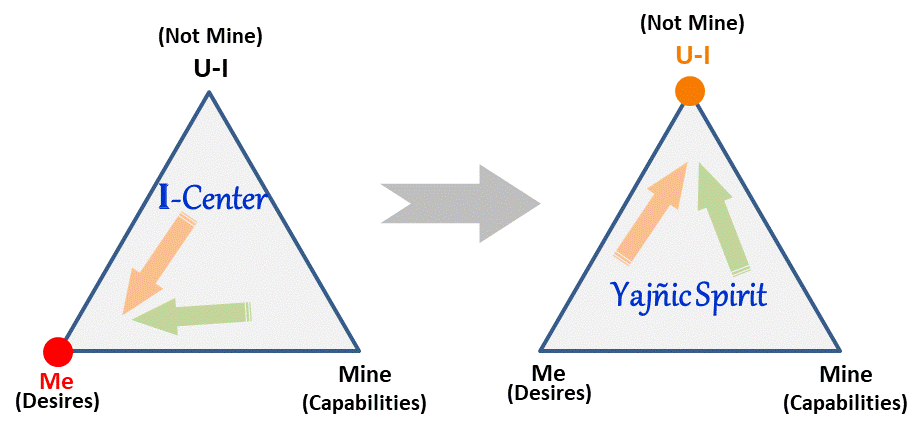
In the epic story of Mahabharata where Gita is delivered, Arjuna, with Krishna in tow, gets ready to undertake a certain action path. As he is about to launch into action, the burden of expectations overwhelms him and he experiences psychosis. After a lot of yoga-centered counseling from Krishna, summarized in eighteen short chapters, Arjuna embarks on that same action path. No changes in the goals, weapons or actions. The difference? Attitude! Basically, people and organizations can fail not just because of their skills and resources, but also because of their attitude. Hmm….
That in a nutshell is Karma Yoga – it is that simple – Attitude Adjustment, a shift towards neutral attitude, while undertaking actions in common interest🙏🏻
 Yogic Thought
Leave a comment