Karma is not a simple “tit-for-tat” principle, but more broadly, the operational residue of an act. Physical actions, thoughts, feeling, and all such are considered actions.
It is the actions of the mind [i.e., thoughts/intentions] that are truly termed karmas – Sivananda
Do this with me – go ahead and have a random thought. Go ahead, try it. Like “I want to have a billion dollars”. Does this thought have any consequences? In our modern thinking, the statistically overwhelming consensus response would be a definitive “no”. Our minds churn out thousands of such thoughts every hour! But, that’s not the answer one finds in yogic thought! Every action, including a thought, has repercussions – leaves behind a karmic imprint, residue. Very profound and revolutionary, and is also what is unique about yogic thought. Even gods cannot violate karmic laws. They told story after story to emphasize this immutable reality of karma. They asked us to pay a lot more attention to Karma than even to ethics and morality.
The most documented and surviving version of this concept of Karma is by Mīmāṃsā philosophers, who (narrowly) interpreted vedas from a ritualistic perspective. They asked a simple question – in pursuit of ascending to heaven after death, if a seeker undertakes a ritualistic action, called yajña/yāga (a vedic ritual), where’s that record held or result stored until the person dies on earth? Because heaven is supposed be after this life, right? Where are all the records of good actions stored? The mythological version of the answer is that there is anthropomorphic version of an agent called Chitragupta… A long story, but they came up with the phrase apūrva-mīmāmsā for this theory, which essentially states that the results are stored in some kind of an invisible energy field – if you want you can equate this field to Chitragupta. Intriguing. We will cover this later.
Any type of action, when it does not produce its complete result immediately, produces some potency which remains with the agent and yields its fruit at a later time, even though the act itself has ended a long time ago. This latency is commonly referred to as adṛṣṭa (meaning unseen). This theory, most significantly, puts the responsibility of human happiness and suffering on the shoulders of one’s own acts. This apūrva mīmāmsā theory is refined and retold in Bhagavat Gita as Karma Yoga.
The Path of Karma Yoga
The theory of Karma Yoga is the epitome of yogic thought, and is very unique in its approach. It is a yoga because it joins (yoga) or relates our most self-centered actions with most-selfless actions and goals. This theory does not require one to go away into forests, or to an ashram, to achieve enlightenment. What it takes is a little bit of attitude adjustment or realignment, through comprehension of the big picture. This path shows a practical way to achieve our “original” desire – which is to experience that Universal-I (brahman), of which we are all a part.
The theory of universal memories (ākashic records) of apūrva mīmāmsā type forms the foundation for the Theory of Karma. The element ākasha is that continuous medium that mechanically reacts and thus records all actions, including those of the mind. Basically, our action and thought histories (information records) cannot be erased easily. At a very fundamental level, Karma equates to a special case of Conservation of Information – conservation of “personal” information”. It’s only after the advent of Quantum mechanics that we realized the information-conservation principle.
“….as no thought can perish, so no act is without infinite result.” – Edgar Alan Poe in The Power of Words
To apurva-mimamsa philosophers, Poe’s assertion should be of no surprise. So, all actions have consequences- some are intended, some are unintended… Some are tangible and some are intangible, some results are immediate, and some results manifest later, over time. We pay attention only to the near-term tangible results, and follow through with a chosen few. The unresolved results are just as real, and they keep yielding results into infinity. Again from Edgar Alan Poe’s narration:
“….We moved our hands, for example, when we were dwellers on the earth, and, in so doing, gave vibration to the atmosphere which engirdled it. This vibration was indefinitely extended, till it gave impulse to every particle of the earth’s air, which thenceforward, and forever, was actuated by the one movement of the hand. This fact the mathematicians of our globe well knew [the math to retrace back to the source]….”
The impartial Universe remembers these residuals from our actions. Not only does the universe contain them, per yogis, but also these records are encrypted with our individual personal signatures – action “entangled” with “I”. They come back to us for resolution and closure – after all, the driving action was ours! This is the boldness and uniqueness of this theory – the personal entanglement aspect. Anything left unresolved from an action is called, Sesha or “Vāstu” (Rudra is acknowledged as Vāstavya and Vāstupāya in Rudra-Namakam).
Thus from a practical standpoint, karma is not necessarily pleasant or unpleasant, kind or unkind to anyone or anything. Consider an example of a bomb falling on a children’s hospital. The Karma hypothesis explains it in a very impersonal sense, without attempting to rationalize it as good or bad – no judgement, very yogic in that sense. We will talk about this more in Tenet 4. Consider a wave crashing into big rock on a beach… Should we mourn for that wave. We will deepdive into the analogy while discussing the concept of brahman, but the children’s hospital example is very similar. Karma acts at a very impersonal level. What we call consciousness and awareness emerge out of all that, at a much later stage…
They did not just produce a theory, they actually lived by it. They tried to undertake actions with smallest karmic residues or “karmic footprints”. Their entire mythology is filled with stories depicting this principle. My Kundalini Guru used to say “you are exactly where you are supposed to be, doing exactly what you are meant to … there are no accidents!” Even god-incarnates did not violate karmic laws! Yogis swear by this principle: for example, master yogi Vasishta tells Rāma:
daivam asat sadā (Fate is unreal, always…) – in Yoga Vasishta
It’s all based on our actions, effort. According to Adi Sankara, Karma can be divided into three groups, based on the timeline. Any residues from actions starting from this moment are āgāmi, which are to materialize in future, sančita, results that are in seed-form, from past actions, and prārabdha, the results of past actions materializing at the current moment.
To obtain liberation (Moksha) is to resolve these residues – zeroing out all the entanglement “information”, to have no akashic records… That requires a conscious effort. Else we will be adding more to the karma bank than we subtract. According to yogis, one of the very purposes of life is to at the least make an effort to move in that direction. All this forms the foundation for one of the most practical and comprehensive lifestyle models of yogis – Karma Yoga.
Karma Yoga is a lifestyle choice. We can break this down anyway we want but, there are five key tenets. The following schematic depicts the model in the standard “House of Strategy” format. The pillars describe how, and the top describes what.
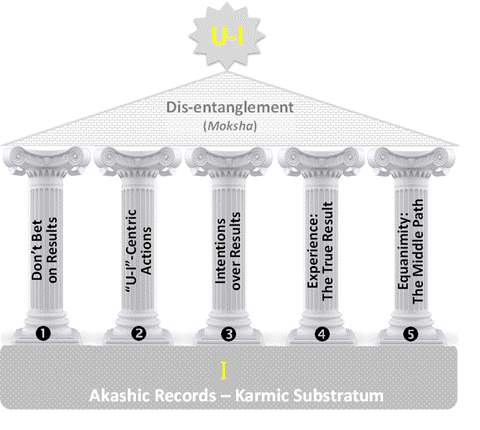
How to live as a karma yogi? The five pillars show the key components of this approach.
What’s achieved? Dis-entanglement (or Moksha) from nature (or prakriti).
We will delve into each tenet as we go through this model. This is what Master Yogi (Krishna) teaches our model seeker (Arjuna).
May we all be blessed with a vibrant mind_/\_/\_/\_
भद्रं नो अपि वातय मनः
(bhadraṃ no api vātaya manaḥ)
 Yogic Thought
Leave a comment