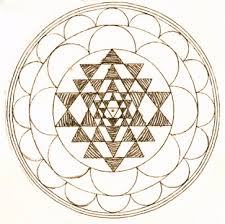
The Fundamental Triangle of Yoga:
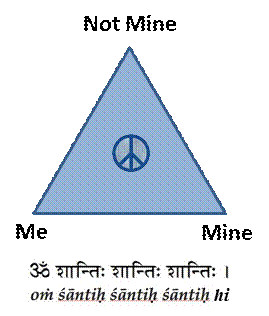
Me-Mine-NotMine
Yogis always paid special attention to all details including balance of polarities, relative positions of things. Everything has to be ordered and placed precisely, according to them. It’s all about relative angles and formation of triangles. Śri-chakra is a great example; it’s supposed to be the two dimensional representation of human body. In regular hatha yoga practices, when you go into something like a trikonasana (triangle pose) or adhomukha-svavasana (downward dog pose), the angles and triangles aspects are very clear. So, yogis use this triangle template to analyze a lot of concepts of interest to us. This summary explores two such important concepts – I and Universal-I (sahasra‘śīrṣā puru’ṣaḥ).
This basic triangle has Me, Mine and Not-Mine as its three vertices. All events and experiences have contributions from these three corners. For a complete understanding of any specific event, all three aspects should be recognized, analyzed and integrated. For one to be centered, all three aspects must be in equilibrium, and at peace (Śanti). All afflictions including fears and phobias arise from imbalances in this equilibrium. We will use this template to analyze a few other things…. This is the reason why master yogis (rishis) end all efforts including mantra recitals by acknowledging this universal by chanting shanti three times – “om ṡanti, ṡanti, ṡanti hi”…..
Before we delve into the I-triangle, we need to consider a few concepts from a yogic standpoint – here they are:
- Thought
A thought is a simple computation or an elaborate set of computations, at a semantic level …
Conclusions/answers are the endpoints of respective thought-computations, and they depend upon the energy, capacity and structure of the nervous system. That’s why we all reach different conclusions, at different times.
Thought computations, prefer to follow familiar routes because it minimizes the energy consumption. These familiar routes can be previous thoughts or pre-printed wiring from birth. Environment (nurture) plays a huge role through social acceptance…. In evolution, that turned out to be more rewarding than other alternatives.
Do we all individually have the same number of neurons and are connected the same way? No, but we all have the same unlimited potential… A yogi’s goal is to tap into that potential. Now, where do thoughts come from? Wait until we talk about meditation.
As yogis always exhorted and modern science now readily agrees, finding “truth” is not the mind’s main job, although we put a lot faith in its conclusions… Yogis coaching? Whenever possible, dissect everything with an unbiased view, as if you are coming across it for the first time; otherwise our lazy minds will just label things and make decisions for us. The process of contemplation is what takes us to where we all want to go.
- Belief
A belief is a fixed thought, which may or may not have been arrived at or verified individually.
From a modern science point of view, the more we research, the more we are discovering that we come with mostly pre-printed wiring at birth! We fine tune and/or optimize this circuitry by what we call “learning”. Breathing is a great example. We are born knowing how to breath, and can learn breath differently (hopefully for the better).
“What we call rational grounds for our beliefs are often extremely irrational attempts to justify our instincts” – Thomas Henry Huxely
- Faith
Faith is a belief with a strong intuitive component. Like when we say “I have faith in your skills”. Belief and faith are close but not the same.
- Memories
Memory – as we know – is a record from the past (of a scene, incident, etc.)
Memories (smriti) is an interesting topic, as we all have a lot of these, and have relevance to our main topic of “I”. Universe actually has more complete records; we only record memories in a very narrow band. If you would like to think more technically, a healthy human being can see electromagnetic waves in the range of ~430-790 terahertz, and hear longitudinal pulsations in the range of 20 to 20,000 kilohertz. Similarly, the three senses are also severely limited, compared to what nature can generate. What we call memories are basically consolidated and compressed information chunks in the brain, in this limited frequency ranges. Unfortunately, the compression process is very selective, fickle and inefficient. Recollection process is a kind of decompression process, which can leave out some significant chunks of details, depending upon where and how the memory is made (emotional state at that time) and how that person is recalling that event. We will wait until we cover the topic of Brahman to discuss this further.
With this background, we can discuss the concept of “I”, as in who-am-I, what-is-I…
Who am I – the “I” triangle
In a nutshell, “I” is a thought or a state of mind entity generated by our brain-body machinery, feeding off of our desires and memories. Below is the schematic of “I” depicted using the standard yogic template of Me-Mine-NotMine triangle.
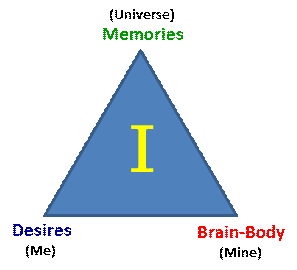
Me: Desires/Intentions – “You are what your deepest driving desire is” – Brihadaranyaka IV.4.5.
Mine: Brain-body – the computational machinery, including the nervous system that synthesizes and binds all the information into single mind construct.
Not Mine (Universe): Memories – as discussed above, memories belong to the Environment/Universe category. So we need to be careful about what memories we want to keep – can we control that? We sometimes include our own emotions with the memories. This could be one reason why we feel that there is a conflict here. But, if someone plays a video of one of our memories, the corresponding emotions will flow and we will get the same sensation as if we are recollecting our own memory. As mentioned before, it’s the Universe that records every aspect of an event, not our limited sense-brain machinery. The role of memories in the “I” generation is very well depicted in the iconic movie: 2001 A Space Odyssey (~a 5 min video-))
https://www.youtube.com/watch?v=UgkyrW2NiwM
The environment determines how we react to external stimuli, as the surroundings we are in define our roles. For example, when we walk into our office, when we are at home versus on a playground… Our perception of ourselves as well as behaviors change; for the same sensory input, our response could be very different. That’s because the computed I-state of mind construct is different.
We will discuss a lot about nature of these memories, but let’s register one point before we close out on the capabilities of the universe and brahman, which is subtler than it appears. Here’s a opening salvo from a review article on Quantum Computing:
“One of the most bizarre and fascinating predictions of the theory of quantum mechanics is that the information processing capability of the universe is much larger than it seems. As the theory goes, a collection of quantum objects inside a closed box will in general proceed to do everything they are physically capable of, all at the same time. This closed system is described by a “wave function…”
The “box” cited in the example from our standpoint is everything that is not measured or observed yet, which is the entire cosmos. Everything we do and think impact these subtle wave functions. Even in our brain, memories are stored more as electrical patterns, than in any hard coded memory chip-type manner. These patterns could be affected by other activity around them – the not mine corner. Karma and memories is an extremely complex topic, and volumes have been written on it in the modern as well as in the ancient literature. We are entering a realm where every aspect of the word and the emphasis become important. In yogic tradition, the “guru” typically teaches this to the disciple as the last lesson, as s/he is ready to leave the ashram to go and conduct own research to arrive at their own conclusions through direct experience.
The Infinite Headed-Self, sahasra‘śīrṣā Purusha and Tat (That)
Continuing with the concept of the universe recording perfect memories of everything (humans, animals and immobile entities), master yogis (Rishis), through their meditations, realized a radical and fascinating concept, called “infinite headed self” or Universal self.
If the universe has memories, an equivalent computing “brain” machinery, and collective desire/s, theoretically, there must be an Universal-“I” (U-I from now on), analogous to “I”, right? This is the vision our model-seeker Arjuna had when he experienced “awakening” – suddenly he saw his life coach and master yogi Krishna as that containing everything (Chap 11 – Vishwaroopa Sandarsana Yoga).
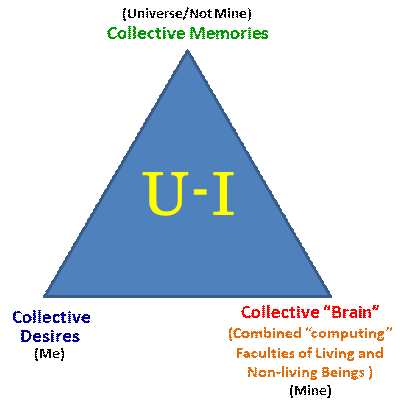
The concept is actually pretty amazing – individual consciousness is additive! Means adding an extra person to a room with people will change the collective behavior, and the consciousness of that room. The corollary is that we are just a piece of that aggregate U-I. Communication and connectivity is how we generate that collective state of mind, just like our nervous system! The famous Purusha Sukta (Rig Veda 10.90) and several others talk about this concept at length, with description of this U-I having infinite heads, eyes, arms and bodies…. This U-I includes both living and non-living beings, space-time, and all the stuff embedded within this space-time….
“There is one and undifferentiated, which is the power of “that”, which makes one look like many (maya)….There is one – self-existent, eternal, who is the base of all belief that “I am”… And knowing that One, Undivided Self that is beyond space-time, as your own Self, gain peace …” – Adi Shankara in Vivekachudamani
“All happenings are played out in one universal consciousness and there is no multiplicity of selves. This life of yours which you are living is not merely a piece of this entire existence, but in a certain sense the whole… what the “Brahmins” express in that sacred mystic formula which is yet really so simple and so clear: tat twam asi, this is you…” – Erwin Schrodinger , a luminary of Quantum Mechanics
Same division of the “I-consciousness” applies to us. According this model, all thirty three enabling “divine-forces” are within us also. The conceptual structure of “I” and “U-I” are the same! Tat Twam Asi (Thou Art That)! We all have what’s necessary to be more like Tat! It’s just a matter of realization. Their reasoning is far reaching – everything is “fractal” in nature.
(Hu)Man is made in the Image (in likeness) of “God” – Genesis
This concept is the same in all the Abrahamic scriptures also. Basically, the structure of things does not dependent upon size (scale-invariant)! Everything is proportional, but absolute size itself doesn’t matter! This is what a famous rishi, Vasistha, tells the seeker, Rama:
There are worlds within worlds – Yoga Vasistha
Meaning same stuff repeats itself at different scales (sizes) – a world within a world. We talked about an example for such similarity before: nautilus pompilius, financial market behavior and spiral galaxy structures (see 24 Oct 2014 post). After all, our entire universe was supposed to have been contained within an atom, before god popped it! We can go on forever … Let’s summarize our thoughts using the standard Me-Mine-NotMine template of U-I:
Me: The collective desire. The one that counts at that instant is the strongest one, when we add up everyone’s desires. It is after all the first “desire” that was responsible for sprouting forth the entire creation. It is probably the same driving force for the first “quantum” fluctuation that caused the big bang. Rishis think of this as the causal fluctuation (spanda) in pure consciousness. So, we can contemplate from both creationist and evolutionist perspectives.
Mine: Collective “Brain” – the computing machinery. In that large machine, we all play the roles of individual neurons with contributing views, opinions, beliefs, etc. (this is exactly what happens in our brains too). Yogis consider all living and non-living beings to have an intellect, and contributes to this machine.
Not Mine: Collective Memories: the memories are of all of us recorded in their entirety . The collective memories starting from the beginning of “time” become the reservoir.
We are not necessarily proving anything here, but just identifying seeds for our contemplation during meditations…. Our own individual intuition teaches us the complete story.
Good luck to all of us in this pursuit….
May we all be blessed with a “contemplative” mind!
(Bhadram no api vAtaya manah)
_/\_/\_/\_

 Yogic Thought
Leave a comment