Yoga is where Philosophy meets Science
Because yoga is the practice where we observe how our inner universe comprehends our own philosophical paradigms at progressively deeper levels.
yogaḥ karmasu kauśhalam
Yoga is the art of working skillfully – BG 2.50
yoga chitta vritti nirodhah
Yoga is the cessation of fluctuations in the awareness field – Yoga Sutras 1.2
ātma-spanda-camatkāra-vibhavo’yaṃ vijṛmbhate
It is the vibration of the atma/brahman that displays these wonderful conceptions in the mind, and excites the various phenomena in nature – (Yogavasista, 6.22.48)
tāṃ yogamiti manyante sthirāmindriyadhāraṇām
This firm holding of the senses is what is known as Yoga… (Katha Upanishad 2.3.11)
Yoga practice gives us a peak behind the curtain of illusion (maya) created by movement
Let’s repeat the first para from the previous meditation blurb. The yogic concept is that everything around us and in us is made up of motion and pulsations, which in turn create fluctuations/wripples (vritti) in the awareness field (chitta). You want to try it? Just pick a point on the wall in front of you, and try holding your focus on that. You will immediately notice that your twitch, so much so that you can’t hold it steady!
In fact, we are sitting in an ocean of fluctuations, while we ourselves are trillions of vibrations strapped together; “I/ego” is that strap or that glue. The mind comprehends these bundles of specific vibrations as forms and gives them names. Yogis say that the mind (manas) is of the nature of forms while speech (vāc) is of the nature of names. We cognize these fluctuations in that awareness field and react to them. Yoga in simple terms is to gain control of these fluctuations, while meditation is to understand these fluctuations.
Not only that, we externalize everything – meaning, we externalize the fluctuations happening in our mind onto the external world and interpret it as something that is happening outside. (Jung calls it projection in modern psychology). This correspondence between internal and external worlds is a key tenet of tat twam asi.
Only one remaining question – why do we want to restrict (nirodha) these fluctuations if that is merely a mechanism of the mind to cognize names and forms? This has to do with Patanjali’s brand of Yoga which teaches Samadhi (Nirvana) as the ultimate goal of yoga. The alternative goal is Moksha which is taught in parallel schools of yoga even at that time, particularly Bhagawat Gita, which teaches both while asking seekers to prefer Moksha. Moksha theory would may reword this Patanjali’s sutra as – yoga chitta vritti samrodha – more on this in the later blurbs.
Now a few more details.
Yoga – What is it?
If meditation or dhyana is one of the eight steps of yoga, then what is Yoga? We are picking up where we left off in the last blurb. We probably should have started our self-study (svadhyaya) with this question, with Patanjali’s definition. It is definitely not just good flexibility, to go deep into postures, nor it is a belief system – and we already know that. What is it useful for? It’s primarily a method of (intuitive) inquiry, and a lifestyle choice. That twitch-free focus is apparently central to this method of inquiry.
Yoga is that integral science which can demystify anything that catches our attention. If we ask yogis what is one thing that we should covet the most, the illumined ones will say – the power of discrimination, an eye for it (viveka and vichakshana). It is that power which leads us from
Asatoma Sat-Gamaya, Tamaso-Maa Jyotir-Gamaya, Mrytyor-Maa Amritam Gamaya
the unreal to the real, darkness to light and mortality to immortality
So, how do we get there? Yoga. According to Patanjali, the following eight are the “limbs” of yoga [Patanjali 2.29]:
यम नियमासन प्राणायाम प्रत्याहार धारणा ध्यान समाधयोऽष्टावङ्गानि ॥
yama niyama-āsana prāṇāyāma pratyāhāra dhāraṇā dhyāna samādhayo-‘ṣṭāvaṅgāni
1) Yama – Attitude towards everything belonging to the “Not-Mine” corner.
2) Niyama – Attitude towards everything belonging to the “Me and Mine” axis.
3) Asana – Body control (through postures)
4) Pranayama – Breath control
5) Pratyahara – Sense control
6) Dharana – “Wearing the mind” for concentration
7) Dhyana – Holding the attention on a single point – Meditation
8) Samadhi – Experiencing the “medium” or absorption, unitive state awareness
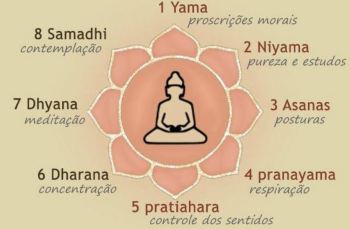
As we can see, there is a significant control aspect to all these steps; first two steps are about behavior control and steps 6 and 7 are about attention control. It is the control that allows switching between states of awareness. If we can’t get back to where we want, it’s not much of a technique, is it?
These stages of yoga are given very high importance in that literature – for example, here are a few lines from Mahabharata as Bhishma is about to leave the heavily pierced (injured) physical body. Below para from translation by Bibek Debroy:
Then Kounteya (Bhishma) remained silent for a while. In due order, he held himself in different stages of dharana. Having controlled his prana, the great souled one propelled it upwards. In the midst of the audience, an extraordinary even occurred… He restrained his prana and controlled all the (nine) exits. Therefore, it pierced the crown of his head (the seventh, Sahasrara chakra) ascended towards heaven)…
Controlling prana, and directing it, all that is part of yoga. Where is all this thinking coming from? It starts with Yogis’ model for the manifested universe – that it’s all waveform disturbances… Let’s restart with Patanjali’s definition of yoga:
Yoga is “Chitta Vritti Nirodhah”
Yoga is the cessation of (identification with) fluctuations arising within “individual consciousness”. [Patanjali 1.2]
The key to understanding this definition is in the concept of “Chit” and how “fluctuations or vrittis” are generated in Chit. Here are a few helpful notes from various commentaries on Yoga-sutras of Patanjali:
Yogis’ reasoning about the universe is that there must a pure medium that is enabling subject-object interactions, including basic perception. In the modern science, this medium is called a field. In that case, this pure stuff must be pervading everything in the universe, because subject-object interactions are universal.
Mystics around the globe, in their experience of unitive states, observed that subject-object distinction disappears in those states. Basically, “I” and the object that “I” is chasing become one at those levels of awareness (Tat Twam Asi – Thou art that). That means that they must be made of the same stuff – otherwise, complete uniform merger cannot be possible. It’s like in a Supercollider, where at very high energies, gold and a lump of coal merge and turn into a puddle of subatomic particles. Long story short, in enhanced states of awareness, apparently all subjects and objects melt into an ocean of fluctuations in pure medium. At normal operative level of awareness, when viewed through our conditioned senses, ensembles of fluctuations appear as “forms with names” (nama-rupa) .
So the “Me” corner of the Me-Mine-Not Mine triangle is the fluctuation-ensemble, “mine” corner is the other fluctuation-ensembles that we think we own, and “Not Mine” is that ocean with all the fluctuations.
They termed this pure medium Chit (as in Sat-Chit-Ananda or existence-consciousness-bliss) and is the same as attribute-less (nirguna) Brahman of Upanishads. They often used Ocean-Wave analogy to explain it to beginners. If the ocean is Chit, then the waves form the basis for individual entities, including our “I”. This fundamental quiescent material (Chit) is translated into English as “Self” for some reason, but the word or concept analogous to “chit” in English is the quantum physics concept of Zero-Point Field or other fields similar to it. What we call consciousness in daily usage is dominated by “I”-awareness.
Based on this model, we have two things within each of us (the fluctuation and the medium; I and Self; the Personal and the Impersonal, the Frontal Self and the Authentic Self…), and we invariably associate ourselves with the former, i.e., the fluctuation. We not only identify ourselves with this fluctuations, but also revel in interacting with other fluctuations (other sentient and insentient beings), while inquiring very little about the medium that makes up these waves and sustain them.
Now we can see the Yogis’ model: the reality is just bundles of “glued”, “correlated” or “entangled” fluctuations interacting with each other in myriad ways. Some bundles develop stronger identities (sentient) than some others (from primitive lifeforms all the way to insentient beings); there are some pan-psychic aspects to this thinking. Perception of space-time is critical for this form-identity (nama-rupa) paradigm, hence our sensory development and twitching to support that.
Element air (vata) is at the root of these subtle fluctuations – we will explore this later. To see reality, one has to peek behind these fluctuations. An intuitive understanding of this model is useful to the extent that what we are seeking is the bliss (ananda) aspect of the Existence- Pure Consciousness-Bliss paradigm. Now we see the motivation for the development of Yoga methodology. Yogis wanted a peek behind these noisy fluctuations. The technology or practice that gets us to this place is Yoga.
We will go through the important details of these eight limbs next.
May we all be blessed with a vibrant mind_/\_/\_/\_
भद्रं नो अपि वातय मनः
(bhadraṃ no api vātaya manaḥ)
 Yogic Thought
Leave a comment