Apparently, Yamas and niyamas are the most important and difficult components of yoga practice…. That’s because it involves a deliberate analysis of everything we do, both voluntary and involuntary acts. This analysis in a way holds a mirror to our “I”, and in the process transforms it. They form the foundation upon which everything is stacked, and hence serious practitioners place a heavy emphasis on these.
In his summarization of yoga practice, Patanjali dedicates a lot more verses for these two topics than on Asana or any other steps, because it is the yamas and niyamas that set the table. If chosen right, these two will begin to focus the mind and make the subsequent steps easier.
Here are the two sutras of Patanjali that lists yamas and niyamas:
अहिंसासत्यास्तेय ब्रह्मचर्यापरिग्रहाः यमाः
ahiṁsā-satya-asteya brahmacarya-aparigrahāḥ yamāḥ ||2.30||
Non-violence, truthfulness, non-stealing, celibacy, non-greediness are Yamas
शौच संतोष तपः स्वाध्यायेश्वरप्रणिधानानि नियमाः
śauca saṁtoṣa tapaḥ svādhyāy-eśvarapraṇidhānāni niyamāḥ ||2.32||
Cleanliness, Happiness, practice of contemplation and meditation, self-study, and surrender to “personal god” are Niyamas.
What’s so special about this list? This list is pretty benign, right? Their practice is apparently very powerful. It is very difficult to be perfect on all of them, but this exercise will at least make us reexamine the criteria we set for ourselves.
Not to veer off from the topic, but in the modern setting, Mahatma Gandhi is one individual who experimented with the use of yamas and niyamas for application on a mass scale. Apparently he saw common elements of yamas and niyamas in all religious and metaphysical teachings. His admiration for Tolstoy and Ruskin is well documented. Dalai Lama is another example, and probably there are many others…
Interestingly, protagonists in both mythological stories of Ramayana and Mahabharata recede into jungles from society for a period time to get their practices on track. In these stories, they bump into various practitioners taking different approaches to this topic – for example, some eating only ripe fruits that drop to the ground from trees… Why? Let’s review the first yama.
Yama #1. Ahiṃsa (Non-violence)
The word ahiṁsa or non-violence is more about what not-to-do, or at least to minimize what we do, because there is no way of completely avoiding it. The process that we apparently cannot avoid is “violence”. For definition, violence has some important characteristics – intent, excessive force-for destructive and selfish purposes.
Paradoxically, per yogis, living itself involves violence. And we all acknowledge that tacitly. In that case, it’s just a matter of minimizing it. Karma completes this living-killing cycle.
Here is the exchange between one of yogis’ role model, Bhrigu, and his father, Varuna, on this cycle.
(from Roberto Calasso in Ardor; based on translation of Satapatha Brahmana by J. Eggeling)
__________
Consumed by arrogance of knowledge, the young Bhṙgu, son of the supreme god Varuna, was sent off by his father into the world to see what knowledge alone could not reveal, to find out how the world itself is made. Without this, knowledge is pointless.
In the east, Bhṙgu came across men who were slaughtering other men. Bhṙgu asked: “why”. They answered: “because these men did the same to us in the other world.” He saw the same strange scene in the south. In the west, there were men eating other men and sitting about, calmly. In the north as well, amid piercing cries, there were men eating other men.
Then he saw two women, one beautiful, and one very old (alt. over-beautiful); between them stood a man, lifeless, with yellow eyes, and a staff in his hand. On seeing him, terror seized him, and he went home, and sat down.
When he returned to his father, Bhṙgu seemed speechless. Varuna looked at him with satisfaction, thinking: ” Then he has seen.” The moment had come to explain to his son what he had seen. The men in the east, he said, are trees; those in the south are flocks of animals; those in the west were wild plants( and herbs). Last, in the north, men who cried out while they ate other men, were the waters (waters could represent anything that’s yet to manifest).
What had Bhṙgu seen? That the world is made up of Agni and Soma, of these two brothers. One of the two became the devourer and the other became food. Down here there is nothing else than the devourer and the devoured. And this cycle keeps reversing and repeating (saṁsara)…
The revelations that Bhṙgu came across were set one within the other. First of all: the final act from which all others followed was the act of eating – or at least the act of severing, of uprooting. Every act that consumes a part of the world, every act that destroys. There is no neutral state, no state in which this doesn’t happen. That act of eating is a violence that causes what is living, in its many forms, to disappear. Whether it’s plants, trees, animals, or human beings, the process is the same. There is always a fire that devours and a substance that is devoured. This violence, bringing misery and torment, will one day be carried out by those who suffer it on those who inflict it. Such a chain of events cannot change. But the serious damage, the paralysis that this (knowledge) causes in those who become aware of it, can – we are told – be remedied. And Varuna goes on…
Vedic seers have a conception of evil that covered a far wider area – and it included certain involuntary as well as (some axiomatic) acts that cannot be avoided if mankind wants to survive – for example, the act of eating…
Interestingly, Bhṙgu encountered during his terrifying journey through a world in which animals devoured people. But this wasn’t just a reversal of the order. It was also a lighting glimpse of the history of humanity, as if someone at last taught Bhṙgu about some of his forebears…
_____
This explains why some practitioners relied on ripe fruits that dropped to the ground for sustenance. By extension, we can talk about other things such as our individual immune systems, which kill bugs every minute. The basic process is the same whether one is a vegetarian, vegan, meat lover or a tiger. The primal pair of polarities – devourer and the devoured – runs the show. In that case, the practice of this yama boils down to balance. How much do we want to impose upon the environment to “ live”? Non-violence as yama is to minimize this imposition , and in the process, reduce our karmic footprints…. The deliberate mediation on this basic equation of life and balance we individually want to maintain, forms the foundation for this yama, and for our overall behavior alignment.
Some examples of practices we witness even today that reflect this philosophy are:
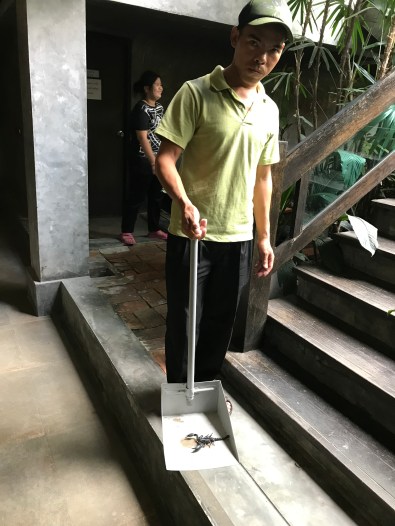
1. Catch and release: Some practitioners, particularly monks, rarely kill bugs, or even poisonous creatures such as snakes and scorpions… In the picture below is what I personally witnessed while in Thailand – this gentleman is catching a live scorpion to be released into an adjacent unmanicured area.
2. Special prayers and “homas” to acknowledge, and pacify all the lifeforms that are displaced during the construction of a dwelling, as part of the housewarming ceremony… The hope is that such a ceremony would bring up the issue into active awareness, and in the process lead to possible behavior adjustment in both the performer as well as in all those that are present at the ceremony.
3. In some cultures, while harvesting crops, they leave behind some grain deliberately to ensure that the birds etc that come there by habit are fed, and the food supply disappeared more gradually and not suddenly.
At the core, Yamas and niyamas are individual choices; there is no right or wrong; and they evolve as we learn and make progress….
May we all be blessed with a “discriminating and vibrant” mind _/\_/\_/\_
 Yogic Thought
Leave a comment