Yoga at the highest level is a science of absolute awareness, and Yamas form the foundation. In this regard, we went through a reasonably complex set of topics under the yamas’ banner and sampled a range of yogic thoughts. Just to recap, the tone of rishis on this is – what we consciously disapprove of doing, we may be doing them unconsciously, to some extent – investigate it and be aware of it.
The selection of words for yamas is very interesting, particularly those that have “a-” as the prefix. For example, take the practice of aparigraha (non-hoarding); distributing away is not what they are necessarily recommending. Otherwise they would have used those exact words.
Most importantly, the yama-contemplation will get rid of any notion of superiority or inferiority complex! Because, we are all doing it too, maybe to a different level and extent. To this point, towards the end of the twam-portion of the Gita, master yogi Krishna tells Arjuna:
“The humble sages, by virtue of true knowledge, see with equal vision, a learned & gentle brāhmaṇa, a cow, an elephant, a dog and a dog-eater.”
At the end of it all, all forms are knotted up bundles of “tat”. As Yoga Vasistha says “the one who does not know gold sees only the bracelet!”
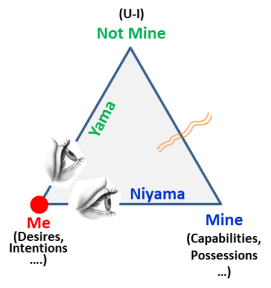
In even simpler terms, Yamas form the basis for our code of conduct towards the Environment or NotMine corner, while Niyamas are our standards set towards ourselves or Mine corner, since that’s how we view ourselves. Yamas are about Me-NotMine relationship and Niyamas are about Me-Mine relationship. We constantly maintain a dynamic equilibrium, instantiating the frontal-I.
None of this contemplation should weaken and/or paralyze the practitioner, like Varuna tells Bhrigu under the first Yama. Awareness must lead to strength. Swami Vivekananda summarizes rishis’ message in one statement (paraphrased): if something is making you weaker, quit it and have nothing to do with it, whether it’s yoga, science camp, or a relationship. Everything that we choose to do has to strengthen us, individually as well as collectively.
The path to complete awareness and wakefulness is paved with the contemplation of Yamas and Niyamas. Yogis insist that the “pasu” or animal part of us, i.e., the instinctual part of our brains control 80-90% of our routines. These automated behaviors are installed by nature, and our lazy mind evokes those stored procedures depending upon the situation. Here’s a contemplation-worthy verse from Gita that speaks to this important point:
प्रकृते: क्रियमाणानि गुणै: कर्माणि सर्वश: |अहङ्कारविमूढात्मा कर्ताहमिति मन्यते (3.27)
prakṛiteḥ kriyamāṇāni guṇaiḥ karmāṇi sarvaśhaḥ| ahankāra-vimūḍhātmā kartāham iti manyate
This is a very profound verse – nature is doing everything through us? The very thing we categorize as “NotMine” is responsible for all our actions? Clues for an answer lies with our senses, with all its processing paraphernalia in the brain; senses are inherently connected and strongly drawn to their objects. It is the past information that entered the mind’s memory banks through senses that make up the part of our “nature” that drives our actions…
Yama and niyama-contemplation changes the way sensory information is processed, and hence is a path to understanding both personal and impersonal aspects of nature. Most important of all this is not to code that information as like/dislike polarities, at least going forward. Again, nothing we do might change, but doing it with awareness is the most important aspect of yoga. “It’s not the posture-depth, it’s the posture integrity that matters” – we all heard this before, right? We can fill up pages talking about this verse, but at the end of the day, the wisdom we seek is within. It’s the “internal guru” that will make sense of all this for us. With that, we will move onto Niyama-contemplation.
May we all be blessed with a vibrant mind_/\_/\_/\_
 Yogic Thought
Leave a comment