नासिकयोर्-वायुस्तिष्ठतु।
(nāsikayor vāyu: tishThatu)
In the nose is established vāyu (element Air)!
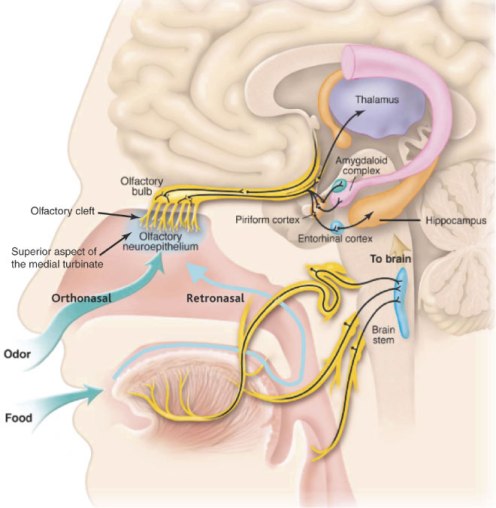
The picture tells us everything – our breath talks directly to the mid-brain, which in turn controls our emotions. it’s the breath rhythms actually. Also notice the nerves going from the lower palate and throat to the brain stem. Doesn’t take much to relate mantra chanting to instinctual part of the our brain, the unconscious!
Please google keywords – Breathing and Rhythm – and you will find a lot of links reflecting the current state of art in Breath Research. Here’ some information from Prof. Zelano’s research at Northwestern.
The need to breathe links the mammalian olfactory system inextricably to the respiratory rhythms that draw air through the nose… Our results reveal that natural breathing synchronizes electrical activity in human piriform (olfactory) cortex, as well as in limbic-related brain areas, including amygdala and hippocampus. Notably, oscillatory power peaked during inspiration and dissipated when breathing was diverted from nose to mouth. Parallel behavioral experiments showed that breathing phase enhances fear discrimination and memory retrieval. Our findings provide a unique framework for understanding the pivotal role of nasal breathing in coordinating neuronal oscillations to support stimulus processing and behavior.
The rhythm of breathing creates electrical activity in the human brain that enhances emotional judgments and memory recall, scientists have discovered for the first time. These effects on behavior depend critically on whether you inhale or exhale and whether you breathe through the nose or mouth.
It’s nice to see the modern research aligning with what the old realized – who knows how they got there. But they were very clear in summarizing it for us:
नासिकयोर्-वायुस्तिष्ठतु ।
(nāsikayor vāyu: tishThatu |)
In the nose resides vāyu!
वा॒युर्मे॓ प्रा॒णे श्रि॒तः ।
(vāyurmE” prāNE SritaH |)
In vāyu is established prāna!
– Taittariya Aranyaka of Krishna Yajurveda
Who knows the age of these texts, which are transferred through memory. But, these are such profound statements… They are also embedded in Laghunyāsa Rudram, which is chanted even today. The Air element is firmly established in the nose – the nerves or the nadis take the breath pattern and equilibrate with the emotional part of the brain – the mid-brain – and vice versa. As the air flows over the nerves, they set electrical oscillations of certain frequencies in the mid-brain where our memories and emotions reside (hippocampus and amygdala-thalamus complex, respectively). The pranayama (4th limb of yoga) is the application of these principles.
Here’s a bonus: inducing oscillations in the nasal passages (again vibrations) produces extra nitric oxide, which is the molecule that is responsible for vasodilation – in lungs to genitals (viagra!).
For example: https://www.atsjournals.org/doi/pdf/10.1164/rccm.200202-138BC
“The paranasal sinuses are major producers of nitric oxide (NO). We hypothesized that oscillating airflow produced by humming would enhance sinus ventilation and thereby increase nasal NO levels. Ten healthy subjects took part in the study. Nasal NO was measured with a chemiluminescence technique during humming and quiet single-breath exhalations at a fixed flow rate. NO increased 15-fold during humming compared with quiet exhalation. In a two-compartment model of the nose and sinus, oscillating airflow caused a dramatic increase in gas exchange between the cavities. Obstruction of the sinus ostium is a central event in the pathogenesis of sinusitis. Nasal NO measurements during humming may be a useful noninvasive test of sinus NO production and ostial patency. In addition, any therapeutic effects of the improved sinus ventilation caused by humming should be investigated.”
We have states this a few times, but breath is an important marker for emotional states. The more important question is whether this can be reversed – that is, if we used a specific breath pattern, can we access specific emotional states, like anger or bliss, however long that breathing pattern is imposed? Pranayama says yes, and at least yes to disposition to those states, while the modern science is in the early stages of this research. Below diagram shows the correspondence between breathing rate and the emotional state, as measured by breath rates when that subject is in that emotional state.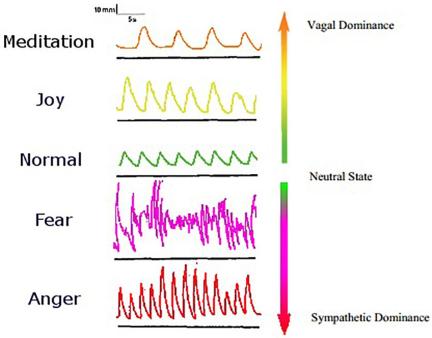
[From Jerath & Beveridge]. A spectrum of emotion. Affective states are shown here alongside the dimension of respiratory rhythm. The respiratory tracings shown have time on the X-axis and displacement on the Y-axis. See how the breath slows down and evens out as we go towards meditative states. Downward direction reflects the uncontrolled automatic controlled breathing., while the upward direction shows controlled breathing. We need both, but having control is the most important part.
We will get into concepts that are an integral part of this frequency-domain description of human functions – breath patterns and brain waves. We briefly touched upon these while talking about the “sleep trigger” under the Sivaratri blurb also.
In the yogic theory, and in Ayurveda, Vayu is all about signal transduction, i.e., information transport. Rishis routinely pray to Vayu to be blessed with speedy communication, particularly when “soma” is flowing … Kundalini experience counts on such high speed information showers.
Will continue….
 Yogic Thought
Leave a comment