Meditation is the training program for the mind, to go where you want to go…
How to learn to meditate? No, we don’t learn; we actually un-learn…
Free will vs. Instincts – that’s at the core of this meditation equation. We are circling back to what meditation is, it’s goal, and the relationship with Vayu, Vata, and the subtle body. It’s important to recall that the karmic background predisposes your unconscious to deliver automated responses. Staying awake all the time is the challenge here.
For a meditation goal, finding yupa within is a huge chunk of it. Why? Because, yupa is what supports the subtle body, that subtle body from the previous blurb. Why subtle body? Everything in your body and mind emanate from that. If we want to grab the proverbial bull by the horns, grab hold of the very pillar that holds the subtle body together [hint: The frontal-I has something to do with it]! It’s also noteworthy in a symbolic way that Jesus Christ carried his own sacrificial post in his last act on earth…
Yajur veda also states that the goal of the meditation is actually to find your own inner yupa, that personal sacrificial post. The sacrificial post is within the performer of the yajna – yajamano vai yupa! It’s the yupa that supports the subtle body. The search is for that support.
The sacrificial post is obviously symbolic. In a way, meditation achieves this goal is by dissolving away the deep “I-construct” we have built up, at least in spurts to see the whole for what it is. It’s the reversal of the creation (of “I”) process. Going back to Purusha Sukta (10.90 of Rg Veda, which describes the macro creation process, which is also the process of how we create our own world, as a I/world -pair). In this creation chant, there is a key reference to this oblation offering process:
“abadhnam purusham pasum…“
So, here the “purusha”, which is our own information body that generates our consciousness, itself became the oblation, the sacrificial offering, and an entire new creation came out from that yajna. Minor yajnas generate and add minor knowledge constructs… To understand this process of yajna, all yajnas have three elements: the input-offering/oblation, the fire (inter-converting agent), and the output/result. The meditation process is the reversal of the I-creation yajna process:
CREATION
Offering: Self
Fire: Desire to be (to interact with World)
Output: Construction of I-boundary
        Separate identity from Self
MEDITATION
Offering: "I-construct"
Fire: askesis/the fire of Tapas (Niyama #3)
Output: Dissolution of the I-boundary
        Merger with Self
        (merger of individual-self with the Universal-Self)
At the end of the day, yoga and meditation are about setting up and accentuating that element fire, before we offer the oblation, to realize a quality end product!
Yajurveda in particular is a collection of “rituals” that provide several hints at this process. Unfortunately, the techniques are kept secret, and we are expected to learn them from teachers who actually experienced it. Here’s a sample recipe from Krishna Yajurveda (Chapter 3 of book 1), called Agni-stoma pasu yajna. For those interested, the section between the lines provides additional details of this yajna.
1.3. Agni-stoma yajna
This recipe has 14 anuvakas or sections. Some of them have very intriguing insights, and are listed below.
1.3.1. Construction of the Yajna hall (manḑapa): most of these rituals start with an invocation of at least one Aditya; in this recipe, it is Savita (devásya tvā savitúḥ prasavè), the force that takes thoughts forward. The yajna performer is already in a certain state of mind, and ready to expand the inner awareness. Adityas reside in the forehead-part of our face (where our prefrontal cortex sits also, the most human part of the brain). In this yajna, at the end of the day, own body is that yajna hall!
1.3.2. Removal of the hostile elements through mantra: The desire/intention generating engine, the subtle body, is not completely defragmented. The defects – “hostile” forces, are at the subtle body level. The remedy – the right vibration, mantra! Here, the Gayathri meter is recommended here.
rakṣoháṇo valagaháno vaiṣṇavā́n khanāmi: Raksha and Vala are the two demons that reside within us. The former is all about I-protection, and the second one is the creator and sustainer of the I-boundary. If you go back to the Meditation blurbs from before, it’s Indra that slays Vala to free the “cows” (Blurb#10 – Meditation: Vedic Perspective has the details)
gāyatréṇa chándasā́vabāḍho valagáḥ: Gayatri chhandas (meter) is evoked to overcome this Valaga tendency in the subtle body.
1.3.3. Understanding and preparing the fire altar (in the subtle body): The protagonist is now ready to set the altar. By this time, the subject should have an idea of the sacrificial post, as the altar is built around it. This part of the process is about activating the “fire”. There are several methods, and pranayama, chanting samidheni verses are two of the ways.
1.3.4. Visarjana Homa (Assignment of duties to inner forces): By this time, all the god-forces have been invoked, and they are dispatched to do their jobs. Most importantly, the hero, Soma starts flowing (soma is that agent of delight – as discussed before, humans experience a type of this flow, for a short duration, during conjugal experience). The performer requests Savita to protect the Soma – eṣá vo deva savitaḥ sómas táṁ rakṣadhvam mā́ vo dabhat. Then prays to agni – may my body be in you, and yours be in mine… Of course, soma does not flow until the inner fire is lit.
1.3.5. Yupa Cʰedanam (piercing the yupa): Here comes our main topic. Cʰedanam is not just finding it, but also piercing it! Very interesting description, as the yajna performer is looking for this post, s/he describes his/her observations – “have met some, have not approached others, have found some nearer than the farther, farther than the near…” Obviously, the subject is trying to locate this subtle yupa. S/he also implies that this yupa is touching all the three worlds.
1.3.6. Yupa and Vishnu: Here, once the yupa is found, it is extolled as Vishnu, the expanding force. Starts off by saying – you are earth (prithivi), you are the mid-world (antariksha) and heaven, or the bright-world (divi). The yupa reaches all three worlds.
1.3.7-13: They go through details of the inner process, and the descent of Soma. These anuvakas (sections) discuss advanced states, where they discuss which organ-offering goes where. Among these, our active topic, prana is also mentioned – which is goaded to merge with external-vayu (sáṃ te prāṇó vāyúnā gacʰatāṁ). Isn’t that death (as discussed before)? Does the yajna performer die? No, then it’s guided suicide, and yogis do not subscribe to that. This is where things get interesting – they play the edge. Edge of comfort/discomfort, edge of life and lifelessness.. – that’s when the internal fire rages (called Nachiketāgni). But they have enough control to come back to normal world, on their own volition, without calling 911. That explains why the techniques are esoteric, and kept secret.
Meditation and Vāta
Meditation is nothing more than unwavering attention. You twitch, you lost it – that’s yogi’s observation. Vāyu/Vāta contribute significantly to that disturbance-process, through movement. After all, Vayu is the force that causes movement. That’s why yogis minimize colorific consumption and expenditure – to slow down the movements within the body. Eventually we start finding our own breath to be in the way of this goal – hence we learn to slow down the breath in our kriya practice sessions.
How to learn to meditate? No, we don’t learn. we actually try to un-learn. To meditate is to actually “un-learn”. Vipasana-style meditations actually exemplify this. What Buddha said when someone asked what he gained by meditating: he said
“I did not gain anything. But I actually lost a few things – sickness, anger, insecurity, depression, anxiety, fear of death, ….”
We always think in terms of gaining, accumulating, planning…. What meditators and monks point out is that we actually need to lose a few things. Yogis/monks had turned this into a science. Going back to all our earlier blurbs, learning creates knowledge that actually clouds our “Self” (Tenet 4 of Karma Yoga).
May we all be blessed with the art of meditation_/\_/\_/\_
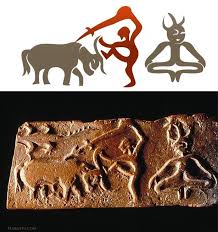
A ~4,500 year old Harappan carving for Tiptoe posture to pierce the Muladhara or the Root Chakra. The first chakra is dominated by animalistic instincts that are routinely accessed by the lazy (tamasic) mind. Hence the buffalo analogy. Piercing the root charkra is symbolically depicted by the piercing of a buffalo. Such is the Vedic Symbology. 🙏

 Yogic Thought
Leave a comment