You are a mantra in motion!
You are trillions and trillions of vibrations strapped together.
Mantras are not for Gods/Goddesses … Mantras ARE Gods/Goddesses
– Tantras
…on the lip of that cup (mouth) sit the seven ṛṣis. With the tongue as the eight, that cup communicates with Brahman!
– Satapata Brahmana (14.5.3)
Yoga schools of the old have investigated this concept of mantra extensively. To them all these are different aspects of brahman and any of them can lead us on that path. This universe evolved through musical metres (chhandas) . We had already came across the terms like nāda-brahman, saḅda-brahman etc. – the word saḅda loosely translates to sound. Hopefully, we will get to talk about the word Mātṛkā later, but according to Tantrāloka commentators, she is an energy that we all seek to experience. All different paths to realize the same brahman – after all, it’s all one at the end.
Actually a lot happens in the mind-field before we actually get to verbalize a mantra, or even a thought. Anyways, returning to our main topic, what happens when we chant? We can try it for ourselves – experiment by vocalizing some sounds, like ka Ca Ta ta pa. Notice where the tongue touches the upper palate, and how they are vocalized. Now, explore the schematic below… The alphabets are arranged in that order.

To be a little more specific, rishis line up the alphabets, called akṣara-mala or the garland of alphabets, using this principle. [aksara itself means indestructible; once the sound is made, that sound persists in the universe, albeit it fades with time]. Each letter group is associated with a specific faculty of prakruti (nature), including the five sensory faculties. They gave each energy a śakti name (notice the long i at the end of the names indicating they are feminine). The table below shows that –
(in some texts Anila is Touch/Vayu, and Dhara is Smell/earth.)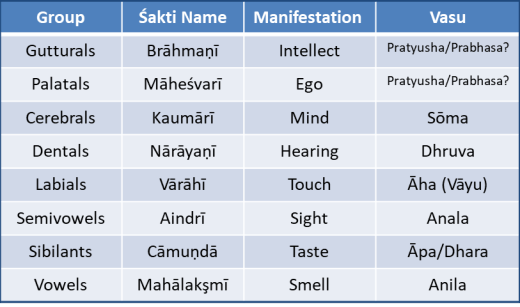
So the alphabets are arranged according to where the tongue touches the upper palate, which is like a gong, or a guitar. Depending upon where you pluck and hold, a different standing wave pattern, or chord, emerges. There is the vibration propagating through the bone structure, including the spine, which is the fastest path. Vibrating every cell in the body, every neuron in the brain with same pattern is the ultimate goal. Then, we have nerves in the mouth and backside throat itself that go up to the brain. It’s easy to see that different touch points hit different nerves, or the same nerve at different points (lengths). Let’s take a quick look at how the upper palate and tongue are wired with nerves.
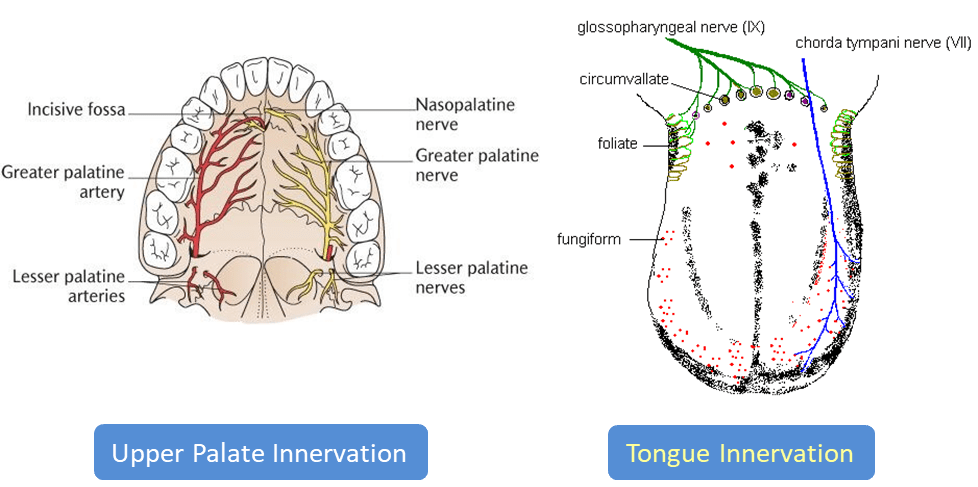
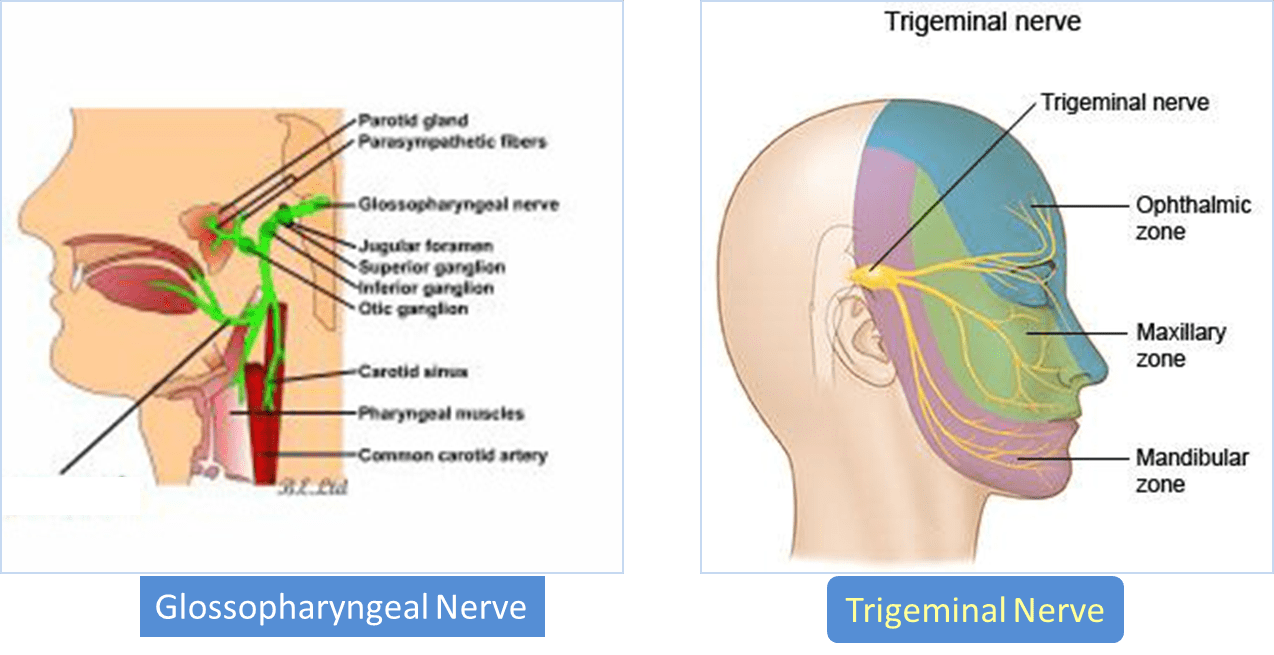
Anatomically, Glossopharyngeal nerve is energized as the backside of tongue hits the backside of the throat, while other consonants activate the maxilliary and madibular branches of the Trigeminal nerve. What’s special about these two nerves is that they are cranial nerves (they don’t pass through the spine, to reach the brain). The maxilliary nerve comes from the side, and turns inwards to the center. In the guitar analogy, we hit these strings at their ends when we chant. We don’t know the specific effects, but there are two mechanisms: general overall broadband energy transmission, which helps to sync up all the parts of the body to the same vibration pattern, when chanted millions and millions of times. The second is specific activation, where a specific part of the mouth is repeatedly activated with a seed mantra. See the schematics below:
How about just normal talking? We hit those same points too, right? That is correct. In actuality, every word we speak (or even a thought) leaves an imprint behind – serious yogis would be very picky with thoughts, words and communication. The word-formation and vocalization itself is an involved process. In any case, the standard talking is too random for it to establish any sustainable patterns – like white noise. Whatever worth it is, here’s a factoid: the top three most commonly vocalized words in English are – the, of, and and, in that order.
In a very interesting conceptualization, yogis equate the head to an inverted cup, having its top below and the bottom above. The top of that cup is the mouth. Placed in there are the secrets of the universal form (viśvarūpa). On the cup’s lip sit the seven ṛṣis. With the tongue as the eight, this inverted cup communicates with the Brahman! Wow – so intricate! Essentially the seven ṛṣis are the seven pranas in the head (much more on the seven ṛṣis in the later blurbs).
Now add tone and pitch to the sounds of chanting. Now, we have a rich variations in chanting, hence variations in effects as well. Below is an example: to chant ṡrauṣaṭ call
Nnyak: begin in a high tone and concludes in a low tone
Tiryak: conclude in the same tone as at the beginning (dip in the middle)
Urdhvam: begins in a low tone and concludes in a high tone
Kṛpaṇam: thin, long-drawn, toneless way
Bahih-śri: open lips wide and utter Srausat call at a high, toneless pitch
Antah-śri: Close lips wide and utters with loud toneful pitch
One can now appreciate the richness of mantra chanting methods. Not difficult to imagine different styles activating different parts of the body/brain. What the effects exactly are and how to control them, which is actually more important for yogis, is left to the practitioner to learn and explore, preferably from a practitioner (and not a quack!).
The usual practice tidbit: when trying something new, always start slow.
These are just dots for us to connect, and develop our own intuition. Unfortunately, rishis did not leave a lot of explanations behind, unless we lost the dictionary, where they defined what each energy signifies what in the body. This information was all transmitted orally. But for a big picture, it is clear that generating specific repetitive vibrational pattern through the mechanical chanting part, and directing that specific energy through the right nādi branch/es is the principle that underlies the mantra method. (Note: nerve is an approximate description of nādi, as nādi also has a psychic aspect associated with it). Vāta is intrinsically connected to all this, and that’s what we are talking about under the general topic of Vāta and Vāyu. And also explains our udāna vāyu focus in some of the paractice sessions, where, the focus was on the upward (body to brain) directed signal current.
Let’s quickly go through what this might mean:
- The eight alphabet, or akṣara, categories are also the eight energetic components of pṛakṛti (nature) that we discussed in the “Yogic Model of Everything”. Note the pairing of the feminine energy with a masculine Vasu aspect.
- All god forces are within us, including śakti energies – their equivalent projections are outside, in the macro.
- When we activate a specific vibration, that is through a specific śakti component, it seem to work with the corresponding god-force, typically portrayed as masculine. Our goal is to hit neutral, that middle path.
- The sense faculties we talk about, like hearing, is not just physical sound, but there is more to them, depending upon the level of energy directed to that channel. When the sense reaches a higher plane, they hear (sense) a broader range of energies. We will return to this later.
Once the body is tuned with the mantra, merging with it is the next step; typically we only chant for a few minutes, but sometime you experience the echoes for some time even after we stop chanting. Patajnali calls this process of merging samyama – notice our favorite root sam again (meaning “together”). Merging with that mantra awareness is the goal.
So mantra, leaves a single mode of vibration in the entire body-mind complex – a path to the first stage of samādhi (the eighth step of Yoga) – savikalpa samādhi. At that point we may just be chanting that mantra silently. Even that mantra vibration disappears in the final stages of samādhi – nirvikalpa Samādhi… We got a little ways to go, but with limited chanting we do in our sessions, even if we can enter the fifth step (sense withdrawal), we are making a lot of progress! With that…
May we all be blessed with an intuition for Mantra-energy_/\_/\_/\_
(bhadraṁ no api vātaya manaḥ)
 Yogic Thought
Leave a comment