yajñyo yajñyena kalpatām
Yajña is created by Yajña
yajñena yajñamayajanta devāh
Gods accomplished Yajña through Yajña
Yajña, this element of effort with smallest karmic footprint, is at the core of yogic thought, and spirals down into an egg-from-the-chick conundrum at the beginning of creation. It folds onto itself – yajna is created by yajna – as fundamental as that. After all, this universe is a result of yajna, so is our breathing. Universal Mind is a key piece in that yajñic creation cycle. We will continue with the theory of mind. As far as the practice is concerned, what’s listed in the previous blurb (#53) is all we need. The book Ardor by Robert Calasso, and the translation of Śatapata Brahmana by Julius Eggeling are great references for these concepts. Eggeling’s translation is all we seem to have of this great Brahmana, but it provides gross level pointers and a good starting point in understanding this great brahmana.
Back to the theory part… first of all, Ŗsis seem to be sure of one thing, as they state in several places in Yajurveda – the head is made of seven entities – “vital breaths” [prāṇās] in some places, and rsis at some other places. They are also the seven gates to the external universe. Somehow the vital breaths are equated to (seven) rsis – saptaŗsis – which were apparently the leftovers, or the residue, from the previous creation cycle. This residue forms the seed material for the next creation cycle. They are pressed together to form the Prajapati of the next creation cycle, who in turn creates the seven rsis of the next cycle. Full story can be found in Śatapatabrahmana; (of Śukla Yajurveda; e.g. Kanda 6 – Chapter 1 – Brahmana 1; a part of it is included at the bottom) :
… sapta vai śīrṣaṇyāh prāṇāh
…the head is made of seven prānās
… saptā́nām púruṣāṇāṃ śrī́ḥ
yo rása ā́sīttámūrdʰváṃ samúdauhastádasya śíro bhavat…
the essence [rasa] of the seven púruṣās [r̥sis] was concentrated above as the head
sá eva púruṣaḥa prajā́patirabhavat
that seven together was nothing but that purusha, Prajapati!
These seven pranic streams/rsis energize the seven sensory gates to the external world – two eyes, two ears, two nostrils, and the mouth/tongue, which also energized the first conscious being, Prajāpati. The names associated are (Eggeling in Satapata Brahmana, 14, Ch 5, Br 3):
1. Right ear: Gautama 2. Left ear: Bharadvāja
3. Right eye: Viśvāmitra 4. Left eye: Jamadagni
5. Right nostril: Vasiṣtha 6. Left nostril: Kaśyapa
7. Tongue: Atri
These seven rishis are born from specific set of vibrations – for example, Vasiṣtha is born from silent repetition (upamshu) of Gayathri meter (via Tvitrut stoma and Ratantara) … And Indra is the one that enabled the flow of these seven streams [He, the seven-rayed, the showerer, the powerful, who let loose the seven rivers to flow – Rig Veda 2.12.12]
These sensory instruments and the rishis that energize them are a critical aspect of the creation, without which the creation cannot sustain – because that’s how we are connected to the foundational fabric of the universe. Imagine not being able to sense a predator like a tiger in the savannahs…we would have probably been gone by now. At a technical level, our senses depend upon the very cosmic fabric, to allow transmission of information for us to be able to “sense” – in modern terms, they are the fields.
Why are we talking about all these ancient yogic concepts anyway? Because we want to understand the yogic concept of what constitutes our minds and how our minds work so that we can tune it through yoga practices. From the “about” page, recall r̥sis’ goal – they want to understand how our minds switch mental states. For example, must one always have coitus to reach the orgasmic state? (the answer apparently is a no). How can we always be in a non-dualistic bliss state so that we can see everything as a part of the karmic cycle? Both villainous and heroic acts… It’s all a part of the cosmic drama, yet we have the freewill to choose our actions and activities. That freewill requires laser-focused effort, to rise above the karmic background.
(That choice we make while sitting on a couch without thinking much? No, that ain’t freewill, even though it feels like it)
As we browse through this vedic model, there are quite a few mysterious concepts, but nothing is more enigmatic than the three that we will discuss here – Yajña, Prajāpati and Prāna. They are not disparate, but actually closely related. The Yajna concept runs through all these.
A fire altar or chityagni (or citya or agnichit, with a yupa/post at the center, and a hall/vedi or maṇdapa around it) is at the center of that yajna. In close examination, these are used as transitional objects or just simple anatomical models for practitioners, especially for beginners; as Satapata Brahmana teaches (SB 6.1.2.17), the five body parts (tanu) of Prajapati — hair, skin, flesh, bone, and marrow — they are these five layers (of the fire-altar). A careful examination of both Satapata Brahmana and Taittiriya Samhita points to how the fire altars are designed for prana flow: bricks with holes for prana flow, and relative deity positions, which are essentially how prana flows in our bodies. Something for practitioners to practice and experience. There are different ways of how we can manipulate our body-mind configurations. At the ontological level, it’s all about fixing Prajapati’s swollen eye and returning it to its original position (blurb #7), the ultimate prize, while the Prana is that mediating currency. Ultimately, everything is within each of us, and yajna is going on everywhere in and around us.
Every act is a yajna. Wherever there is an input (offering or oblation, which is our physical and/or mental efforts) and a fire at the center – undoubtedly there will be an output (result), and that process is yajna. How’s that input converted to the output? Element Fire. Externalizing that yajna event for common good is the ultimate action that leads to Moksha, and is the essence and purpose of our individual lives according to Karma yoga. Internalizing the yajna event for self-realization is a critical parallel process in that journey, as we cannot be of much of help to others if we don’t understand it ourselves and our roles in this creation.
Through numerous external rituals and physical models, rishis had demonstrated how to prepare our body and mind for action – the vedas, particularly Brahmanas, are all about those recipes. Some of the instructions include fire bricks with appropriately placed holes, to let prana flow freely through them with no interruptions (check your own breath – is it uninterrupted?). Unfortunately, what we are left with now is just the exoteric ritual part. But through all the complex metaphors and elaborate liturgical procedures, there shines an intriguing model of how to expand, and shift modes of awareness. The ritual part was supposed to lead us and eventually guide us to the internal practices. Let’s review the three concepts we have chosen in the quest to understand and gain control of our “mind”.
yajñA
As we talked about it already, this is at the center of everything. At an individual level, yajna starts with setting up that internal fire altar, and lighting the fire. There are several shapes, including the most popular one, which is the bird shape. The infamous garuda: Vishnu’s vehicle is this powerful bird, whose body is made of metres.
prajaápatirimaáMlokaánaipsat sá etaM váyovidhamaatmaánama
pashyadagniM taM vya&dhatta ténemáM lokámaapnotsá
Prajapati was desirous of gaining these worlds. He saw this bird-like body, the fire altar: he fashioned it, and gained this world.
What is Yajna? This verse below, from the tenth of anuvaka of Chamakam (of Krishna Yajurveda) summarizes yogis’ vision:
āyur yagñena kalpatām | prāno yagñena kalpatām
apāno yagñena kalpatām | vyāno yagñena kalpatām
chakshur yagñena kalpatām | shrotram yagñena kalpatām
mano yagñena kalpatām | vāk yagñena kalpatām
ātmā yagñena kalpatām | yagñyo yagñena kalpatām
That explains it all – life (lifespan or ayur) is because of yajna, so are prana, apana, vyana, vision, hearing, mind, speech, atma, and finally yajna is possible because of yajna!!
…this universe is because of yajna
– this is for our deepest contemplation. Recall that yajna has three aspects (blurb #43) – an input (oblation or offering), the interconverting agent (fire), and the output. The list above contains a series of outputs. The homework is to figure out our inputs; the fire within us takes care of the conversion process. Talking of fire… How is the fire altar set up? They are called Samidheni chants of specific chanting patterns. Will elaborate on that later.
Fire is lit through these chants. Fire altar is the central piece of the yajna. The schematics are shapes of different fire altar designs. The seven pranas are placed in different parts of those altars. Bird shape is a common one (see appendix). Garuda the great king of birds is Vishnu’s vehicle. Again it’s inside. Locating it, strengthening it and lighting the fire is process of what we call yoga.
Imagine a sequence of kriyas, like the sequence of leg lifts followed by locust, performed in a yoga session. That heat generated at the navel is that fire. So, the fire altar construction is nothing more than accessing, energizing and finally fixing the defects in that subtle (information) body…. (see blurb #43). Specific verses with measured breath intervals are chanted to light that fire; of course there are probably other ways too.
Now, what is to be done after setting up the fire? The internal “great” attitude (or maha vrata) is next – Dharana stage of yoga. With that, the preparation is complete, the litany through a series of those specialized chants (maha ukkhtam – the great surge) follows. Through these chants, Vasus energize the body through Gayatri metre, Rudras by Tristubh, Adityas by Jagati metre, The whole fire altar is eventually set up by using different metres or vibration patterns.
Also , there are eight Vasus, and there are eight syllables per line and three such lines in the Gayathri meter. Similarly, eleven Rudras; eleven letters per line of four lines make up Trishtubh metre. Twelve Adityas; twelve letters per line of four lines make up Jagati metre. Finally, eight letters per line of four lines make up Anusthubh metre, which addresses all gods, which is Vak herself. How many verses of each type included in a recipe is what makes that recipe unique, with its own effects.
prajāpati
Who is Prajapati? How did this first being come about? Brahmana texts associated with vedas are obsessed with this question.
Interestingly, Prajapati is extolled as both space (kha), and time (samvatsara); and blissful awareness on top of that: sat-chit-ananda. Prajapati creates those space-occupying entities, and he’s also the time – “annual cycle” or samvatsara.
Space is considered an external sense, as we locate things outside, time is considered an inner sense, as we order events internally to gain awareness of the flow of things, and ananda as state which creates the binding feelings, sensations, and thoughts that lead to a sense of blissful wholeness.
Prajapati morphed its meaning through ages, but Prajapati is the sum of consciousness, consciousness as defined by vedas. A thought itself is a manifestation of that prajapati. In vedas, consciousness is that which enables any and every experience, like cognition, as well as the cognized – the whole thing. Note that a significant chunks of cognition occurs in the background. Prajapati is that integral “consciousness”, which devolves into islands of cognized (objects) and the medium. Hence Prajapati as the ruler is the first being.
In meditative yajna, prajapati is the fire altar itself. As noted above, it is modeled after the structure of living creatures (twam) and the universe itself (tat).
Prajapati is also depicted as death itself! The depiction of time in vedas, yogic methods is fascinating. That timing has to be perfect. The body has to be constructed and shaped perfectly to be in resonance with the cycles of time. Their emphasis on this is so great that they wanted to build physical models with bricks and stones. It’s almost like any body that is not in sync with the year concept will decay with passage of time! It is called the fire-of-time (kāla-anala) in that context. We will find an opportunity to elaborate on Prajapati later.
Prāṇa
To yogis, prana is so fundamental that they say it is everything, including all gods (SB 5.4.6.2)!
…prana vai visve devah
Prana is all gods of the universe
What is prana? When we breathe in, we think of air. We consume food, and think of the grains, vegetables, etc. But, this breath and food are a lot more than just that – they are information carriers, pre-programmed with prana. Satapata Brahmana teaches us that there two components to food – one that travels downwards from the stomach, southward, and a component that travels upwards, towards the head, northward. What’s exactly is that? It’s all the information in the form of various types of subtle vibrations, pulsations… all that coded into the fundamental stuff that makes up air atoms, molecules, etc. that go into breath and food. But the largest contribution to prana in individuals comes from breathing, since we breath about 22,000 times a day. That waveform generated by the lungs expanding and contracting imposes that pattern on the body. This actually sets and drives all other internal clocks. In that sense, when we breathe in, we are taking in a bit of the pulsations of the universe and incorporating them into us, and when we exhale, we release a small replica of ourselves into the universe.
This is similar to saying the fundamental particles that make up electrons, protons and neutrons makeup you, me and everything around us. Yes, we are all made of the same thing – no surprises there, right? These fundamental particles carry bits of information with them.
Hopefully it’s all coming together for you – at the core, all are just vibrations, pulsations, rhythms and meters. They are all one and the same at the building block level – a little bit of purusha and a little bit of prakriti. Speech (vac) is not just the sounds, but the signals from the mind that vibrate the vocal chords. Speech actually has four parts; we will get there soon. Pulling together the body/mind around a vibration pattern, through either mantra or a breath rhythm, is essential to gain control on states of consciousness. Urge to breathe is the strongest of instincts we have. That’s at the core of “I”. Let’s revisit that “I” next…
May we all be blessed a good understanding of our Mind_/\_/\_/\_
APPENDIX
(translation by Julius Eggeling)
Satapatabrahmana Kanda 6 – Chapter 1 – Brahmana 1
1. Verily, in the beginning there was here the non-existent [asat – where did we hear this before?] As to this they say, ‘What was that non-existent?’ The Rishis, assuredly,–it is they that were the non-existent. As to this they say, ‘Who were those Rishis?’ The Rishis, doubtless, were the vital airs (prānas): inasmuch as before (the existence of) this universe, they, desiring it, wore themselves out (rish) with toil and austerity, therefore (they are called) Rishis [All the previous universe reduced to prānic residue, to form the seed for the next!].
2. This same vital air in the midst doubtless is Indra. He, by his power (indriya), kindled those (other) vital airs from the midst; and inasmuch as he kindled (indh), he is the kindler (indha): the kindler, indeed,–him they call ‘Indra’ mystically.
3. They said, ‘Surely, being thus, we shall not be able to generate: let us make these seven persons one Person!’ They made those seven persons one Person: they compressed two of them (into) what is above the navel, and two of them (into) what is below the navel; (one) person was (one) wing (or side), (one) person was (the other) wing, and one person was the base (i.e. the feet)
4. And what excellence, what life-sap (rasa) there was in those seven persons, that they concentrated above, that became his head. And because (in it) they concentrated the excellence (srî), therefore it is (called) the head (siras)…
5. That same Person became Pragâpati (lord of generation). And that Person which became Pragâpati is this very Agni, who is now (to be) built.
6. He verily is composed of seven persons, for this Person (Agni) is composed of seven persons to wit, the body (trunk) of four, and the wings and tail of three; for the body of that (first) Person (was composed of) four, and the wings and tail of three. And inasmuch as he makes the body larger by one person, by that force the body raises the wings and tail.
7. And as to the fire which is deposited on the built (altar),–whatever excellence, whatever life-sap there was in those seven persons, that they now concentrate above, that is his (Pragâpati’s) head. On that same (head) all the gods are dependent (srita), for it is there that offering is made to all the gods: therefore also it is the head (siras).
There are eight more verses that go on to discuss Prajapati projecting out the creation through the process of Yajna, with austerity as the offering/oblation.
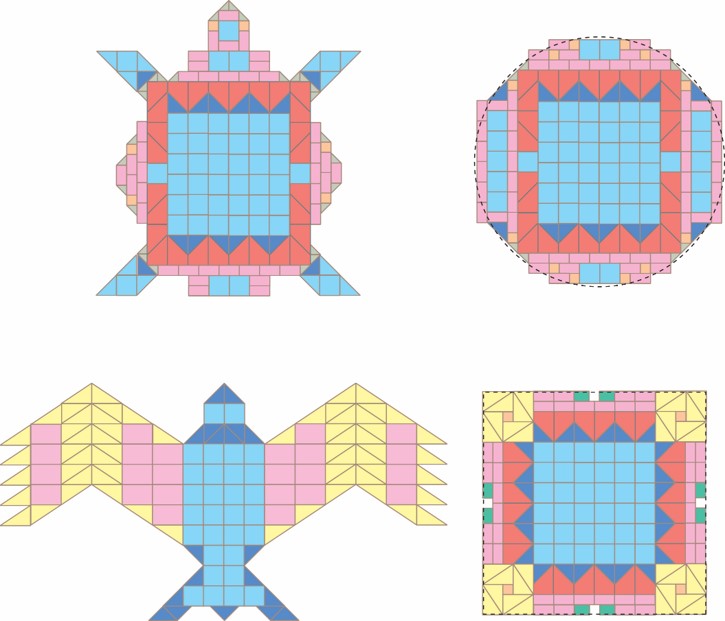
Geometric Precision of Vedic fire-Altars
 Yogic Thought
Leave a comment