A Healthy person is one with balanced humors (sama dosha), balanced agni (sama agni), balanced building blocks (sama dhatu), well functioning waste elimination system (mala kriyah), and with pleasant atma, senses, and mind.
[Notice the inclusion of mind and senses also in the health equation; not just taking care of body. And the word “sama” again – meaning balanced, harmonious]
The person who eats amiable food (hita-hara), enjoys regular low-intensity outdoor physical activity (vihara), remains unagitated by the external events, gives and forgives, honest and truthful, and serves others, is without disease.
– Sushruta Samihita
Let’s begin with the purpose of life according to yogis – it is to thoroughly experience this manifested world. Experience is at the core of it. To have such a life full of experiences, one has to have good overall health – enter ayurveda and yoga. The former is the corrective aspect while the latter is the preventive aspect of that health equation.
We will pick each aspect up from the first verse, and highlight its yogic relevance. We will only cover aspects that are not covered in general books. The bottom line is that we can control all those aspects in Susruta’s sloka, through practice of yoga. That which is present in the macro is present in the micro as well. Yoga uses the internal resources while Ayurveda uses the external also. That is also how yoga and ayurveda are connected.
Health is a body-mind-atma issue and not just a physical body issue. These three aspects are loosely tied to three sources of maladies/death – ādhi-bhautika (physical causes), ādhi-daivika (external cause-related) and ādhi-ātmika or ādhyātmika (mind-atma-related). They are not as disparate as they appear to the naked senses. Even more profound is their conclusion that the seeds of all maladies in our physical bodies have their origins in our minds!
The root cause of all maladies is forgetfulness at the mind level, i.e., the mind forgetting aspects and/or parts of our body, which eventually become the source of the problem. An extreme case of forgetfulness is Alzheimer’s and dementia. Forgetfulness is not just our recollection of conscious records, and this definition includes the stored unconscious responses too, like our immune response. Not completely unexpected, right? …because body and mind are one and the same – body in the physical plane is the mind in the psychic plane. Repeating the key yogic message – use this mind-malady correspondence to cure any disease, or at least use it for prevention.
All that we need in terms of medications are in potential state within us. Rig Veda boldly declares –
apsu me somo abravīd antar viśvāni bheṣajā – Rig Veda 10.9.6
Soma has declared that all medicaments are in the apah, the cosmic waters-state, a potential state. The mind can materialize them.
So, you can use the “inner” doctor to heal and adjust the dominant humor to cure anything you put your mind to. By the way, in the above sloka, why did Soma say this?
In the recent list of popular accounts, Joe Dispenza’s personal story of healing his own compromised spine by himself is a remarkable example. For those rishis, Joe Dispenza’s experience would not be a surprise at all. According to them, that’s exactly how things actually work!
The title of that book is “Evolve your Brain“. Rishis probably would have titled it “Evolve your Mind“. Doesn’t matter – in the modern thinking, the brain mediates the mind anyway. Okay, if I have to evolve my brain (that mediates my mind) how do I do that? What is that mind made of, and what are the control knobs? Let’s go back to blurb #53:
There are only two seeds to the tree that is the mind – one is the pulsations of prana, and other is the mental imprints (vāsanā). – Yogavasishta
This should be rather obvious to those familiar with flow patterns in Fluid Mechanics. Google the phrase “flow around objects”, and view the images – the fluid/flow characteristics (analogous to prana) and the object characteristics (analogous to the vasanas in the mind field) are it to dictate the flow (thought) patterns!
How do you change your state of mind, and flow the mind’s energy to (away from) trouble spots? The two knobs as stated in the sloka above are the prana and the mental imprints. The mental imprints are difficult to change in the short term. So, altering the breath pulsations (prana) is the only short term solution we have – enter pranayama. How do we work on mental imprints? Meditation (sixth/seventh stages of the 8-limbed yoga). Long kriyas followed by meditation opens up the subconscious, and eventually the unconscious, to access and modify the mental imprints.
Now, thinking of Ayurveda and general health, consider this example – how and why do cysts form and grow in our bodies? Why in a specific location for a specific individual, and not the same place for everyone? It is because weak areas, or dead spots, in the nervous system are different for different individuals. The weak areas in the nervous system are created by chronic shunting of these areas – due to trauma or exclusions in thought patterns. Will circle back to this again.
Body and Mind are one and same: body protects the mind paraphernalia, a.k.a. the brain, in the physical plane, while the mind protects the body, by constantly monitoring and fixing breaches in the subtle body as they happen. It is thru mindfulness that the mind protects the body – yoke the mind with the body. You forget a spot in the body, as in losing neural awareness of that part, you will lose that part. Therefore mindfulness and meditation are the essential vitamin pills for a healthy life. All bad things happen to the body when the mind is away not watching the fence!
The previous blurbs gave us a glimpse into the deeper aspects of mind (#52-54), how vata plays a key role, and how all this can help us in real life issues like pain management. All this has to have practical utility – otherwise, as yogis insist, that theory is utterly useless. It has to work for you, but at the same time, we have to make sure it is not our lazy mind that’s making those decisions. Now the rest of the story…
Ayurveda basics
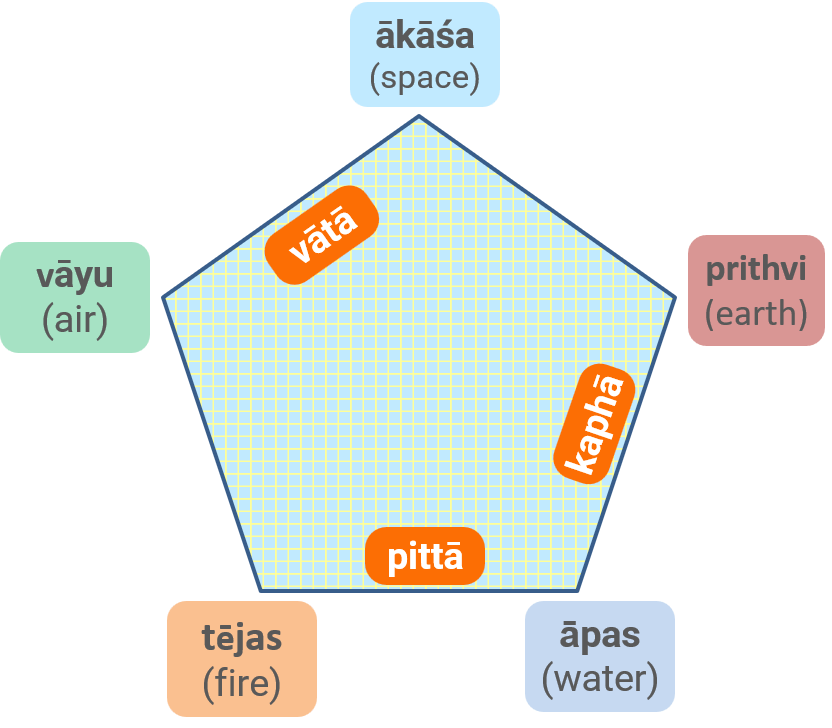
The yogic health model in a way is very simple: five elements, and three intertwining aspects (gunas) of nature interact to give us minds and bodies. By extension, these mind-body complexes are run by the same forces of nature, most important ones being the popular triad of “doshas” or humors; these three doshas run human bodies (as well as the universal body). The mind-body function is a direct result of the balance of these three doshas – everything is mediated through them.
In the manifested bodies, the five elements do not exist independently but in combinations. They want us to worry about three key combinations at a minimum, and as long as we have them in balance, there’s no decay of mind/body. If perfectly balanced, we can live happily for a long time. Of course, that’s not our (human) nature, but we can at least cut out the waste to minimize the decay, and thus slow down aging.
Here are those three combinations:
-
-
-
- Vata: Akasa + Vayu
- Pitta: Tejas + Apah
- Kapha: Apah+ Prithvi
-
-

These elements are what we take in, as food, pills, water, potions, air, etc. The body, depending upon the state of the mind, absorbs and converts the intake into what’s needed by the desires of the mind. Note that everything we take in comes with information packages embedded. For example, not all drops of water are identical, only identical to the extent we can measure. The change in the doshic balance is to accomplish what we desire, and process what we consumed to achieve our desires. If our desires are diffuse, so are the absorption and conversion mechanisms. So, if you really want to achieve something, sharpen the focus and the intention – ardor and askesis (tapas)!
Sama dosha
As stated in the foreword, if one wants serene worry-free life through good health, sama dosha, or the balanced doshas is critical for such a wholistic life. What does it take to control them? Everything we do, like what we eat, drink, watch, think of and desire, affect these three dosha balance. Straight from the Samhita of Sushtruta:
Vayu [Vata]:—
The imparting of motion to the body (Praspandana), the carrying of the sensations of the respective sense organs (Udvahana), the passing down of food to its proper receptacles (Purana), the separation of excretions from the assimilated food matter (Viveka), and the retention and evacuation of urine and semen, etc. (Dharana) should be ascribed to the functions of the five kinds[1] of Vayu (nerve force) which support the body.
Pitta:—
Pigmentations or colouring (Ragakrit), the digestion of food and metabolism of tissues (Paktikrit), the vitalisation and nutrition of the protaplasmic cells (Ojakrit), the origination and preservation[2] of eye-sight (Teja-Krit), the germination of heat and maintenance of the temperature of the body (Ushma-Krit), and the origination of the faculty of intellection (Medha-Krit) should be regarded as the functions of the five kinds[3] of Pitta, which contribute to the preservation of the body through its thermogenetic potency (Agni–Karma).
Shleshma [Kapha]:—
The function of the five kinds[4] of Shleshma is to lubricate the interior of the joints (Sandhi-Samshleshana), to contribute to the gloss of the body (Snehana), to aid in the formation of healthy granules in sores (Ropana), to add to the size of the body (Purana), to build fresh tissues (Vrimhana), to impart a pleasant or soothing sensation to the body (Tarpana), to increase its strength (Valakrit), and to give firmness to the limbs (Sthairya-krit), thereby contributing to the welfare of the body by supplying it with its watery element.
So, as long as we have these three doshas in perfect balance all the time, there’s no decay of body/mind.
Again, the good old theme of yoga – the need for complete awareness, which in turn requires a lot of training and practice. Until such a point, we have to use the combination of yoga practices, along with occasional external intervention (like pills, shots, surgeries…) to manage our overall health and well-being.
Vata and yoga
We cannot talk enough about vata, as it’s so critical to everything, yet we can’t really sense it. We spoke in detail before, but let’s review that concept briefly. Vata is that signaling component of the “I” in Ayurveda.
Right information transport to the right place at the right time is the key – when Vata dosha is balanced, that’s what is accomplished. The conduits for these signals is the nadi system, or loosely translated as the nervous system in the physical domain. Hence, yoga practices focus on opening up and cleansing the nervous system more; traditions like kundalini yoga emphasize this aspect even more. Nadis carry the thought energy as well – an important aspect to note. Nadis open up the widest when we are hovering around the neutrals. Totally relaxed – like in yoga nidra/savasana. Remember the reclining vishnu metaphor from before.
Notice the sophistication of the theory – your thoughts and desires affect your wellbeing, which in turn is dependent upon what we eat, hear, and watch (actually all sensory inputs).
Now, let’s revisit how and why cysts form and grow in our bodies. Why in a specific location for a specific individual? By now, we all can tell that the answer lies in gaps in our mind’s map of the body – the subtle body. Our own habits, infatuations, beliefs, and stress develop blind spots in this subtle body. Our mind, through various built-in mechanisms like the immune system, fight off and cleans up many such accumulations and/or maladies in the connected, or healthy part of the body, thousands and thousands of times a day! However when the awareness is low, to cope with the stress, combined with a breath deficit (actually prana deficit), mind shunts awareness to those areas. They become dumping grounds for the body. Stuff happens in those parts of the body, but the mind does not know it completely, or does not have the pranic resources to repair it! So, when the resources are low, the mind shuts down that area – surgical removal of that part is the most likely solution at that point.
Your body, through different clenches and permanent knots, determines the breath and the pranic flow pattern. And this pattern is ever so shifting as our consumption and thought preferences change. Yoga is to declench and de-knot the body, and move it closer to the neutral. As simple as that, which in turn allows the inner doctor to do the job unhindered, as opposed to working through obstructions and/or redirections or even completely ignoring that doctor’s instructions, because they are catering to higher priority stress commands from the “I”! That’s why we see claims that strong emotions make certain organs more vulnerable to malfunction than others. Occasional outbursts are okay but an unchecked chronic emotional state is a definitive way of hurting the body – meditate regularly to get rid of those stressors that cause chronic non-neutral emotional states.
Sama agni
This is the second aspect in Sushruta’s sloka from the beginning … Pitta is governed by the fire element, whose presiding deity is Agni. Sama-agni means that the fire element in the body should be balanced. Too high or low? From a practical aspect, metabolism gets too fast or too slow.
Fast metabolism –> Oxidative stress –> Excess energy generation –> Restlessness and aging
Slow metabolism –> Low energy generation –> Lethargy and functional degeneration
Note that the most important thing is to match the metabolism/food intake with the expenditure. Eliminate that gap between the two. Modern medicine also agrees with this – rapid metabolic processes such as glycolysis contribute to increased inflammation, while slower metabolic processes such as fatty acid oxidation contribute to anti-inflammatory activities. Having said that – which mode should we be in? As should be expected from yogis – we should be able to switch between the two, at ease. When we are performing physically and/or mentally demanding tasks, we need to be in the first mode. When we are not doing anything useful, we need to be in the slower metabolism mode. We should be able to slow down the metabolism from ~100 Watts to lowest possible, with corresponding lowering of energy usage. True meditation is possible only then. Back to the Shivaratri notes from before.
Sama dhatu
In a previous note, while talking about Sex, Celibacy and Kundalini, we had discussed the seven key materials in our bodies; they are – 1. Rasa (blood plasma), 2. Rakta (blood cells), 3. Māmsa (muscle tissue), 4. Medha (adipose tissue), 5. Asti (bone), 6. Majjā (marrow, nerve tissue), and 7. Šukra/ Ārtava (male/female reproductive material). Food is the main raw material for all this, and fire element (Agni) in its various forms is the transformational agent. These seven ingredients should be in right proportions, and there should be strong enough fire element to convert one from the other when needed.
Happy mind
All three qualities of Prakruti (Vata, Pitta and Kapha) affect the brain-function and thus the state-of-mind. A balanced mind is the ultimate goal.
Sometimes, it takes training the mind to bring the right perspective to bad situations. It is extremely important to understand that what our mind tells us, especially at the first look, is a only an opinion generated through the path of least thinking (resistance). Follow that conclusion if life is at risk. If we think what their mind is telling us is the ultimate truth, at some point it is bound to drive us into a ditch. Practicing compassion, empathy and feeling-connected helps with the state-of-mind. That’s where our yamas and niyamas play a key role. Again, notice – at the beginning it takes deliberate practice of these emotions and sensations. Feeling-connected and the associated feeling/sensations is the larger meaning of love. Continuous contemplation is the path!
Finally – what is aging?
According to yogis, humans are given 100 years, as counted by rotations of seasons. Any disturbance in the balances discussed above, dhatu, agni, manas, atman, is reflected in our effective age. Not everyone ages at the same rate. We will get to the details next.
May we all be blessed with a vibrant mind_/\_/\_/\_
भद्रं नो अपि वातय मनः
(bhadraṃ no api vātaya manaḥ)
 Yogic Thought
Leave a comment