Chronic Stress is the real poison within – the true agent of aging
Reactive Oxygen Species is that poison
Thoughts/beliefs + Breath pattern + All Intakes (food, breath, TV, …) —> Health
All issues begin with disturbances in the breath pattern
Your youth is laying dormant at the edges of your lungs
Heal the subtle body for a healthy life, with breath
śataṃ himā aśīya bheṣajebhiḥ… [Rig Veda 2.33.2]
Nourished by the curative medicaments, may I live a hundred winters –
[Hundred autumns in Satapata Brahmana]
Uma: Why do humans age and die before his due hundred years life? Could the creator be wrong?
Śiva [Uma’s consort]: No. Premature demise of a human is due to his own beliefs, habits and addictions.
citte vidhurite dehaḥ saṃkṣobhamanuyātyalam… [Yogavasista 6.81.30]
The mind being disturbed by stress and anxieties, the body is disordered also in its functions…
We all age, right? At least biologically… The quest to understand the aging process and slowing it down has been at the center of human quest for ages. Even though we all want to remain young and vibrant forever, do we ever stop and think why and how we age, and whether we can control any of that or not? We see advertisements for all sorts for pills and potions for aging-related issues. How helpful are they? Can they also change our state of mind? Because it is now a known fact even in modern medicine that chronic stress is one of the, if not the top, risk factors for the aging process. Interestingly, Siva, the first guru of yoga, also points out those as significant factors in aging. Most commonly accepted theory now is that the oxidative damage caused by reactive oxygen species (ROS) is the primary cause of aging.
Stress became such an important topic in medicine that there’s at least one fully dedicated journal, called Stress! Coming to what causes stress, instincts play a key role; instincts like when we see a snake, feel hungry, or see an unlimited food supply. These instincts and emotional reactions can play a critical role in generating stress. In this blurb, as usual, we will go through what yogis hypothesized and connect that to what we have been learning in the recent past. We will particularly focus on how it ties into some of the yogic practices in the larger sense (not just asanas).
contemplation point
Along those lines, a thought experiment – dig up a picture of yourself in your youth – say when you are about 20-25 years. Look at your own body type, bone structure, and overall physique. Our individual goal should be to stay as close to that as possible. Why did the body change so much over time? Yes, we used the body. But the body has the amazing power to heal itself. Could it be that we didn’t just use the body, but abused it? Something to meditate upon…
Okay, what happens as we age? As expected, in contrast to what we routinely read, yogis don’t stop at saying growth, and aging by extension, are unconscious processes that are automatic, dictated by genes or something like that, and we can’t do anything about it. Our habits, addictions, daily rituals, etc. make a huge difference. The first half of yoga steps (Yama, niyama, asana and pranayama) are designed to contemplate and then counter these automated growth/aging processes. Let’s go through some frequently asked questions, starting from puberty.
Q: what happens at puberty?
The root lock opens up! Boys start releasing reproductive fluid from that point, and girls start menstruating. That disperses and discharges energy that otherwise is used for physical and mental growth, i.e., growth and learning. This why celibacy was given such prominence. It is not that sex is bad It has basal metabolism and aging implications according to yogis, and therefore to be used judiciously [see the blurb on Sex and Spirituality]. Mula-bandha (root lock) is THE key!
Anatomically speaking, as the pelvic structures open up as we grow, the pelvic inlet widens, and root structures naturally compress and consolidate into the pelvic cavity with age. Typical age when we hit puberty in around 10-15 years. The goal is to protect the root lock by restoring the pelvic structure closer to the original – practice the full root lock!! Note that restoration takes time and does not happen overnight.
Q: What happens after bandhas/locks open up?
At a mental level, the internal world begins to fully separate out from the external world, and the gap begins to grow. Most of the learning occurs through empiricism, and beliefs and habits begin to form, which essentially insert knots into the nervous system. The knots can be more pronounced when the child is growing up in a stressful, conflict-ridden household. Numbing the nervous system with knots help cope with the stressful environment. In the presence of such knots, Prana flow is no longer freeform. Mind begins to disperse, and this gets worse with age; beliefs (knots) become stronger and learning becomes weaker, unless something rattles us into refocusing.
Q: What opens and closes as growth starts, from infanthood?
It’s the neck lock, or the jalandhara bandha that opens first, and pineal gland begins to calcify, shifting learning from intuitive to empirical. Both are important for contributing to the understanding of the physical world. Then the thyroid begins to calcify (fifth, or the visudhi chakra). In general, glands begin to calcify; pound for pound, breath weakens.
Q: what drives and stops growth? For example, why are some taller than the others?
Especially during adolescence, it’s the reach of prana that dictates how tall and large we grow, Just like how a tree grows, if the nutrients and water don’t reach beyond some point, the growth also stops there. Similarly, where the breath pulsations stop, that’s where the growth stops, since any cells beyond that point don’t get the prana signals – the vyana component is that component of the breath pulsations. Think of the nervous system, i.e., the nadi system as a tree, for an intuitive grasp.
Q: Does nature play a role?
Absolutely. We have already talked about stress in the environment that the child grows up in… It impacts the nervous system. But there are some global forces that also play a role – the most important is the good old gravity. Gravity pulls everything down. This has a huge impact on the natural processes like locks opening up. Yoga’s goal is to slow this down, and even try to reverse it in some cases. But reversal takes a lot of effort, so even if we can slow it down, it’s a big achievement.
Q: What can chronic stress do?
Chronic stress can essentially kill us, prematurely. This is the central theme of this blurb: consciously control all the stress in life – whether it’s thru yoga or something else – health will naturally follow. In the last two decades, modern medicine has also came to agree that stress, particularly of the chronic variety, can significantly accelerate the aging process. This connection was not in the mainstream for the longest. To repeat, chronic stress can lead to a range of maladies, including accelerated aging. At a minimum it increases inflammation in the body, which leads to a significant impact on cell health and increased load on the cleanup duty of the lymph system. Short-term inflammation to heal the body is a normal healthy function, and we need that. It is the Chronic inflammation that we need to eliminate. Chronic inflammation along with compromised immune function and uneven sleep patterns have been linked to a range of age-related diseases, including heart disease, diabetes, and cognitive decline. Intermittent fasting is a solution, which has been a part of almost all cultures for eons, and in healthy individuals, this practice can fight chronic inflammation very effectively.
We have said enough about the negative impact of stress on aging, but let’s talk a little deeper into how stress is created in the first place, and how that is related to habits and beliefs?
Q: What causes chronic stress?
Our own beliefs and habits – a revolutionary hypothesis!
Q: What’s wrong with expectations?
Outcomes and others’ behaviors are measured against them
Q: Why beliefs and habits ultimately lead to chronic stress?
Because they set expectations for outcomes… These expectations create a mismatch between our internal and external views of the world/surroundings, which in turn change all rhythms and patterns in the body. With age, these defects begin to have an impact on breathing.
Q: What happens to breathing as we age?
Your lungs mature by the time you are about 20-25 years old. After about the age of 35, it is normal for your lung function to decline gradually as you age. This can make breathing slightly more difficult as you get older. Weight goes up with age. Breath or grams of O2/Kg of body weight or grams of O2/Calorie consumed goes down. Lung volume (active) goes down. Pulsing energy. For some more summarized information, see aging of respiratory system.
One way to summarize this is to say that the lung elasticity, or flexibility, decreases with age. If you actually asked yogis, they would say the respiratory function begins to slowly deteriorate from almost the time of birth. By that, the best breath any of us took is the very first breath. Yoga’s goal is to slow this deterioration, if not completely eliminate it. Back to:
Q: Why beliefs and habits ultimately lead to chronic stress?
Because they set expectations for outcomes… These expectations create a mismatch between our internal and external views of the world/surroundings.
Q: What’s wrong with measuring against expectations?
That difference, the shortfall or excess between outcomes and expectations, creates internal stress. As long as this stress is short-term, it can be used for learning purposes, and released in a timely manner, the body can recover from any damage effectively But anything longer can do permanent damage to the body in the form of cell/tissue/organ damage, aka aging, and serious ailments in some cases.
Q: What if the results exceed expectations?
It still puts pressure on the mind-body. Good news also raises blood pressure, for example.
Mind-body connection after all, right? Stress! Mind trying to reconcile the outcomes of our observations and actions with expectations is what we call stress! Once reconciled, all the stress is gone! Another way to rapidly eliminate stress is to minimize expectations, either positive or negative. That preemptive toning down of expectations is at the core of yogis’ holistic approach – actions for common good, with zero expectations is the best solution. Selecting and executing actions for common good, in a karma yoga sense, is one such effective solution to achieve that state. The physical approach of hatha yoga comes at it from a different direction. After all, mind and body are the same, and therefore, the way to control mental processes is the same as controlling the physical condition. Did anyone stop and think why simple stretching feels good? At one level, asanas extend that to stretch us out and relieve stored stress in every direction, and use breath to ensure the the knots do not return. Of course, if we go back to same old habits, same old knots will return.
from Yogavasista…
Yogavasista also teaches this connection as the root problem, which is actually a common theme in the yoga literature. Below is the sequence of events:
Expectation gap –>Disturbed mind/stress –> agitated breath –> out of sync body rhythms/ pranic deficit –> asynchronous hormonal secretions –> poor nutrient absorption –>
–> excess free radicals –> accelerated cellular damage –> compromised healing
–>accelerated aging
Not just that, unless we are awake, our unconscious mind schemes to fix this shortfall, without our conscious approval – a huge contributor to the problem. Below are a few verses from Yogavasista that speak to this.
saṃkṣobhātsāmyamutsṛjya vahanti prāṇavāyavaḥ 6.81.32
With mind troubled, the praṇa flow is disturbed and breathe in fits and snatches;
asamaṃ vahati prāṇe nāḍyo yānti visaṃsthitim 6.81.33
The vital airs/breathing flowing irregularly, derange the lungs and nerves (nadis) of the body
kāścinnāḍyaḥ prapūrṇatvaṃ yānti kāścicca riktatām 6.81.34
The breathings being irregular, unsettles the whole body; by making the nadis quite empty and dry in some parts, and full and stout in others [look up Cheyne-Stokes breathing]
kujīrṇatvamajīrṇatvamatijīrṇatvameva vā | doṣāyaiva prayātyannaṃ prāṇasaṃcāraduṣkramāt 6.81.35
The drive for even breathing is accompanied by indigestion and mal-digestion of the food; and these defects in digestion, bring forth a great many maladies in the system. [apana vayu is the downward current that is responsible for elimination]
Try this Yogic breathing technique
Now when you are upset or stressed about something next time, try your favorite segmented breathing technique to regularize the breath pattern. Start with 11 min sit down, and do that 2-3 times a day. Just like taking a pain killer every six hours. The stress will subside over time, depending upon how bad it is.
To achieve the objective of 100 year lifespan, yogis tell the practitioners to ensure that two key fires are burning brightly (in the body), and pray that these fires are not removed prematurely (SB 2.3.3.4), because that will lead to early end, or aging as we call it. This fire is the very element that converts what we take-in into what we need (dhatus, and others from there). Once these two fires are lit, Agni is in place. Now the work in the form of gestures, as in meditative actions, can begin.
The last point from ancient yoga theory: aging and death are attributed to the function of the apana, the sub-prana associated with waste and toxin elimination from the body. Interesting that it is the apana that goes out of sync. It can’t keep up with all the waste we generate, and whatever is not pushed out, stays inside the body! Recall the 5 sub-pranas from the previous blurb on Prana. If we allow body sufficient time, energy, and resources to complete elimination between eating and working cycles, we can minimize aging.
A prevalent malady of the modern day, which is also an implication of chronic stress, is what we call blood pressure. Apparently, in 2015, a whopping ~70 million people or 29% of US adults were treated for hypertension! It is a true state of the mind irregularity. The nervous system is stuck on the sympathetic nervous system (SNS) side of the balance; parasympathetic nervous system (PNS) is the counterpart to the sympathetic part. They are the gas-pedal/brakes analog of our functional body. Our body should be able to do this switching smoothly, naturally and relatively rapidly for a healthy body function. SNS uses the blood pressure as one of the tools to accomplish short term fight-or-flee objectives. When the body is stuck in the SNS mode, due to chronic stress, the blood pressure remains high. Now, to counter that, we take pills to mediate this SNS response. In a way, the brain is telling the body to do something, and we are artificially taking pills (natural and synthetic) to counter that. What should the brain make of this? At some point we will end up with messed-up control circuits, having all sorts secondary issues. [Warning: none of this should be taken as medical advice]
This switching is controlled through structures in the mid-brain where a bunch of emotion-driven switches sit. Fear and anxiety are two key emotions that regulate these switches. There are two primary axes that have their origins in the hypothalamus – these axes are called HPAA (hypothalamus- pituitary adrenal axis), and HPTA (hypothalamus-pituitary-thyroid axis). The solution is to learn how to switch between these responses. The HPAA axis regulates the release of cortisol (glucocorticoids) from the adrenal cortex into blood vessels to circulate throughout the body.
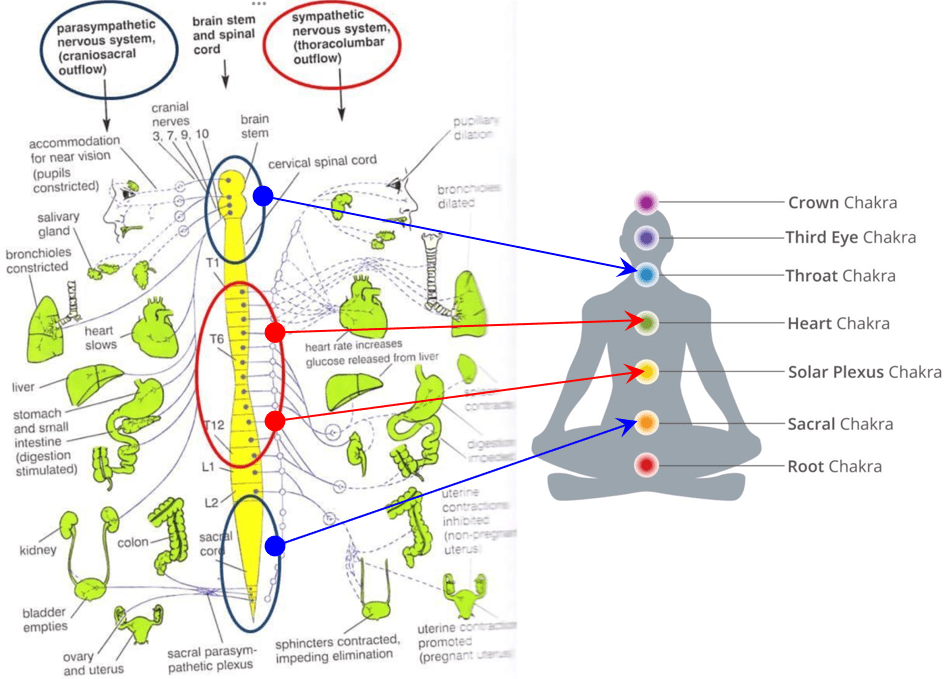
Kriya yoga is designed for this switching between SNS and PNS, and is ideal for practice. For example, the commonly practiced oceanic breath activates the cervical part of the spine, hence relaxes the mind, and switches the body into the relaxation and rejuvenation mode. See the schematic from Coulter’s book on Anatomy of Hatha Yoga. Highlights and chakra correspondence are added to this schematic. for easy understanding. All the major organs communicate with brain via two different sets of cables, and therefore function in two different modes. The sacral (2nd chakra) and cervical/neck (5th chakra) parts of the spine contain the nerve fibers for controlling organs through the parasympathetic system while the thoracolumbar (4th and 3rd chakras) part of the spine contain the nerve bundles that control organs through the sympathetic system.

Another interesting aspect of this schematic is it’s use for workouts. While working out, do we want to activate SNS or PNS? SNS obviously, as exercises typically require higher blood flow to the muscles and higher heart rate, etc. So, while hitting the peak of an activity, when heart rate is peaking, breathing rapidly, the last thing we want is to activate wrong chakras that are tied to the parasympathetic system. We consciously keep the heart/naval chakras active. Even among these two, which one should we use – heart chakra if you can consciously increase lung functioning, and less stomach. But while hitting the peak performance, you may want to release the stomach also.
Now if you let the unconscious do the job for you, it will switch to the stomach while you barely pass the warmup phase. Now, switch your awareness to the nose. As the air moves faster through the nose, it interacts with several nerve centers that activate the mid-brain, particularly Amygdala, thalumus and hypothalamus. Make sure to not press the nose inwards to feel the airflow past the nasal surfaces, particularly the downflowing sections. Amygdala activation can lead to fight-or-flee response, which gives the peak performance, but will tire you out quickly. Again, as a yoga practice, it’s less about what is good or bad, and it is more about observing, and gaining control in the process.
Try this technique:
While running, walking or during any aerobic exercise (only), hold the stomach, tight, rib cage slightly tight, and use lungs only to breath. Then, try to do this faster, to keep the supply of additional breath (oxygen) ahead of the demand. Essentially, doing a lighter version of bhastrika (bellows) breath while moving. [note that you pick the right bhastrika recipe as there are several on the web. Pick simplest where you use the lungs as the bellows]. First practice this, while not exercising, and then take the technique to your favorite aerobic exercise. Notice the difference.
[as in all techniques – start slowly; use only if it works for you; don’t force anything]
Let’s begin to summarize (will update with additional notes shortly). So, if we simplify aging, it boils down to three things – health of the nervous system, breath/prana level, and oxidative stress. We always want to have expansive nervous system, ample pranic energy (oxygen and pulsational energy), and low chronic stress levels in order to slow down aging. Minimizing any damage due to oxidative stress imposed on the cells/organs of the body plays a central role.
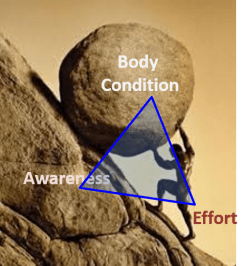
As you can see from the picture below – it is the standard triangular format. The body condition is what we are trying to maintain – the Not mine corner. Why is our body condition closer to the NotMine corner? A contemplation worthy topic – think everything our body contains – where’s all that coming from? Moving on, good company (satsang) is an absolute necessity as it minimizes stress it puts on the body. Awareness and desire at the me-corner, and effort is from the mine-corner.
May we all be blessed with a vibrant and healthy body, nervous system and mind_/\_/\_/\_
भद्रं नो अपि वातय मनः
(bhadraṃ no api vātaya manaḥ)
 Yogic Thought
Leave a comment