… yogaḥ karmasu kauśhalam
Yoga is skill in action (Gita)
Why do all sixteen chapter titles of Gita have yoga in them?
Yogic path to enlightenment is simple – overcome emotions!
Emotions are THE causal karmic entanglers
How much do we have to read, how many sermons do we have to hear
…to realize that all we truly seek is inner silence
... this show is about nothing
(George Costanza in Seinfeld)
So is this blog, and so is yoga. It’s about nothing. Nothing as in zero… Yoga is truly all about the concept of nothing – zero– and how to get there, that precarious balance between two polarities; that neither this-nor that state, like Brahman, which is neither existent nor non-existent. That plane that’s neither stretching nor under compression while in an asana. That infinitesimally short now moment that’s neither in the past nor in the future… That nothing state where there no more thoughts – inner silence!
Whatever has bubbled out of that nothing at the beginning is all still connected. Every bit in and around us is connected to everything else around it. Don’t see it? That’s only because of the limitations of the information gathering capacity of our senses, and the information processing capacity of our brains. In another way to say it, we don’t have an understanding (model) of everything around us, and how we individually fit into that model, i.e., our surroundings. That in itself is a major contributor to our unhappiness, stress, “suffering”. What’s worse is to have a wrong model, and most of us are in that state. Without a good model, we do not see the connections, without which everything is a surprise, and our minds don’t deal with that very well. That lack creates a lot of stress. Yoga is the way to address that gap, by expanding our sensory and processing capabilities, to intuit such a model, and see those connections. We can call that paradigm anything you want – enlightenment, self-realization, or whatever you like.
At the end of the day, Yoga and Meditation are about creating a model of life for ourselves, individually. This model has to be internally consistent (multiple beliefs must align, without contradicting each other), and externally viable. The model development process goes through several learning steps, and is a lifelong journey. Once we have a decent model, we will be able to cope with any external event, reducing stress, and thus allowing a carefree life, which in turn allow us to be joyful most of the time. That’s the ultimate goal. Did you hear flexibility, or closing eyes and sitting under a tree anywhere? Not necessary!
Yes, yoga is a whole lot more than flexing into all those contorted postures. By the way, why does stretching feel good? And, no, yogis didn’t wing it. Underlying this practice is a highly ambitious and holistic model, and nothing plays an important and overarching role in this model calibration.
At the core, yoga is an attitude, a lifestyle choice…
For continuation of this theme, and more, see their vision for the whole. and/or see the next page. For detailed blog posts on different topics – see here.
The Yogic Model – Kundalini
How to be happy all the time? Why do the heart rate and heart rhythm change with changes in our mood? How does my heart know my thoughts? How can we relieve ourselves from pain – both physical as well as psychological? Why do we get depressed, even when we know we have everything we need? How does the universe really work?
Yogis asked the very questions that our modern day scientists and philosophers ask. If we had answers to those questions, we could be perpetually happy they reasoned, because we can play our cards accordingly. The goal never changed; it’s our approach that changed. The difference is that the yogis’ labs are inside, whereas our labs are outside.
Thoughts manifest in the physical world- thoughts activating muscle groups to act, by changing the heart and lung functions is as basic an example as one can get for manifestation of our desires/intentions in the physical world. Sometimes we call that mind-body connection. But that manifestation can take several other subtler routes. For them, “thou art that” or “tat twam asi” formed the basis, and they betted their entire model on that.
Tat Twam Asi
By extension – Tat idam asi – this is that!
Thou Art That. How can you already be that which you have been looking for all this time? This is at the crux of the yogis’ model of the “whole”. They envisioned a holographic model for the “whole” – the brahman – and everything emerges from it, and goes back to it. The implications of this paradigm are total interconnectivity, and fractal nature of the universe. The structure we see in any entity is similar to the what is seen at the macro universe level. Nature creates some monads, and let them aggregate in different ways and to different sizes, and that creates all the complexity we see…
It’s more about “realization” than materially gaining anything new. It’s almost like remembering suddenly that you had left your mobile under your bed pillow, but searching everywhere. In a nutshell, everything is everywhere… It’s just a matter of signal-to-noise. What’s outside is inside as well. The goal is to figure out what is the signal part and what is the noise part of what we are sensing and feeling. The bottomline is that yoga is a thinkers’ game – contemplation is more important than believing in anything.
It’s an amazing intuition of theirs to point out that what we see as just space between people, or between two planets, is not passive at all, but actually is highly active and potent. This has several implications to the yogic lifestyle choices.
At the core of all this is the most fundamental triangle: the Me-Mine-NotMine triangle. It is the triangle that forms the foundation for both tat and twam – same template, scale invariant in modern terms. As bible also teaches us, you are made in the image of “god”. If one does not have time for anything else, Tat-twam-asi is that one liner, or mahavalkya, to contemplate on… This holographic mantra captures pretty much everything.
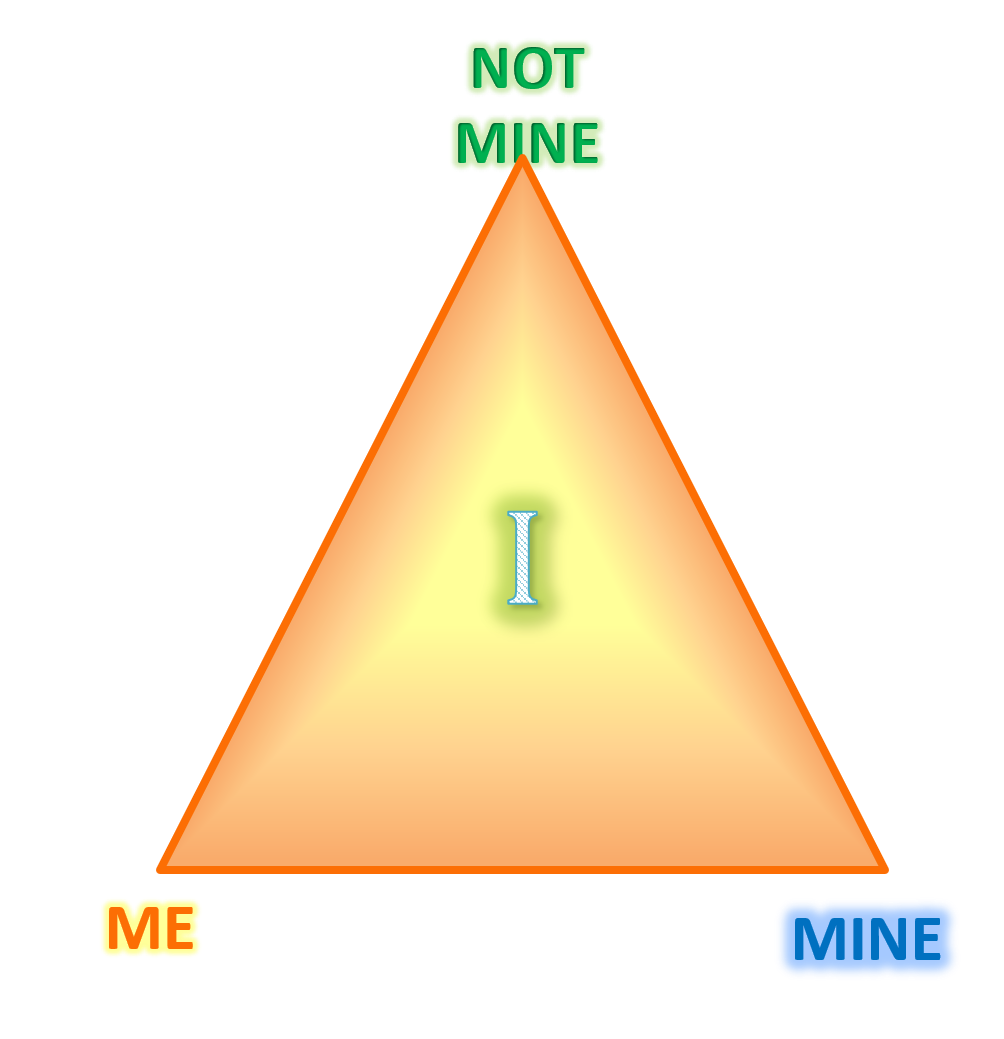
Now we can see why yogis always chant ṣanti thrice after any mantra:
Om ṣanti ṣanti ṣanti hi_/\_
… a little more
We will dig a lot into that model, but here are the top five aspects of yoga that struck me as the most unique about yogic model:
- Yogis’ goal is absolute freedom. Not ethics, not morality, not altruism…, again, repeat this for yourself, not ethics, not morality, not altruism – it’s absolute freedom. Being able to control is to feel that freedom; when we have full control of things, we feel that freedom.
- Yoga and gymnastics are two different disciplines. One of the most common comments, especially from new entrants is “I am not that flexible”. At best, yoga and flexibility are remotely connected; otherwise, gymnasts would be the best yogis. Hint: Flexibility in yogic sense has a lot more to do with “letting go”… Once you go into a comfortable place in an asana, the goal is to shift into pranayama, and not necessarily stretch further into a posture. The goal is to be able find that breath that allows you to be comfortably for a long time. However, some flexes help you ease into asanas.
- Nothing is random; there’s no such thing called luck! Karmic flow is that invisible non-computable field that sets the background. It requires a laser-focused effort to rise above this karmic background, to impose our individual will. Free will and pre-determinism weaved into a single model…!
- It’s the journey, not the destination that matters. Yogis ask us to experience every bit. Experience is the true result of an action, and it is through action that we experience this world, our surroundings. Every experience you seek can be found in the action you are undertaking. What we typically seek, financial security, is only a part of the prosperity (saubhagya), per yogis. But, due to the conditioning of our psyche, we automatically chase substitutes for security (power, money, and other chattel…).
- Everything is connected – Tat Twam Asi – that total interconnectivity – it’s just that we can’t see with our limited and feeble senses. Pain and prosperity propagate through this network (indra-jala). Without having intuition for that net, it feels like magic.
This is epitomized by what’s called Sweet-Knowledge (madhu vidya) of Brihadaranyaka Upanishad. Knowing or realizing that that there’s no second, to know that it’s all one, is that sweet knowledge! Then, why don’t we pray for everyone to be happy all the time? That’s because we don’t see those connections. In a nutshell, Yoga and Meditation are all about that. Our attitude will not change unless we keep at it.
So motivation for this blog is very basic – to regurgitate what I understand of rishis’ messages, in my own words, and make it available for anyone who may wish to use it for their own “self” exploration purposes. Rishis codified their findings in a very concise and pithy way, requiring contemplation to decipher the complete meaning. Significant number of intermediate steps worth several modern day PhD theses were left to seekers as exercises, just like what Fermat did, for example… It’s almost like the yogis worried that casual and/or untrained individuals can misuse/misunderstand their messages, and even ridicule them…
The best things can’t be told; the second best are misunderstood…— Heinrich Zimmer
Added to this is my own personal observation that yoga in the modern day is taught without the context of the underlying theoretical framework. For example, yama and niyama form the bedrock of the yoga practices, not asanas. Again, the practice of yamas and niyamas are personal; there are no universal rules (see here). Not that there’s anything wrong with just doing asanas, which is better than doing nothing, and asanas actually help us realize the importance of yama and niyama practice. But yoga practice can be a lot more than that, I learned. These blurbs posted here are essentially what we have been reviewing at our practices, and I hope this information can complement your yoga practices as well. So,
What is this method of yoga in practice?
Just like how scientists create experimental procedures to conduct an experiment to verify a hypothesis, or mathematicians create what are called groups to study specific topics, which contain symbols (like numbers, pi, e, i, etc.) and operators that combine these symbols in different ways, rishis created groups of kriya elements (aka symbols), and operators that combine these kriya elements in specific ways, to study different hypotheses of theirs, like experiencing different states of awareness or aspects of specific energetic and/or experiential aspects of our being – Kundalini. In that sense, Kriyas are the fundamental monads of Kundalini… Those hypotheses cannot be tested through pure intellectual deliberations – it’s a combination practice.
Why is there so much disturbance, so much fighting and quarrelling in the name of God? There has been more bloodshed in the name of God than for any other cause… because they never went to the fountain-head! The sources of these teachings…
… religion is not only based upon the experience of ancient times, but that no man can be can be religious until s/he has the same perceptions erself/himself. Yoga is the science which teaches us how to get these perceptions.
Swami Vivekananda in Raja Yoga
Every rishi group, like Vyasa group or Vasishta group, created specific sets, and fortunately we have at least some of these sets available to us, under general kriya yoga banner. If you want to experience a specific thing, there a kriya set for that. Practice it regularly, while contemplating and focusing on that aspect you are seeking, whether that is some pain relief aspect of the physical body or a specific mental state of awareness.
What happens when we practice Yoga?
At the core, the method of yoga involves experiencing everything around us, call it the world, the universe, at a very deep level, with all the focus and attention. As we go to those depths, we see more causal connections. As these connections start becoming apparent, everything else starts falling into place, including peace of mind, because most of our agitation comes from either not seeing, or misunderstanding (avidya) these connections. Again, at the end of the day, yoga is a lifestyle choice – a commitment to observe everything with full attention, without judgement (unless one is absolutely warranted).
What happens as we practice yoga and meditation? We will intuitively begin to grasp those connections… Same scene, same sensory information, but yogis grasp more. Causal relationships between events separated in space (as in different locations) and in time (in past, present and future) become more intuitive. Even in cases where they are not apparent, we become more patient with information arrival. The final result is to move into a more stable, non-judgmental, neutral state of mind. Why do we seek such neutral state/s?
We are (re)learning what yogis realized – bliss or euphoric states are associated with neutral places, i.e. nothing places. Modern science is beginning to teach us the same. Yogis did not need the concept of zero or nothing for counting their millions, but to define this state between two polarities, where the two polarities are perfectly balanced. These neutral states are nothing mystical, and are very much accessible to us. For a simple example, between inhales and exhales where we are doing neither. But this is a dynamic neutral state, which stabilizes as we practice yoga. Similarly in any posture – identify the planes which are neither stretching nor under compression.
This blog is all about such simple observations – nothing fancy. One can take daily observations, and go very far with just some directed contemplation. No super collider, EEG, or sophisticated labs required. A long story, but the yoga practice presupposes a model, just like how modern physicists approach it. The goal of this blog is to explore the underpinnings of this model, and it’s relevance to yoga and kriya practices.
Yoga at the end of day is all about attitude adjustment, looking at things in a new light, a lifestyle choice. Contemplation and yajñic effort are at the core of that yogic path!
… for an unadvertised sale, you are doing a lot of yapping.
Costanza in Seinfeld
Yes, yoga is a perpetual unadvertised sale. And yes, maybe this blog is doing a lot of yapping… Will leave that to you:)
Good luck to all of us on this path!
Finally, I am ever so grateful for coming across these ancient teachings, and some incredible teachers. I must acknowledge that I have personally benefited tremendously from that science. I hope your story is similar… All the credit for the concepts go to those ancient Rishis, the original teachers-without-borders, and I will take responsibility for all errors in interpretations of their teachings.
भद्रं नो अपि वातय मनः
(bhadraṃ no api vātaya manaḥ)
May we all be blessed with a vibrant mind_/\_/\_/\_
 Yogic Thought
Leave a comment