Offer it or not, Prajapati wondered. At that moment a mighty voice responded in a thundering voice – offer it! … Prajapati quickly realized, it is his own voice, which split from the self of Prajapati, due to the first emotion, fear of own’s nonexistence (or end). Thus started the dialog with self – the very first thought – Vac(aha) talking to self (Sva). Thus the Svaha call is born! Satapata Brahmana -2.2.4.
The constant dialog that goes on within us is the very splitting that occurred sometime after our birth. Do you remember when that dialog with yourself started? That chatter tends to get louder with age, unless a concerted effort is put in to calm that down.
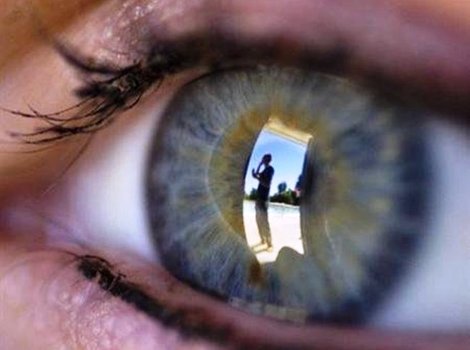
The yogic quest for the birthplace of Vac has also started at the same time (for later discussion). This is a very influential concept in yogic lore – Self/I splitting is the first ever duality. This duality leads to several key phenomena like thoughts, emotions, etc. We also encountered this topic during the Karma Yoga discussion from below. The knowledge that we acquire and store is that boundary between our own self and I. This yogic thought culminated in the development of a long ritual called Aswa-medha yaga (swelling-elimination procedure, to restore it to the original condition). Carefully examine the two eyes of the painting below. Will return to discussion later.
Rishis, as they taught all this, made sure we understand that all the knowledge we are acquiring has to be let go eventually, for a different kind of knowledge – the knowledge of the “Self” itself, the “higher” knowledge. The “lower” knowledge is everything that’s gleaned and interpreted through the senses, and mind (manas). That’s because, our mind is dualistic in nature. How can an implement of dualistic nature be the means to a non-dualistic goal? At best it can be an important rung in the ladder to that higher knowledge.
Krishna tells Arjuna something very intriguing while explaining Karma Yoga, which is also a little counterintuitive – for one who understands Brahman and lives by the (derived guidance) principles, all lower knowledge, including scriptures, including what he himself is teaching, is useless!!
यावानर्थ उदपाने सर्वतः सम्प्लुतोदके।
तावान्सर्वेषु वेदेषु ब्राह्मणस्य विजानतः॥४६॥
Yāvānartha udapāne sarvataḥ samplutodake|
Tāvānsarveṣu vedeṣu brāhmaṇasya vijānataḥ||2.46||
“For someone who knows Brahman, all scriptures (vedas) are of as much use as is that of a well in a place flooded with water from all sides”.
If we all want to achieve the knowledge of Self, the higher knowledge, why does lower knowledge exist? The self is nothing other than brahman. The quick answer, as stated already, is that our senses deeply seek objects of their own interest in the external world.
Guess we will have to eventually throw away all the books we are buying:) This is the irreverence of yogic approach… No-holds-barred! A teacher telling his/her student that what s/he is teaching will eventually be useless, at some point in the future!
This goes back to the earlier neurobiological and knowledge constructs discussion that “beliefs” impose constraints on free kundalini flow and disperse energy….Every thought is a tiny flow of energy. When all thoughts line up towards a single point, energies add-up to create stronger and stronger flow…. Eventually this leads to energy-rush, like a lightening strike. A completely aligned mind generates such lighting strike-like visuals, with eyes closed. Beliefs shunt such energy flow.
In yogic lore, Indra the chief of senses, the mind (manas), is the ruler of such energy flows, and his weapon is “thunder bolt”! Yogis say that appearance of lightening-like floaters in the visual field of the third eye portends (spontaneous) kundalini awakening.
Next, the subject of this higher knowledge is “Self”, or “tat”, which is only explained in terms of what it is not – avyakta (inexplicable), anuhya (unimaginable), achintya (unthinkable), asamkyeya (uncountable), ananta (unending – infinite in every dimension). Use of antonyms or “not that” type of words is a poor way to answer a question, but that’s the only way to describe the “unmanifest” or “infinity”. Uncountable is a fascinating descriptor because it’s only in the late 1800s that this topic was formalized (google Georg Cantor). Georg Cantor made a cogent argument as why for example “real numbers” are uncountable (asankhyeya). For a simple argument, if the real numbers are uncountable, how can “tat” or brahman that contains everything including the real numbers be countable? So, how many Brahmans/U-Is are there per yogis? Uncountable – not one or millions! One makes it finite. Therefore, yogis maintain that what we call god is a great starting point, and on that quest for “god”, aided by contemplation, we will gain all the knowledge of “Self” and associated powers (siddhis).
So, if higher knowledge is all about “Self”, what about “I”?
“I” essentially is a state-of-mind-object”, which stems from the knowledge constructs/memories accumulated over lifetime/s. In that account, our brain is the computing machinery while our intentions/desires move the spotlight onto a specific aspect of “I”. Lets quickly go through some short stories Rishis narrated in an attempt to orient us seekers in the right direction (Eknath Easwaran’s translations: paraphrased).
1. Shvetashwatara Upanishad
Two birds of beautiful plumage, companions inseparable, live on the selfsame tree. One bird eats the fruits of pleasure and pain and the other looks on without eating. Forgetting our true origin (Self), we become ensnared in the world of change and bewail our helplessness But when we see the atman in its full glory, adored by all, we go beyond polarities. …
2. Mundaka Upanishad
Like two golden birds perched on the selfsame tree, intimate friends, the ego and the Self dwell in the same body. The former (ego or I) eats the sweet and sour fruits of the tree of life while the latter (Self) looks on in detachment. As long as we think we are the ego, we feel attached and fall into into the world of polarities. But once we realize that we are the Self, the Force of Life (Prana), we will be freed from sorrow, and transcend the duality of life and enter into a Unitive state. The Prana shines in the hearts of all. Seeing him in all creatures, the wise forge themselves in the service of all. The Atma is their joy, Atma is their rest. Such as they are the lovers of Atma. …
Same story is repeated in Rg Veda (1.164). The analogy is the same. In that account, Self/I splitting is implied as the first ever duality. Below is a very instructive and anthropomorphized version of that (original source: Satapata Brahmana; from Roberto Calasso in the book “Ardor”; paraphrased).
Prajapati, was the first self-conscious being, who was born from the premordial waters; he looked around … Nothing really to “see”, including himself. Two things popped up in his mind. First a desire to look at himself, and second, a doubt of his own existence (or fear of lack thereof). In that existential struggle, one of his eyes swells, falls out of place, flips around and positions itself to look at his own reflection in the other eye, to confirm own existence. The eye that tries to establish that Identity eventually transforms into I. The other eye remains as that peerless stainless “self”. But both these witnessing and curious eyes are within himself. Each one of us also have those two “eyes”. The human struggle is to return that swollen eye back to its original unswollen “self” state – that’s our innate desire. All the rituals, pilgrimages, etc., etc., are designed for that sole purpose. All our meditations and practices also have the same goal… to prune knowledge constructs to reduce that “swelling”…

In the great epic Mahabharata, Bhishma represents this “I”/ego; near impossible to kill, but finally abdicates on it’s own volition…
Apparently, asva-medha yaaga (yajna) is that practice which is aimed at reducing or eliminating that swelling (asva-yat), and restore the eye back to its original state. Interestingly, main plots in both Mahabharata and Ramayana end with protagonists performing asvamedha yaaga…
With time, the “I” changes depending upon which knowledge constructs are added to the memory bank, and which ones are the most active at that time – hence, it’s a “state of mind” object; back to our I-triangle discussion. It is just “temporary knot, a “binding together” of different universal faculties in a particular temporal-spatial point of infinite field of consciousness. These “universal faculties” are nothing more than the subjects of lower knowledge. Here’s Krishna’s description about this lower aspect of “self” to Arjuna (7.4):
भूमिरापोऽनलो वायुः खं मनो बुद्धिरेव च।
अहङ्कार इतीयं मे भिन्ना प्रकृतिरष्टधा॥४॥
Bhūmirāpo’nalo vāyuḥ khaṁ mano buddhireva ca|
Ahaṅkāra itīyaṁ me bhinnā prakṛtiraṣṭadhā||7.4||
“This eightfold Prakṛti of Mine (Self) is divided into ‘earth (bhūmiḥ), water (āpas), fire (analaḥ), air (vāyuḥ), space (kha), mind (manas), intellect (buddhiḥ) and ego (ahaṅkāra).
We can immediately recognize that what we call “I” is a construction using all these ingredients. The list starts with the most gross element, Earth, and ends with the subtlest, the Ego. The mind, intellect and ego exist at the impersonal level too – the universe is fractal in nature. We will circle back to this topic later.
In summary, the core of Self and I is the same – the Self. In a sense, “I” is covered-up version of self, a limited view of the Self. Similarly, the higher knowledge and lower knowledge are not necessarily different, but lower knowledge is a very limited view of the higher knowledge, and Maya is the obscurer.
May we all be blessed with a good understanding of ourselves _/\_/\_/\_
(Bhadram no api vAtaya manah)

 Yogic Thought
Leave a reply to 5. Tenet 4: Experience: The True Result – Yogic Thought Cancel reply