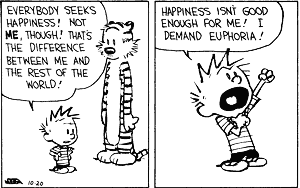
How to be happy? What’s the difference between happiness and euphoria? Is there a drink for that? Btw, Why do we drink? What happens to the brain during “orgasm”? Is it possible to stay in the orgasmic state? What’s the neurological basis for those states?
The Neurobiology of Bliss
We are switching gears here to modern perspectives on meditation, and also looking for some bridges to the old. For this contemplation, we will pick a very interesting topic – bliss, through meditation. After all this is what we all seek, right?
There are some key differences between bliss and pleasure, but we will use them interchangeably for now. This subject of bliss will push us into the deep end of modern perspectives on meditation, but yields some very interesting tidbits when we join them with yogic perspectives.
Going back to the vedic perspective – every ritual (spiritual or otherwise) has a corresponding meditation/mental process, right? So, for example sleeping has a meditation-equivalent; so do learning, chanting, etc.
How about sex? Is there a corresponding meditation? Is there really a eHarmony-free solution here? Per rishis, the answer is a capital “yes!” Basically, the other half (partner) for bliss can be found externally (sex) or internally (meditation) – both can lead to identical results. Humans (and other animals) automatically learn to rely heavily upon the external source.
Bliss, whether it is of the sacred variety or the profane variety, seem to have a lot of neurological similarities. Modern research on meditation is at its infancy, still. The advent of fMRI technique started this revolution, and this happened only about three decades ago. Even with that, we can only go one level deep, i.e., to image the brain while undergoing a specific experience like fear, or a specific meditative state, for example. It is important to note that meditation is not one thing; there are many many recipes… We are using the word meditation as a collective noun here.
From a neural standpoint, if the areas in the brain that light up during peak experience (e.g. orgasm) can be lit up with a meditation, the experience should be the same, right? Yes is apparently the answer, at least from the research so far. There are apparently three areas that drive that kind of bliss – pain, I-awareness, body awareness. The following Scientific American article summarizes the neurological perspective on the peak experience. Here are two key points from this article (between lines).
The Neurobiology of Bliss – Sacred and Profane
https://www.scientificamerican.com/…/the-neurobiology-of-b…/
___________________
Bliss, both sacred and profane, shares the diminution of self-awareness, alterations in bodily perception and decreased sense of pain. Absence of pain is predictably akin to pleasure, but the other two—losing a sense of identity and of bodily limits—are less obvious. I-awareness, apparently, is no picnic.
Pleasure is also linked to a loss of awareness of the boundaries of our body, and this, too, involves both sides of the brain. Orgasm and meditation dissolve the sense of physical boundary, but the activation patterns are distinct. Meditation does so in a somewhat cerebral way, altering bodily I-awareness by enhancing activity in specific brain regions…
_________________________
The similarities end in the brain neurological states, but they are not similar in all the physiological aspects. In meditation, all the action is in the higher chakras, with lower chakras muted (with neck and root locks).
One of the neurological hypothesis for this bliss state is that quiescent systems of the brain break in while the brain is in a hyper-arousal state. Now, from our Yoga practice perspective, think of the “Saubhagya kriya” for example: while we are swinging our arms rhythmically, essentially we are trying to max out on the sympathetic arousal system and push it into a hyper-arousal state as we are also calming the pain centers with breath. As we continue, we expect to enter this target quiescent zone. Sometimes this happens, when the instructor suddenly says stop and take a deep inhale to suspend the breath.
This blissful state sustains only for a few seconds during orgasm in normal humans/animals, and neurologists don’t completely understand what initiates and what ends this process. They even suspect that there is a yet-to-be-confirmed mysterious nerve that drives this; they call it Cranial Nerve Zero and also the Terminal Nerve.
Yogis not only wanted to crack this code, but also wanted to get stuck at the peak, and come back when they want, at their will – not when their unconscious brings them back. Control, control, control – control on all parameters is the key to doing anything right for them. In their typical irreverent style, yogis asked: what’s limiting the duration of this peak experience, how to prolong it, how many times can one experience this, and what’s the downside? More on the specific answers later (blurb #22).
Apparently, as we learn to meditate more seriously, we will climb this bliss intensity-duration ladder. Here’s their bliss scale from Taittariya Upanishad. The unit-of-measure for bliss is this orgasmic pleasure. Not just that, rishis tell us that the pleasure from such meditations can be millions and millions times more potent! This probably explains why in old times, people went away into the mountains to meditate, never to come back!
Here’s Taittariya Upanishad (Anandavalli) with that multi-billion dollar claim (between lines):
__________________
This is the enquiry (mimamsa) concerning bliss.
Suppose a youth, a good youth, learned in the sacred lore, promptest in action, steadiest in heart, strongest in body, — suppose his is all this earth of wealth.
This youth’s peak experience equates to one human bliss (let’s call this H).
100 x Human bliss = Gandharvas’ bliss (100H)
100 x Gandharvas’ bliss = Bliss of the Pitris (forefathers, ancestors) (10,000H)
100 x Pitris’ bliss = Bliss of Ajana-Devas (1,000,000H or 1 million H).
100 x Ajana-Devas’ bliss = Bliss of Karma-Devas (100 million H).
100 x Karma-Devas’ bliss = Bliss of Indra (10 billion H).
100 x Indra’s bliss = Bliss of Brihaspati (1 trillion H).
100 x Brihaspati’s bliss = Bliss of Prajapati (100 trillion H).
100 x Prajapati’s bliss = Bliss of Brahmana (10 Quadrillion H).
________________________
For definitions, brahmana is the one who has transcended the “lower knowledge” and acquired the “higher knowledge”.
So, all of us would love to sign up to become brahmanas, right? Before that, we need to pack a few things apparently, like a good nervous system…. From a science perspective, bliss or pleasure involves electric currents… (yes, pleasure centers can be tickled by electric currents, which can be delivered by drilling electrodes into those brain centers).
Now, how much “bliss” can we handle? That depends upon the capacity of our nervous system. Any electrical current larger than what an individual can handle can lead to disastrous consequences – all the way from epileptic fits to electrical-fire…. Don’t want that, right? Maybe we don’t want to sign up for that just yet. What we need to do is to develop a more expansive nervous system, which means we need to get to some prep work, and that’s what yoga and meditation practice is all about.
We left out a lot of intermediate details here, but the hope is to “churn” the mind enough to trigger own individual research and contemplate…
May we all be blessed with an expansive nervous system _/\_/\_/\_
Happiness and Awareness
Why do we like our drinks, occasional or otherwise? Why do we chose to numb ourselves a little bit? The only other times we chose to numb ourselves is in preparation for definitive physical pain, like for drilling a tooth or for a surgery. Are we under some kind of chronic subconscious psychological pain?
Why do some reports seem to suggest that alcohol actually helps longevity? The less conscious we are, the longer we live? Isn’t that an interesting paradox? After all the work nature put into evolving us into higher conscious beings, we don’t want it? Why did we evolve to gain that? Are we going to lose it through evolution again? Did God give us more than we can handle? That extra awareness seem to get in our way of having fun. Unless we are using that tool incorrectly – are we?
This ties in with the previous segment – the neurobiology of bliss. Here’s the pertinent note from that article (pay extra attention to how they are defining the word self-awareness and the trouble-making aspect of that; self here is not the “self” of yogis; for all practical purposes, self is “I” in this article).
___________________________
Self-awareness exists as a running critique organizing conscious experience. Telling stories to ourselves (often about ourselves) is the cognitive default.
Escaping continual self-observation seems an under-appreciated pleasure. Roy Baumeister wrote an entire book devoted to the premise that self-awareness is frequently a burden. Across cultures, we blunt awareness with alcohol, drugs, auto-hypnotic rituals … Meditation offers relief from this self-preoccupation and one of the few tools for creating a durable boost in happiness—perhaps by dampening activity in regions implicated in judgment, comparison, planning and self-scrutiny.
_____________________________
We can see that I-awareness and happiness seem to be incompatible, and counter each other. Why is I-awareness a burden?
To yogis, when we are not doing anything useful, I-observation is great as long as there is no judgement, scrutiny, etc. included in that; that’s what we call the “witness” mode.
How does meditation help here? Through meditation, what yogis sought is complete inner silence, including muting that “running critique”. This state is called “antar-mouna” or inner-silence. Interestingly, both old and new science seem to agree that this is the euphoric state that we want to be in, all the time. Yogis, of course, want to retain control. Activate self-critique or running critique when they choose – that control is critical.
Yogis’ advice is to handle this tool called mind with extreme care. Use it while performing U-I related business, i.e., something that benefits everyone, and set it aside while not using it. Do not let it weave any complex plots, while ruminating… This is through the use of a mantra. Mind apparently feeds on fantasies and fears.
Here are a few interesting additional tidbits to contemplate on….
1. Mind’s main purpose is to protect our body and identity (I) to its best abilities, over a short time-horizon, at minimal energy cost. Our minds’ purpose is not to keep us happy necessarily or tell us what’s good in long term.
2. Mind not only registers (perceived) problems, but also tries to fix them. A lot of them retrospectively, without permission, which is the most troublesome aspect of mind. It takes us through the wringer as it’s planning all this.
Think of this situation: you are in an interesting argument with your colleagues in a critical project meeting (with people you want to impress also present), and you make an unforced error in the argument, which allowed others to sit you down. This threatens the very identity you established for yourself. The mind-drama begins from that point. Psychologists say that your mind tries to find opportunities in the future to fix and/or justify your earlier argument, sometimes in veiled ways. It is not necessary that your colleagues actually cared, but your mind seeks that. Isn’t that fascinating?
3. Some psychologists claim that we find our spouses that way; we get attracted to mates that have the same issues as our parents!! Mind seeks closure, apparently. (see for example, “Getting the Love You Want” by Harville Hendrix).
How does meditation help?
1. At the highest level, japa (repetitive silent chant) or constant meditation eliminates the “running critique” that troubles us so much. For example, this is the basis for the highly successful method of Transcendental Meditation of Mahesh Yogi. There are several other related techniques. The oldest technique is to take your mind back to your breathing (HumSa): “So” on the inhale, and “Hum” on the exhale, whenever your mind is idling – very simple.
Here’s something Yoga Master Krishna tells our model seeker Arjuna, while describing the manifestations of the Universal Self (10.25):
Among yajnas, (U-)I am the yajna of silent-meditation (japa)….
(yajñānāṁ japa-yajño ’smi)
Why silent repetition? We go through this stage during SaTaNaMa (kirtan) kriya too. Later…
2. Meditation helps us observe what’s bubbling up into the conscious mind. Helps our neutral mind to take several attempts at assessing each situation in a more consistent way. That allows us to truly make conscious decisions.
3. Witness and Negation meditations also seem to deemphasize the I-centers in the brain, to distribute the energy across the brain, possibly eliciting multiple opinions on the subject. Mirror neurons play a critical role here. People who practice empathy and compassion meditations tend to be happier in general, probably for this reason. So, overall awareness goes up, but in a balanced way.
There’s a lot of information on the internet on these topics, but we need to make sure that the definitions for words like awareness, self-awareness are all reconciled. In any case, self-awareness and balanced mind are definitely contemplation-worthy topics. We will pick up on this seed next… the yogic theory of functional mind.
May we all be blessed with a meditative mind_/\_/\_/\_

 Yogic Thought
Leave a reply to 22. Yama #4: Brahmačarya (Sex, Celibacy & Kundalini) – Yogic Thought Cancel reply