...existence was born out of non-existence – Rg Veda 10.72, Rg Veda 10.129
… there are worlds within an atom – Yogavasistha 6.2.56-94
… observation brings forth discrete reality out of quantum unreality – Wheeler
Yes, apparently there are worlds within atoms! Where was this universe at and before the big bang? Probably in a miniscule something, which exploded… But more interestingly, how did the yogis get to this conclusion? Presumably,they didn’t have supercolliders…. Then? We have always said this – yogis had a model. They didn’t wing it. Does this mean that all the ingredients needed to create an universe are in those tiny atomic scale structures? In addition, they thought our sorrows come from us not understanding this model of how things happen and how the universe/ creation works, and how we are a tiny piece of that action. And the five elements play a central role in that model. The Saṁkya description provides the best intuition to this model. Let’s dig a little deeper.
We actually backed into contemplations on some key aspects of elements like Space (memory) and Air (movement), and their relevance to yoga, without actually talking about how they fit into the yogic model of everything. A lot of information is available on the internet about these five elements itself, but unfortunately, some are either incomplete or completely off the mark. As we said before, to think of them as the english translations of the element-names is just a lazy man’s work. For example, the physical water is not the element water (apah). Just like everything else in nature, the physical water is a combination of all five elements. We will cover some additional details that require our contemplation for a complete understanding of this model of yogis. This is a model that aims to offer hypotheses on pretty much everything- tat twam asi, masculine (purusha)-feminine (prakruti) constitution of everything and fractal/holographic nature of reality are at the center of this model. Creation itself is fractal in nature.
It all starts with a pretty powerful hypothesis as the foundation: existence was born out of non-existence (asat-aH sat-ajAyata) – this is a repeat theme in Vedas, and the five elements are a part of this puzzle. So the starting point is an omnipotent potential state of unmanifest or non-existence (asat); yogis say that even the gods are born out of that non-existence, asat. Where did that “potential” in the non-existence come from? The residue from the previous creation cycle. Their models use circular boundary conditions. Otherwise, we have to explain where the previous cycle came from… These “previous” cycles go on forever.
For a comparison, the starting hypothesis in modern physics is that we will eventually get to the underlying building blocks, elements, which cannot be broken down any further, if we blew-up objects into smaller and smaller pieces. Instead, quantum mechanics happened… As we will see, in yogis’ model, thoughts bridge that critical gap, which in quantum physics is observations.
Optional Reading
How can thoughts bridge the gap?
In simple physics terms, things interact when the energies carried by the particles or waves are about at the same magnitudes. For the sake of brevity, that will not be repeated here, but it suffices to say that as we break things up like say, electrons, quarks and photons, their individual energies get divided up. These moieties carrying this information that make up these quarks for example, could possibly get to energies of the same order of magnitude as the thought-carrying moieties, enabling their interaction. We can theoretically estimate what those energy levels are, but that is not required for this contemplation.
The quest is the same, which is to explain everything in front of us, but the questions asked are slightly different. Whether this model is right or wrong, it has a lot of implications to our yoga practices. For yogis, everything is connected, and the life-cycles of all entities are very similar. For example, inner universe and outer universe go through the same creation process thru mutual projection process (tat twam asi)! So…
How do things come into existence, and disappear into oblivion or non-existence? For yogis, procuring raw material is the not starting point but the thought of the concept is the starting point – goes all the way back to the mind stuff, and before. How did that thought actually occur is a part of “everything before”. Same thing after the physical object is destroyed too; have to account for what happens to the thought-ensemble that created the object, and all the memory traces of that object/concept left behind in all other minds. We will see later that the human body/mind also go through the same lifecycle, which is beautifully laid out in Brihadaranyaka upanishad. For yogis, thoughts and memories are important parts of this model, because they influence the future – after all, Karma is all about that. Not that mind stuff is not important in modern thinking, but it’s just that we don’t do any accounting for them. For example, looksie-but-no-touchy is a zero-sum game in modern thought, but not for yogis (see the blurb on Brahmacarya).
So first, what needs an explanation is how something non-existent (asat), unmanifest, turns into manifest, comes into existence (sat). Like a painting – starts as an inspiration, a thought chain, in the artist’s mind. The subtle process of thought generation is the first step in the manifestation process.
Since one is coming from the other, both unmanifest and manifest must be made of the same fundamental stuff. It’s just that the unmanifest is in a potential state, waiting for right conditions to manifest. Like how a rock may be perched on the edge of a cliff for centuries (e.g. Old Man of the Mountain). Rishis called this whole manifest plus the unmanifest the brahman – the whole thing. The macro and micro universes follow the same path. And this brahman is that neither-nor state! Neither unmanifest nor manifest. It can swing either way! Review the About page again.
There’s one more critical principle – there are three domains – bhu, bhuvah, suvah – they refer to prithvi, antariksha and swarga lokas. Same element or element-combination can manifest itself in any of these domains, and proceed from one to the next. For example, in the manifestation cycle, it starts in swarga loka and descend into Prithvi through antariksha. Finally, the element-combinations are woven together by the intertwining forces called Gunas – Satwa, Rajas and Tamas. There is a common notion that Tamas is inferior to Rajas and/or Satwa. No – balance is the important, and magnitudes of all three should come down simultaneously, and eventually zero out, to become guana-atheetha, or beyond-gunas. More on this later.
Equipped with this information, let’s start with the macro universe. There is a lot of metaphysics around it, but for yogis, unmanifest is not inert. Residue from the past cycle is in potential state at this point. Essentially stress builds-up in the quiescent non-existence; it’s the same when we are calm, in a meditative state – that twitch, or a seed of desire to do something… Call it the big bang, loud roar (kranda) in vedas, or a strong urge. That stress results in a super vibration, from which two polar aspects emerge – information (Śiva/masculine; what and how to do) and energy (Śakti/feminine; the means to do it). They are also called as purusha (masculine) and pŗkriti (feminine) in some other sources, such as in Samkhya literature. Those two are not separate, and they always appear together. Information (bits) is the seed, and energy is the means to express or manifest.
Śiva-yeti beejam, Śiva itarayeti sakti hi … – Laghu Rudram (Yajurveda)
Here’s a high level representation of this in a simple picture:
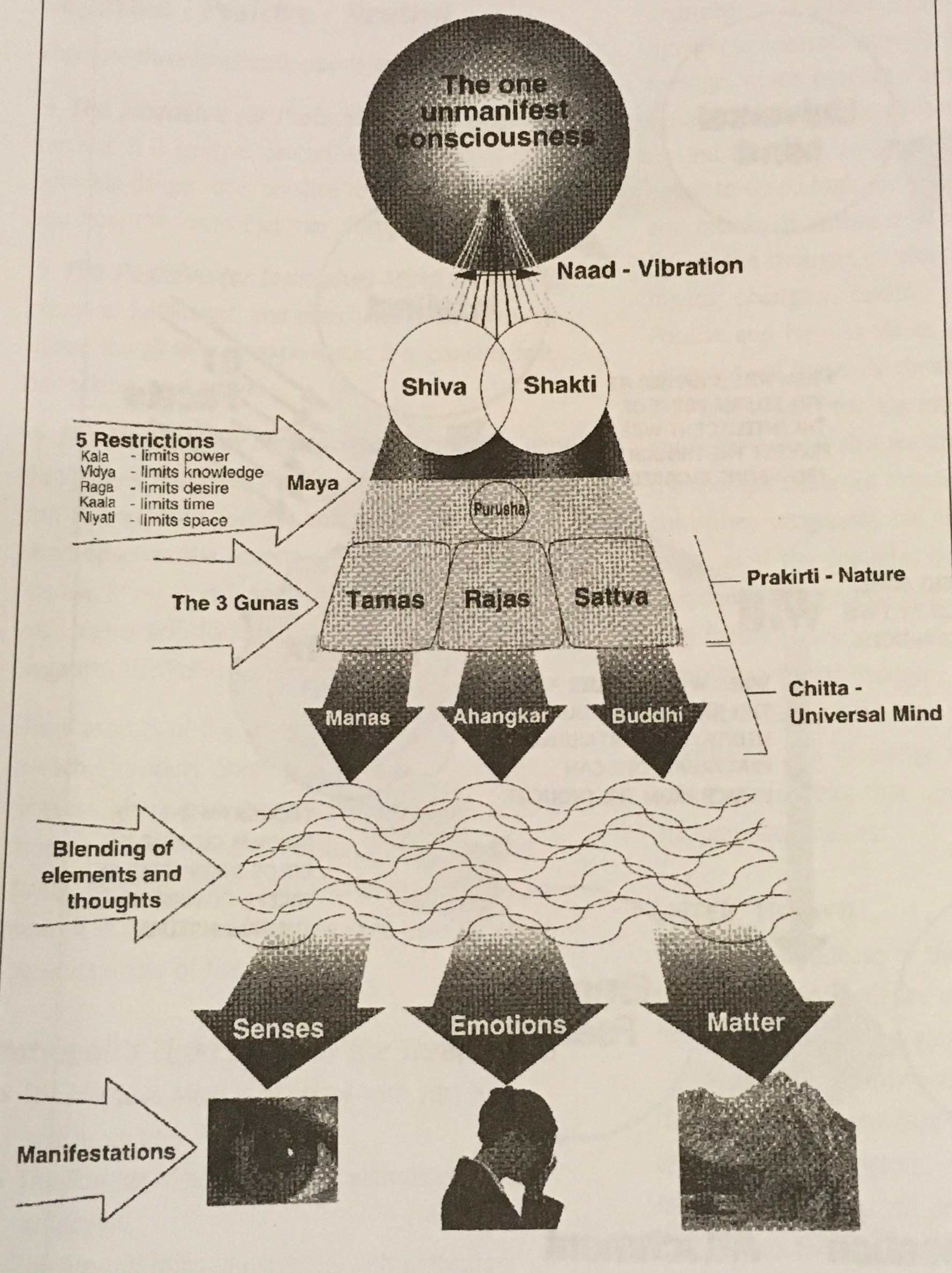
Masculine Śiva and Feminine Śakti interact in multiple ways to create materials to give animate and inanimate beings. In old text, these interactions are sometimes depicted as sexual interactions, leading their depictions on even temples. So, the raw materials fall into two categories, one is anna-supported, the physical, and the second is prana-supported. The five elements makes up the first group, the physical; so, our bodies are made up of these materials. As we all know well, the lineup is:
ākāśa (space) → vāyu (air) → tējas (fire) → āpah (water) → pŗthvi (earth)
Again the translations are for our easy memory only, and do not represent any equivalences. Manifestation cycle is from left to right, i.e., Earth precipitates out of Water, which in turn precipitates out of Fire, etc., and dissolution cycle is from right to left, i.e., Earth dissolves in Water, which in turn dissolves in Fire, etc. Again, it’s all information and energy. So, one way to look at it is that the information chunks get larger from Space to Earth, and more stable, and in dissolution the reverse happens. Note that a large physical object can be viewed as trillions of vibrations strapped together, with >99.9999% empty space! By extension, human bodies too – we are mostly empty!! Somehow, human senses/mind see a solid body! That’s a part of Maya – another important important concept in this yogic model, and we will definitely visit that concept at some point.
One way to think about the evolution of elements is to think of a hot sugar solution cooling down. At the end, when it has cooled down sufficiently, we have solid sugar crystals – that’s like element prthvi. Most stable, most manifested and easily accessible to the awareness of earthlings. Higher elements – we can intuit their presence or, glean their presence from their effects, but can’t directly sense them. For example, the fully pregnant “unmanifest” state is the element āpah, or water (rētas is the reproductive material).
apo me rētasi śritāh (in āpah resides the reproductive seed)
āpo janayathā ca naḥ – Rig Veda 10.9.3 (…bestow upon us progeny)
Progeny in a larger sense, not just physical kids. When dissolution occurs, that dissolved state is often called “cosmic waters”. Death sometime is also called a dissolution process where the body dissolves back to respective elements of the macro.
The third element is Tejas (fire), which is the third element in order. This is by far the most important element for yogis. That is because Tejas (fire) is that inter-converting agent – agni; as long as we have this, we can convert anything we have into anything we want – one form into another. All forms are therefore emerge through Agni. Heat generation (or absorption) or physical fire is only a small byproduct. For example, digestive force (jaThara-agni) is a kind of force in our belly that converts all the stuff we eat into energy. Rg veda starts off and ends with hymns to this Agni. For this reason, and the importance placed on this element, rishis, and all those following this philosophy, including Hindus, are classified as fire-worshipers. Conversion and elevation of thought energies (mental energies) in lower chakras to higher chakras is also a function this element, which is a critical aspect of all yoga practices. Once something is converted into the right form, it is ready to manifest. Since converting to anything means already knowing all forms that can be, Agni is called knower of all forms that can be born, or Jātaveda.
Recapping, the first element Prthvi is in the densest form, most manifest, and is easiest for us to sense. The second element, apah, is the stage before complete manifestation. Fire inter-converts between different forms. The fourth is Vayu, the element that moves things, and in living beings, the very life is dependent upon this element. This element Vayu is responsible all signals, and therefore sensing one form by another form; see Kathopanishad 2.2.10. Finally, akasa, the space element, that’s the entanglement information carrier.
Finally, of all these five elements, apparently ākāśa is the only one that is a continuum, i.e., it has no breaks or gaps. All other four elements are discrete, and means they are dispersed in something else. All the empty space in between is filled with ākāśa. There is a lot written about these five elements, but we will focus on what’s relevant to our practices. As a side note, the following is what Saraswati teaches Lila in our recurrent story:- ‘Of the three kinds of Akasa, namely cidakasa (Akasa of pure consciousness), chitta- kasa (mental Akasa) and Bhutakasa (elemental Akasa), Chittakasa is that intermediate state in which the mind is when it flits from one object to another in the elemental Akaisa of objects. When the hosts of Sarnkalpas in us perish, then the light of chit, which is quiescent and immaculate and manifests itself as the universe, will shine in us. If one becomes convinced of the unreality of visible objects, then, through that Jnana, he will attain chidakasa at once…)” [These three kinds of Akasa correspond to the three halls or bodies referred to in our books, namely the Karana, Suksma (subtle) and Sthula (gross)]
Relevance to Meditation
In the meditation exercises also, what we want to understand, and gain control of, is that thought generation process. That’s what distracts us. and that’s also why we talk about this theory here. We are getting some clues on what it takes to calm down the mind. Buddha noted that we experience the thoughtless state for a second or so only at a time, at the beginning. Then these thoughtless periods grow in duration. So, we are not to get discouraged if a lot of thoughts run through our mind during meditation. Two things: one is that the memory banks are getting emptied; and secondly, we need to focus on the gaps between the thoughts, and not the thoughts themselves. We need to figure out how that stress builds up when we are calm, and how we should manage that urge, to open eyes, twitch, talk… Our natural tendency, left to its own wits, is to be a part of this manifestation process, and get more and more entangled with manifested portion of “tat”. Nature does its things through us… “Be awake” is the yogis’ message!
With that, we will switch back to some modes of these elements that run the body, starting with vata – a mix of Space and Air.
May we all be blessed with a “contemplative” mind_/\_/\_/\_
(bhadram no api vātāya manah)
further reading
- Yoga Vasista, Wisdom Library, https://www.wisdomlib.org/hinduism/book/yoga-vasistha-english
- afsd

 Yogic Thought
.jpg)
Leave a comment