Vātā is the sign of life itself, according to Vasishta! Essentially, without vāta is to be without life. There are two other fundamental forces that play a critical role in running our lives – pitta and kapha – we will get there in the near future. Closely related to Vāta are Mantra and Tantra, which in themselves are huge huge topics in the rishi literature. The root “man” loosely translates into mind and “tan” translates into body, ready to expand both inwards and outwards. The second root “tra” means a method of making, or instrument. So, mantra means the method to make the mind, and tantra means the method to make or expand the body. With that, let’s relate that to what we chanted in our session last week – the ka Ca Ta ta pa chant (or pick a chant). This will take a couple of blurbs, but we will get there…
Vāta – the life enabler
Vāta is the akasa (space)+ vayu (air) force – movement of “information” related to “I” – all about signals. An example is a twitch command that goes from the brain to the target muscle group. Sometimes, the new command interacts with the old command to modify it. All waves, vibrations and pulsations at work. When the brain gets chatty, we are vata-excess, resulting in unnecessary muscle twitches, leg spasms, eye twitching, excessive yapping, etc. The other extreme is not enough vata or no commands flowing out – the state of coma. Partial silence or one-sided silence is basically paralysis or paksha-vata. How to manage this vata? By managing defects in the subtle body. Simple concepts from ayurveda... The actuator of this force must be the mind, because insentient beings cannot voluntarily modify this subtle body.
This vata can be accessed through several channels including meditation, right-thinking, mantra, kriyas, asanas, and food – in the order of subtlety. Mantra is in the middle of that subtlety-range, which is that combination that drives the vata to modify the subtle body. Now, we easily connect the dots from the previous blurbs. It’s not the only mechanism, but it is one of the easily accessible ones. The healer is the sustained vibrations we create through all these modes, like repetition of a mantra. For a quick intuitive grasp of this, let’s take a vibrational (or Fourier) view of ourselves. Here’s a simple schematic that shows how waves/vibrations combine (there’s a lot that you can google); see how a number of underlying vibrations add up to a different shaped vibration.
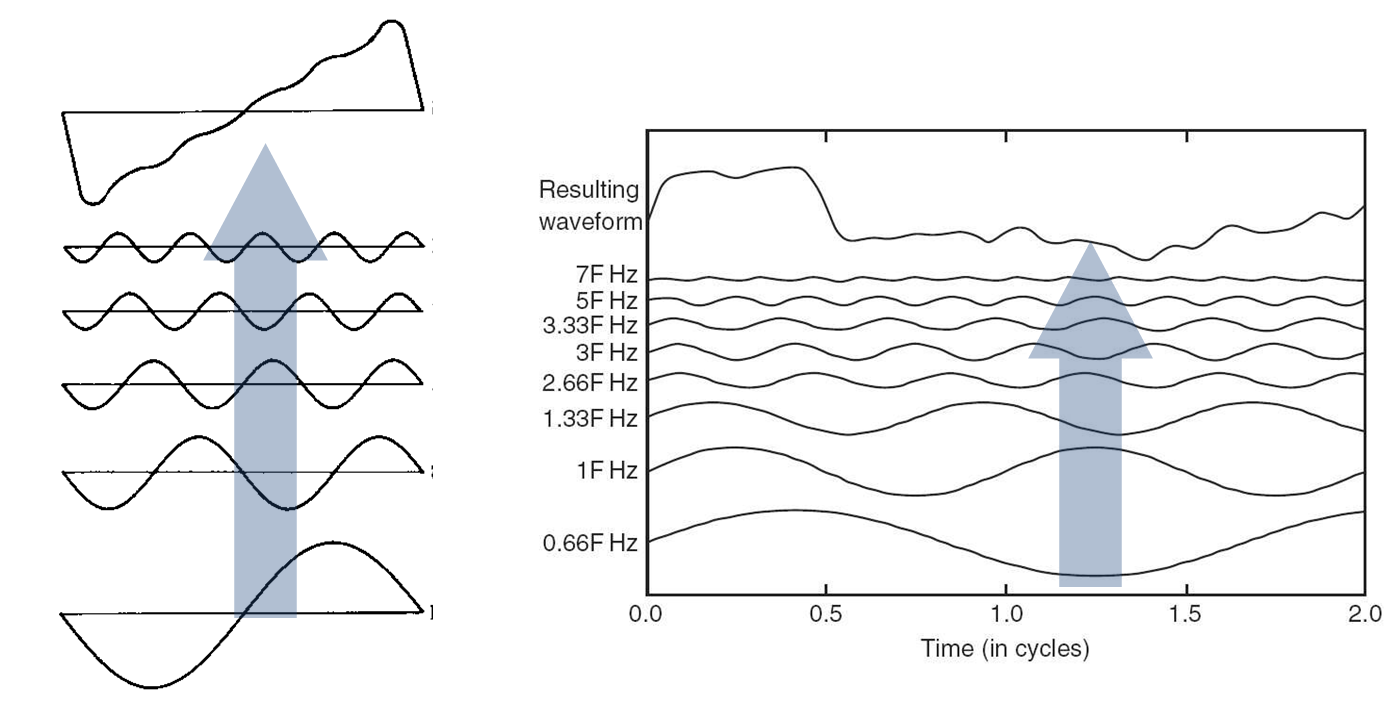
In the these schematics, the top waveform is what we get when we add up all those below that. These are just some simple examples. Trillions of such vibrations add up to make us what we are, individually – the first few add up to fundamental particles, a few of which add up to different atoms, then molecules, then life molecules, etc. The summation of all these trillions of vibrations is dominated by our driving desire – a simple way of interpreting yogis’ hypothesis (you are what you deep driving desire is…remember?).
The reverse is true too – a complex wave form (imposed by breath or a mantra for example) can disperse into individual waves through multiple resonances as that vibrational energy flows through the body. Now go back to “nāsikayor vāyustisthatu” blurb from a while ago. As the breath passes through the nasal passages, it vibrates different parts of our brain, and other parts of the body. As the lungs fill up and empty out, they drive a number of rhythms in our body. Below is the waveform of typical breath, which is the driver of all body clocks:
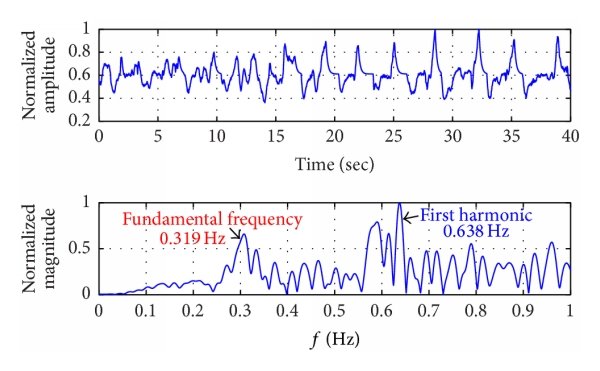
In the diagram above, which is based on the measurements made using continuous wave radar apparatus, you can see the breath pattern in time in the top panel, and converted into frequency in the lower panel. You see the fundamental frequency at 0.319 Hz, which is equivalent to 1 breath every 3.1 seconds or about 18 breaths per minute. Now, where are all those other peaks coming from, especially at the first harmonic? Again, the breath pattern is vibrating other parts at their own resonant frequencies, appearing as vibrations in the spectrum. Now, to get to our main point quickly, examining a typical breath pattern:
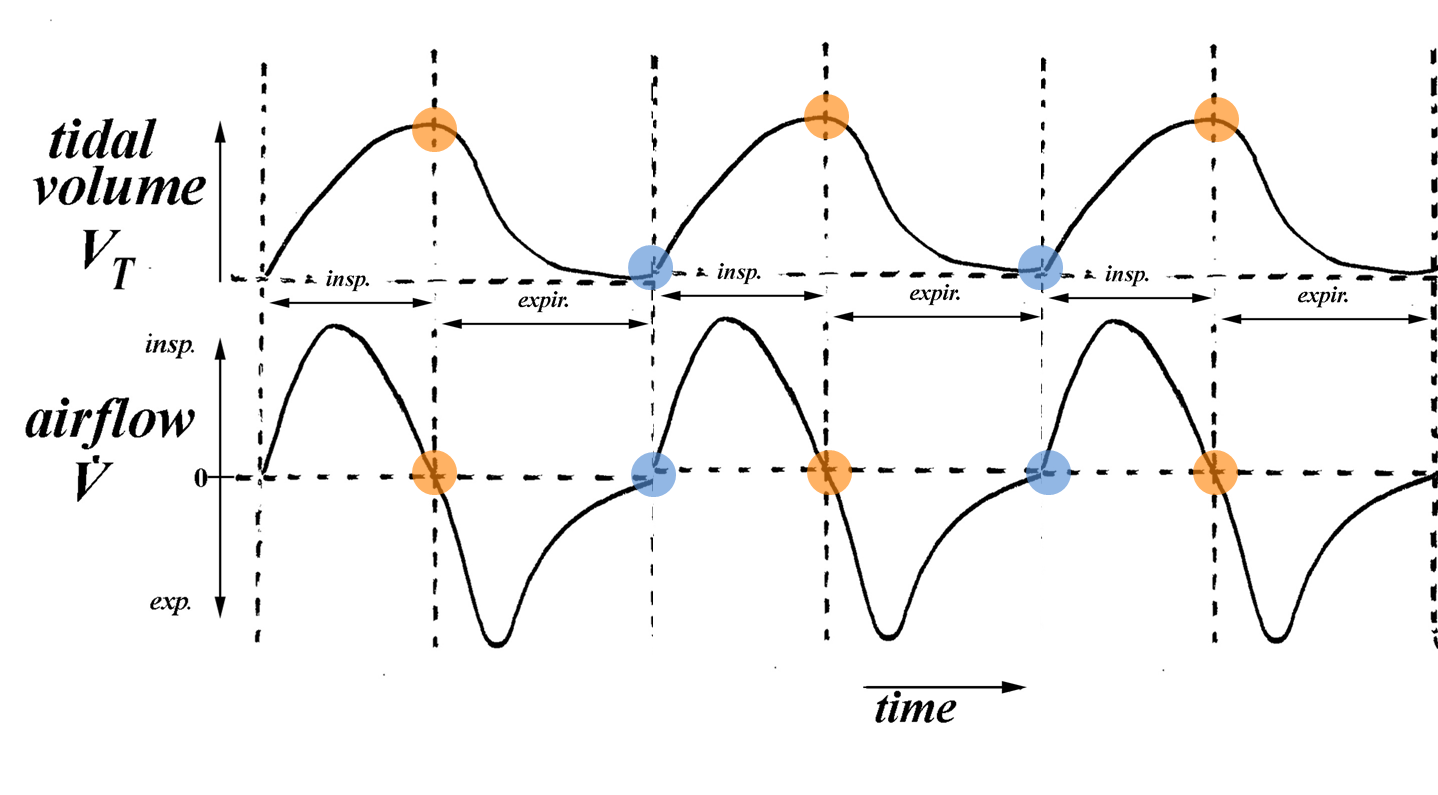
Two things to notice: the bottom curve, which is the flow rate, which we can directly control, and the turn around points from Inhale to Exhale (orange) and Exhale to Inhale (blue). These curves are smooth, but the serrations in the pattern turn into strong thought bubbles and vice versa. Look at the blue blobs, the exhale to inhale turnaround points- notice the sharp transitions. Yogis ask us to control those, and hang around at those “zero” points as long as we can. Euphoric neutral modes we seek reside there. Holding on Inhale is easier, hence beginner practices typically include holding on Inhale only. We will slowly transition to holding on Exhale also.
So it is the thoughts, desires and intentions that maintain the subtle body. It is the driving desire that is at the center of this subtle body, and it is a two-way street. When thoughts slow down, the subtle body begins to calm down, heal itself, and eventually dissolve away – no rebirth if thoughts, desires and intentions completely dissolve away, which is a key ramification of the yogic model. The very desire to exist (raksasa demons of yogic rituals) – to create replicas of ourselves and ensuring their safety – are at the core of most of all sentient creatures.
Vata is that signaling component of the “I” at any given time in Ayurveda, the rishis’ medical science. When vata is compromised like in disorganized “I” or through general weakness, things start to pulse less efficiently than they should – things can either become hyperactive or hypoactive – what we aspire for is a healthy balance. Can mantras cure such maladies? We have to figure it out for ourselves, but the simplified basis for yogic theory is what has been just discussed. Let’s briefly cover some examples as what a mantra is, for tantric yogis.
- AUM: (or OM): This is the most fundamental mantra. Interestingly, this is nothing but the natural sound made while the air starts coming out of the mouth wide open (aaaaa), to uuuu as the mouth is half open to mmm as the mouth closes. So, start with the mouth wide open and slowly close the mouth to the shut position, while continue to push the breath out through the mouth. Aum mantra is automatic! Apparently, that is the first mantra that infants inadvertently and automatically chant as they learn to vocalize…! [footnote 1 below].
- SAUḤ (sau hum): This is the simplest, and it is the sound that our breath makes. There is a long long theory about this mantra (Parātriśikā-laghuvŗtti). Notice that AU syllable, the fourteenth, which is also in AUṂ. The theory is that brahman is fused with this syllable.
- KhPhREṂ: This is a complicated one. How did this mantra show up? It’s not straightforward. Again, a lot of theory behind the sounds. And also there is a lot of debate about whether mantras mean anything, or should they mean anything. Let’s remember that meaning makes our thoughts finite. There are a lot of things that we can’t express in words. We always approximate.
Should mantras mean anything? Kautsa, an ancient grammarian of 5-6 century BC had theorized that they don’t in fact have any meaning as their main purpose is different – setting up vibration patterns, and waking up the god forces. He gave four main reasons: 1. sounds of mantras cannot be changed, unlike words; 2. order of phrases cannot be changed; 3. they are often contradictory and inconsistent, and finally 4. the focus of the oral tradition is to preserve and to transmit pronunciation/sounds and not the meaning.
Finally, as Mark Twain said, the difference between the almost right word and the right word is really a large matter–it’s the difference between the lightning bug and the lightning! One of my favorites. We have to chant these things properly. At a more mundane level, are we really expressing ourselves completely? The gaps between intentions to thoughts, and then thoughts to words are huge! Could we be firing off lightening bugs through our verbal communication? Could that be possible? Nah! 🙂
We will explore how these mantras are transmitted and their significance in the next blurb. That will also take us to the Heart Chakra …
May we all be blessed with control of the breath turnaround points _/\_/\_/\_
FOOTNOTES
- Jakobson (“Why Mama and Papa”) speaks of this tendency: “During the babbling period in the infant’s development, many of the uttered syllables consist of a vocalic sound succeeded by a consonantal articulation. The most natural order of sound production is an opening of the mouth followed by its closure…. You try that and see what sound pattern emerges out of that. It’s Aaaa Uuuu Mmmm.

 Yogic Thought
Leave a reply to 59. Ayurveda, Yoga and Aging – Yogic Thought Cancel reply