Vātadrute naasti ruja – Sushruta Samhita
Without the support of Vāta, there is no pain
[Modify the food intake to lower the vata dosha to control pain].
Unclench your way out of pain!
Yoga nidra is that technique…
One whose mind is not yoked to the body, no afflictions of body can bother them – Yogavasista
[When there is activity is the mind, it generates an “I” object to coordinate all that action. Body clenches in preparation, a significant cause of feeling pain as in “I am in pain”. Unclench, and the pain weakens. Note that this “separating the body and thought” in the sloka has to be temporary, in a safe place, only until the affliction or cause of pain subsides]
If “bliss” is a state of mind, then can we cajole our minds into entering such a state? What happens in the brain in blissful states and at high prāṇā levels (from the previous blurb #51)? Can we scan the brain for some clues? Fortunately yes; EEG. how are pain and sleep related to all this? Again, in the yogic terminology, it’s vāta; all signals and the associated information transport that fall into the realm of vāta.
Long story short: through different stages of sleep, dominant activity in the brain shifts from high to low frequencies. If we can accomplish those shifts voluntarily, we can be blissful while awake, right? What happens to pain, and blood pressure, in such a state?
Remember the instructions during savasana/yoga nidra instructions – the breath pulsation has to reach all corners of the body. This happens only when the body is completely relaxed, without any clenching. With that, we are shifting to longer wavelength, lower frequency pulsations. We are changing how the brain works that way…. A few additional details.
Let’s go back to the more common experience – low prana levels (review previous blurb).
What happens when prana levels are low?
We feel tired, and we feel like recharging.
What choices do we have?
Either sleep or find a way to enhance prana.
What does sleep do to prana levels?
It enhances prana…
How and why?
Shouldn’t it be lowering it, because we are not doing anything, right? If sleep is prana-enhancing, which in turn keeps us blissful, can we sleep forever, to keep us blissful?
Well that’s not possible, we know that, and that’s also a trivial solution. Basically that’s wasting away life.
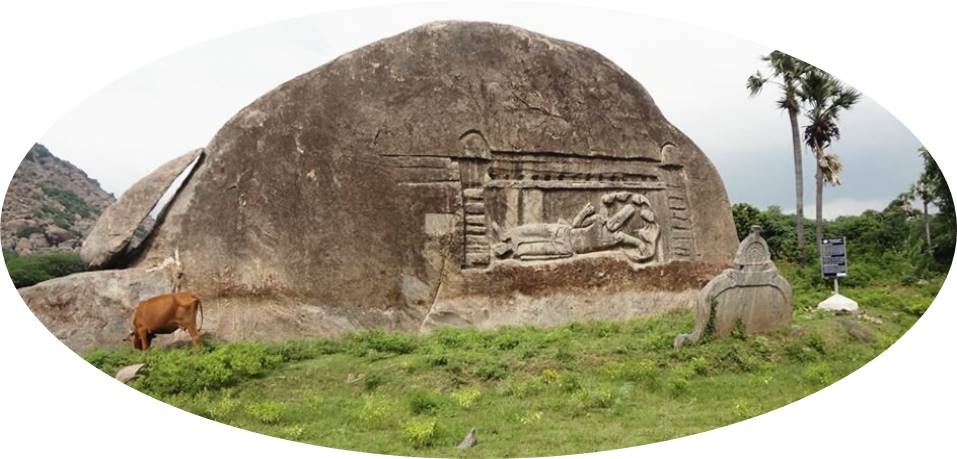
Okay, then can we figure out what’s going on during sleep and do that while awake? Now we are talking… The answer is yes – Karma yoga with interspersed periods of yoga nidra. We are balanced on that edge, between working and resting, working and non-working, wakefulness and sleep – that’s the metaphysics of Vishnu’s reclining posture (sayana-sayi)!
Okay what’s happening during sleep?
The breath, heart rate and brain wave patterns change. Below is a quick summary by Google Gemini:
-
Regular and controlled: Breathing is generally steady and consciously adjustable based on activity levels and other factors.
-
Tidal volume is higher: The amount of air inhaled and exhaled with each breath is greater compared to sleep, according to studies.
-
Slower and shallower: Breathing tends to slow down and become less deep during sleep, particularly in NREM sleep.
-
Irregular and faster in REM: In REM sleep, breathing becomes more erratic and can fluctuate significantly, with a tendency towards faster, shallower breaths.
-
Reduced minute ventilation: The overall amount of air moved in and out of the lungs per minute is reduced compared to wakefulness, according to studies.
What about the brain waves?
Let’s take a quick tour through about that, particularly about the brain scans, and these frequencies. Again, we are summarizing a humongous topic into some simple charts, and short paragraph explanations.
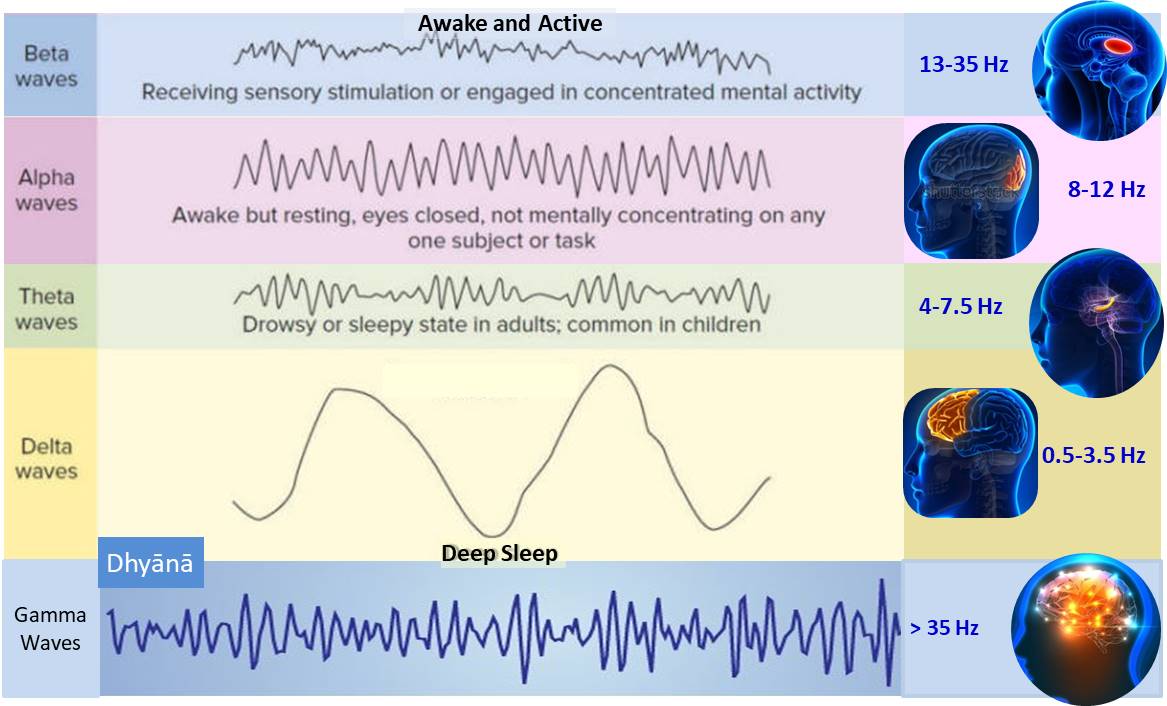
This chart above is the summary. EEG measures the brain wave frequencies below 45 Hz. There’s a lot of detail about this technique, which we will ignore here for brevity, but it’s worth googling and knowing its strengths and limitations. In that table above, the names for these waves are in the left most column – beta, alpha… These components are shown by schematics in the column next to it. In the third column, the right most, we see the brain regions that predominantly generate these waves.
The beta component dominates while awake and active, alpha while awake but not totally engaged with the external world, theta is while in transition to sleep, and finally the most important component, delta while in deep sleep, or non-REM sleep.
1. Beta waves – Awake and Actively engaged with Ambient Environment – Amygdala/thalamus appears to be the epicenter for this activity. Amygdala is the key structure that reacts to even tiniest perception of a threat. So, the connection between Amygdala, emotions and beta waves makes sense.
2. Alpha Waves – Awake, but not engaged completely with the external world – emphasis shifts from scanning the environment for threats, to Occipital lobe which is heavily involved in visual processing.
3. Theta Waves – Sleepy/drowsy state – The activity shifts to hippocampus, which is the seat of the memory organization: associative indexing center for all of our memories! Might be useful to dig deeper into our own stored memories. How deep can we go there?
4. Delta waves – Deep Sleep – The activity shifts to the frontal lobes!!! The very seat of our awareness, the CEO of the conscious brain! Why is the self awareness-part lighting up when “I” is subdued? That is, when we are in deep sleep? What does this tell us?
In the deep sleep, there are no desires, fears, and therefore no I-instantiation either. Means, no observer! Somehow, the body acts as a whole, heals itself and replenishes prana levels where needed. Why can’t the “I-ness” do this for us? After all, “I” desires this too, right? Therein lies yogis’ “quest”.
5. Gamma waves: These are special waves, and we are still learning about them as we speak. Without getting into details, there’s a specific 40 Hz frequency that seem to be critical to pulling information from different parts of the brain together to generate what we call “consciousness”. Our ability to create that scene in front of us… While focusing, this resonant frequency power grows. Meditators not only have higher starting amplitudes, but grow their spectral power during meditation. That probably could mean that they can pull in more details into the scene that normal non-meditators can. So, two people can see the same scene, but a meditator will be able to sense more details than a normal person.
Rishis’ observations related to sleep is pretty much the same as what modern science teaches in terms of awareness phases, except that yogis’ theory goes beyond by hypothesizing an additional half state, which is on the border between wakefulness and sleep. It is that state which makes their approach unique. That neutral state between this and that – the two polarities – between Awake-state and Sleep-state. Let’s quickly summarize what rishis summarize in the short 12-verse Māṇḍūkya Upaniṣad:

The first column is the syllable of the AUM mantra, the second column is the name for the state in the Upanishad, the third column is the awareness state as referred to in modern science, fourth column is the dominant wave component, and finally the fifth column listing what rishis said is the dominant awareness component.
Notice how that three-and-half state template run though their theories. That neutral balanced state is that half state. The ultimate purpose of yoga nidra (yoga sleep) is to enter that half transcendental state. That is also the metaphysics of Vishnu’s sayana-sayi pose; that super-conscious entity is in that half-state while not interacting with Nature (prakṛiti). The feminine Prakriti aspect is shown at the feet, constantly enticing the consciousness for an interaction, through offer of comforts and niceties. [Try closing your eyes and ears – you’ll see the yearning to open them to the outside]. The bed (snake sesha) represents the karmic residue of the creation cycle; notice that the “cosmic snake” is in 3-1/2 cycle form. The masculine Purusha aspect is in contact with all that as in awake state, but is resting like in deep sleep state with no I-ness, with no interaction…

We can go on forever about the metaphysics of this, but let’s talk about a couple of practical aspects of this subject – how we perceive the world and the feeling (and alleviation) of pain.
World dream – maya
These philosophers all along yogis have asked a very important question – what happens to the parts of the brain that generate dreams while we are awake? Hmm!! Apparently, they are very much there, doing everything they were doing while we were asleep. Meaning we are also dreaming while awake…! Actually, these philosophers had argued that we are not awake at all!
This has significant implications to what we call realty, and the yogis hypothesized this as a critical aspect of what they called maya. If we are continuing to dream while awake also, the only difference between dreams and realty is that when awake, the sensory inputs like what you see, hear, etc. are overlaid on top of that dream background! Fascinating. What we call realty is a superposition of sensory inputs onto a background dream that your mind is creating – nothing purely objective about it at all. In this sense the world as we call it is already a superposition – a subjective dream background overlaid with objective sensory inputs. This has been revisited in modern science only 20th century, with the venerable William Dement of REM-fame leading the charge. As recent as in 1950s, scientists thought that sleeping is to turns off the brains. We learned that that’s not the case at all!
Yogis coaching – be awake (as much as you can). Okay you want to me more awake? Take deeper breaths, since shallow breathing is a characteristic of dream or sleep states…
Yoga Nidra and Pain
Pain is an important topic for everyone in our daily lives, right? Look at the opioid addiction crisis. If you ask doctors, they will tell you that the root cause of pain can’t be traced to any physical aspect. Because the source is in the mind-field, and we process the pain signals.
Now, in deep sleep, we don’t have any fears, desires, etc., but do we feel pain in deep sleep? Of course, we may not be able to fall asleep with excruciating pain, but once we fall asleep, we don’t feel it, unless our unconscious decides that our “I” is in danger, right? Note that these are all just electro/chemical messages at that point. Our Intellect has to somehow make these decisions. But through some magic of nature, we do. These circuits are pre-printed into our mental makeup.
Why does taking attention away makes pain disappear, even while awake? Like dropping a hammer on our foot to not feel the headache (for a few seconds at least)? Back to “do we feel pain in deep sleep?” question. If we can make “I-ness” disappear, do I still feel pain, or can we make pain disappear that way? Yogis’ answer would be a resounding yes, and some of our own personal experiences with savasana/ yoga nidra support this observation; but if you haven’t experienced this personally, please try it. Take some simple scenarios – like a mild headache. When you feel the pain, just lie down and go through the yoga nidra instructions (several exist on the web). Practice that for a minimum of 15-20 minutes. We can quickly observe that we did not feel the pain as long as the body is in that perfect savasana/unclenched state. In this unclenched state, theta/delta or lower frequency waves show up, mind integrates over longer and longer ranges, we feel blissful, and all that stuff… What does “clenching” got to do with I-ness and pain sensation, and by extension thoughts, since pain is after all a thought wave? They are the same! We will revisit this…
My fellow-seekers, simple focused tugging on our daily observations is all we need to gain valuable insights into some of these phenomena. No need of any sophisticated external instrumentation to tell us what’s going on within us, at least at a hypothesis level. Then we can go and test on ourselves! In small bits… In modern corporate lingo, this is called the method of “5-whys”. That’s also the yogic method it appears, except that they don’t stop at five…_/\_
bhadram no api vataya manah_/\_/\_/\_
May we all be blessed with a “questioning and learning” mind_/\_

 Yogic Thought
Leave a comment