Be yourself!
(What? How do I do that? What does that really mean?
Only if I know who “I” am – right?)
Wanna be in control of a situation?
(Control your memory recollection process…
Select the right memories, and ignore strong one-time past experiences where necessary)
Who else have I been all this time? When am I not myself, and why? How to be myself?
Unless we understand what “you” or “I” really means, this could imply a lot of simplistic things, right? When someone says “be yourself“, are you to just act out your impulses at that moment. Is that what “be yourself” really means? What if you had to regret after “being yourself”? (never happens, right? lol) How to live by this popular phrase?
Now, let’s think about “be yourself” the other way – when I say “be yourself, John Doe”, what am I asking John Doe to do? Do I have an expectation of what I want John Doe to do? What criteria are we using to say that John Doe is acting like John Doe or acting like someone else?
All this sets the table for I-contemplation – know thyself – from another angle, and motivates us to map it out in a little more detail.
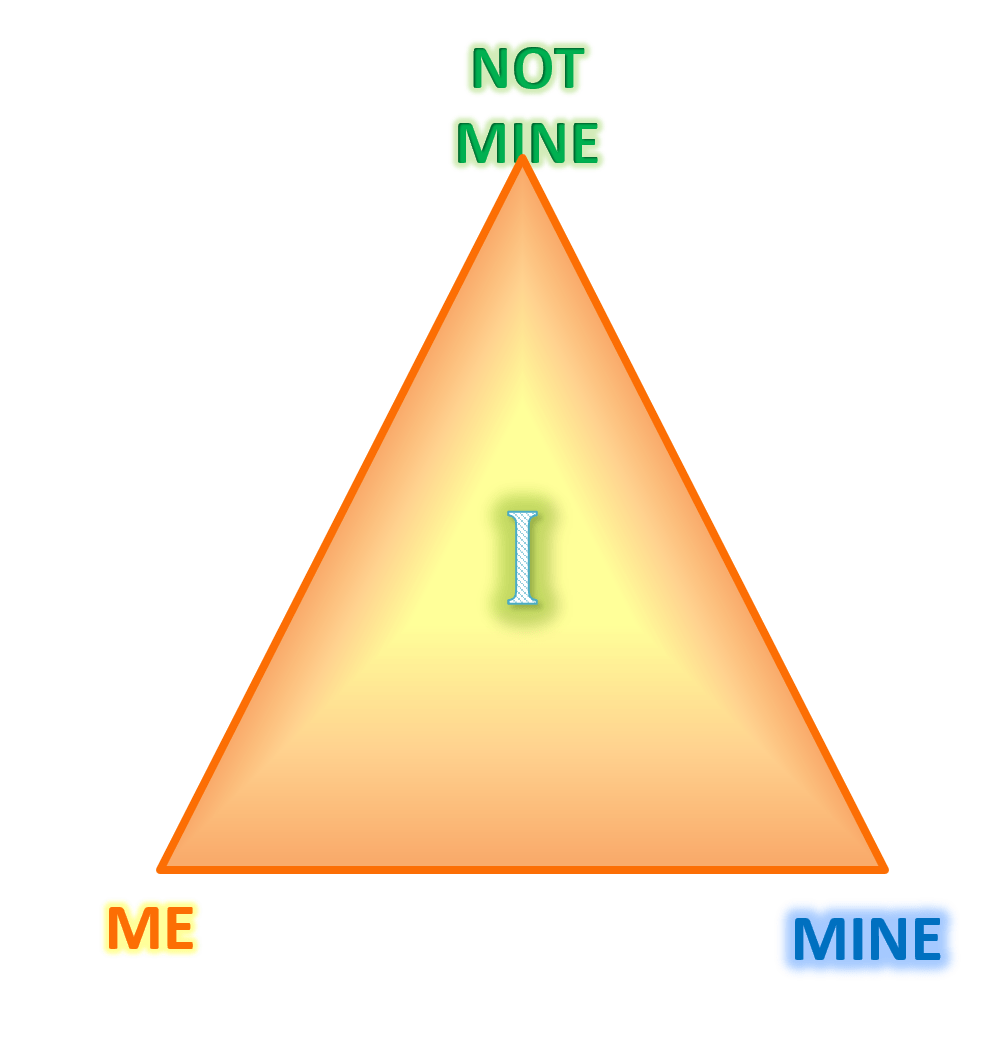
In a nutshell, there are two key aspects to I: memory (including moral beliefs) and expectations. It’s very interesting to read case studies of patients with certain memory-related conditions, including Alzheimer’s and dementia… We will talk about memory in a bit, but it suffices to say – without memory, “I” gets really really faint and even disappear. Morals depend upon abstraction from our knowledge base – both acquired and inherited. And morals need to be memorized too, and therefore let’s classify those as memories in the larger sense of the word (more in line with John Locke’s empiricist theory). The last one, expectations depend upon the environment. Be yourself in a pub could be different from be yourself in a gym, right? Circles back to Me-Mine-NotMine (Environment) triangle – the fundamental of “I”.
Let’s review that fundamental triangle one more time –
Me: Desires/Intentions – “You are what your deepest driving desire is” – Brihadaranyaka IV.4.5.
Mine: Brain-body – the computational machinery, including the nervous system that synthesizes and binds all the information into single mind construct.
Not Mine (Universe): Memories – universe, as it exists are memories, beliefs and such knowledge constructs within ourselves. The environment elicits/brings up past recordings of itself from storage (memory) to set the stage. Note that yogis define memories (see here) in a much broader sense than us.

That is the fundamental I-object generating equation or function. A specific desire in me (desire to exist being the basic), depending upon the context I am in, i.e. the stage I am on (like being at home, vs. at office, vs. at school, etc.), accesses a capability of mine to satisfy that desire. This instantiates an I-object to coordinate the action plan. The stronger the desire, the stronger the emotion (based on memory), the stronger the I-object, generating a stronger memory. This object created to coordinate the action plan to achieve my goal is what we call I at that instance. Evolutionary theories suggest that this I-like object instantiation had evolved to coordinate our movement. Note that not everything is under conscious control, neither is the I-generation process. Hence at the beginner level, it’s important to control what surroundings you put yourself in. If it is toxic, avoid those surroundings.
Less sexy and mystical than we all expect, and a little anti-climactic to the whole “who am I” quest, isn’t it? “I” is not one fixed thing. But therein lies yogis’ twist – the memories and seeds of desires lie printed deep in the difficult-to-access part of our memories. Hence the yoga practices, to access them. If you access them, and gain control, i can be better at “being myself”.
Let’s now revisit be yourself – basically we are asking to play out the reaction of that I-object to achieve that desire. So desires, or the feeling of a lack (fears) are at the root! How about if we don’t have any desires or fears, at least in spurts? Are we being ourselves in those moments? Remember our motto – Contemplate Our Way to Self-Realization (whatever that is)!!
Let’s dive a little deeper on I, but the above paragraph is the summary.
I as a Class of Objects
We will take a quick technical diversion. We just said I should be viewed more as an object. You can google for more information, but our minds tend to think of the external world as bunch of objects, with attributes. The popular Object Oriented Programming (OOP) has its origins in that model apparently. For example, when we see a fellow human being, our minds immediately seek attribute information like name, height, relationship, nationality, etc. Object oriented thinking is popular in other areas as well, but since we started talking about I-object, let’s summarize some key thoughts using that framework.
I-class, which takes in all sorts of information from the three corners of the triangle as inputs and pass them onto embedded functions within to generate the I-object for that moment. This class is massively inherited, with its I-generating operators and functions heavily overloaded, and are deceptively polymorphic in behavior. That is probably the best way to describe the I-generator class. All three characteristics – inheritance, overloading, and polymorphism – are key enabling features of object oriented programming and algorithms as well.
Without getting into actual coding (😀), let’s just describe each adjective used for this class.
Inheritance – Obvious right? The I-class inherits the starting information from parents, who in turn inherited that information from grandparents thru genes, and modified it until conception, and so on, and hence heavily inherited. Note that parents modified that information, but the original information is still available to grandkids as well. This chain continues. Yogis insist that we have imprints from the beginning of evolution, if not time, an inference that Neurologists now agree with (see the I of the Vortex reference below). Fascinating convergence.
Overloading: Basically this characteristic means that the operators and methods in I-class can function with different types of information, and even with limited amount of information. For example, not all information, and/or with distorted information, from all senses are required for I-generation. For example, if your eyes see a slithering thread-like object, an I-object is generated immediately to get you out of perceived trouble, even though that maybe a piece of long thread being moved by gentle breeze. Your mind won’t wait for any sort of other information. Also some operators like is, bigger or equal to are overloaded, implying how the I-object interprets depends upon the context, and information available.
Polymorphic: Meaning I-generator behaves differently depending upon the environment from which it is called. Highly context specific. Notice here that polymorphism is highly environment dependent. For example, the function “Escape” does not completely make sense until we know the environment. I-object behavior can’t be the same in a war zone and in a mall. This is called late binding in technical terms; the functional aspect get locked in only after the full scope of the functional call is defined. Functional polymorphism is critical to our survival.
OOP analogies to our brain is all over the internet; some references included at the bottom. Essentially, instantaneous I-objects can be generated in multiple ways, and there’s not a single defined pathway – what we tend characterize as “consistent”. That’s why humans (and animals) are rarely consistent in their behaviors. Only time we all tend to behave similarly is when our survival is threatened; the unconscious takes over.
I as a Memory Quilt
To be more precise, I is a tapestry of (accumulated) memories… Once an I-object is created, it is memorized, however weak and strong that memory is. Stronger the emotion and repetition, stronger the memory. Now, you put together all the “I” objects you had ever created, and assembled a collage – we have what I call “myself” or “I” with a name. That’s what mind does. This “I” gets stronger and more intricate with age, as long as there are no issues with memory. So, I is a collection of instantaneous I objects – that is what we call I or self. That’s why when someone asks, who are you, it sounds a little confusing, and deep, and “be yourself” sounds so mystical and special. It is because that you is not one thing, but a collection of things from the past, present and what you want to be in the future. Recollecting all that information and summarizing in a short time is a difficult task.
What happens when under anesthesia, or deep sleep? Absolutely no I-object generation at the conscious level to coordinate any memory recollections of any sensory inputs. Also, in reverse, if we can control memory recollection process and make it a voluntary process, we can gain a significant control on that I-generation process, and in turn control our responses to situations. We feel helpless in situations because the memory recollection is automatic, meaning our responses are automatic. The memory that has the strongest emotion associated with it wins out the unconscious process and dominates the I-generation. Critical aspect – worth contemplating upon…
Bonus question – what happens when we are drunk? What happens to memory recollection? Gets shallower, right? And as a result I gets weak! Is that what we are looking for while drunk? How much do we really like to be ourselves? Because we seem to drink (and feel good) not to be ourselves? We are happier when I is weaker?
Let’s now revisit be yourself – from before, it means to play out reaction of the (recollected memory of) that I-objects. That object is nothing more than a result of the strongest desire at that time, the emotions elicited by the environment, and the capabilities that you developed that may be able to support that need. The capabilities and moral beliefs depend upon and the environment you were repeatedly exposed to, and the memory of those I object instantiations. Nothing more.
I as an Abstraction
“I will not lie” – a moral – where is that coming from?
Morals and ethics emanate out of the complex social and personal interactions and expectations of reward hierarchies. Only an “awake” person can think beyond the innate desires and these reward equations That’s why yogis’ goal is not ethics, not morals, not personal rewards, but being awake to control the situation. When we are fully “awake”, those other things line up. If we are not there yet, they ask us to keep “common good” as the guide. Striving for the common good will get us everything else. That approach balances all these complex equations to position us just right, including a balanced development of I.
Now enter the “conscious” aspect of humans – that “strong desire” vibrating at the core can be altered to provide the most benefit to the world, which is the “Not Mine” corner. That is the whole premise of yajna. Yoga gives us, rather enriches our “Mine” corner, with tools required.
I (personality) Development
Memories of these I-objects created over past gives us the sense of what we feel as I. When we experience or act on a stages that recurs, we reproduce the same or similar I-objects repeatedly, and that repetition produces that outline of a persistent personality – a reflection of the memory with the external world as the mirror.
Finally, going back to the Reincarnation blurbs (#47), a strong desire already exists at the core of us at birth, and is preprinted. When that preprinted strong instinct repeatedly expresses itself in a particular set of surroundings provided by the parents (caregivers), the I-objects produced repeat themselves, giving each of us a starting point for a personality. This is our personality at birth. This process continues; the environmental exposure modifies the personality, until the I-memory become strong. From that point on, the changes in personality slow down, but still happens albeit at a slower rate. Basically, we learn to be ourselves more, and changing less.
For an example, consider someone with a strong appetite for taking risk – the thrill-seekers. If that person is born in a military-family, vs. a family of dacoits, which is a popular movie theme, you would have a brave, decorated military officer in the first case, and a Robinhood in the second case. Our perception of their personalities could be radically different, but at the core, they are the same, with same driving risk-seeking personality. (see further readings). There are some interesting experiments and stories involving twins along these lines. We can also run through several examples to understand the implications of that I-equation above.
So the bottom line is that: I is a class of objects rather than a single object. Who’s John Doe depends upon where John Doe is at time, and his surroundings. Any deficiencies in the I-memory recollection mechanism will lead to milder or duller I. All these matter while trying to “be yourself”.
Finally, how strong should I be for us to be happy? Be your own judge. We all think kids are happier, and moderately inebriated people also seem to be happy. In that case, do we really need a strong sense of I to be happy? Meditation offers a way to moderate that strength of I generated, and give you the controls. Something to think about.
As stated in the previous reincarnation blurbs, behind this flimsy I is the “Me” corner that takes on bodies after bodies to satisfy its desires! It is all the ingredients that make up the three corners of the triangle that’s eternal, which can’t be destroyed by any weapon, brahman of rishis. Let’s lock into that Me corner and tune it… Enter yoga and meditation _/\_
I as Object of Meditation
Finally, something practical… We have listed this in blurb#53 already, but let’s repeat that:
A few times in a day, whenever the environment you are in different, close your eyes and pay attention to the series of actions you are about to take. Assess how strongly you feel like undertaking those actions. Assess what if you don’t do them, or even do the opposite? Finally assess the strength of the I-object instantiated at that time. Continue this meditation until you develop an intuition for the I-object instantiation process, and how that morphs during the day/week/month. Journaling is highly recommended if you are attempting resolve any issue.
May we all be blessed with the knowledge of ourselves_/\_/\_/\_
Further Readings
-
Chapter 13. Sense of Self among Persons with Advanced Dementia https://www.ncbi.nlm.nih.gov/books/NBK552152/
-
In this article, memories are defined in a conscious level, narrower sense: otherwise, no contradiction. https://www.scientificamerican.com/article/morals-not-memories-define-who-we-are/
-
Wisdom of Psychopaths: What Saints, Spies, and Serial Killers Can Teach Us About Success by Kevin Dutton
-
“I of the Vortex” by Rodolfo R. Llinas

 Yogic Thought
Leave a comment