ॐ sa̠hasra̍śīrṣā̠ puru̍ṣaḥ । sa̠ha̠srā̠kṣaḥ sa̠hasra̍pāt ।
sa bhūmi̍ṃ vi̠śvatō̍ vṛ̠tvā । atya̍tiṣṭhaddaśāṅgu̠lam ।।
The puruṣa (Universal Subjective or Consciousness) has infinite heads, infinite eyes and infinite feet (sa̠hasra̍ here signifies innumerable), “He” (the universal being) seeds the creation from all sides, and extends beyond the ten directions (as represented by the ten fingers). [Rig Veda 10.90]
nama-śśivāyēti bījam । śivatarāyēti śaktiḥ । mahādēvāyēti kīlakam…
śiva is the seed, while anything other-than-the-seed part is shakti…
[Laghunyasam]
Purusha is the specificity in everything
It is the purusha component that makes any two things look different from each other, two apples, two trees, two mountain peaks, even identical twins…
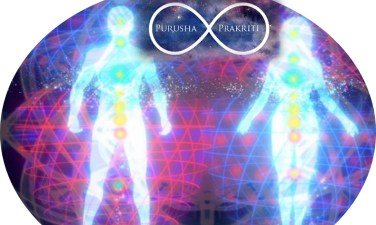
So, the yogic vision for life is derived from this vision for the whole – which is the brahman. This neutral brahman splits into a masculine aspect and a feminine aspect for creation to start and sustain. They are masculine subjective, Puruṣa, and feminine objective, Prakṛti.
Let’s start with Puruṣa (ṣ as in sha), the subjective aspect of brahman – that is the total consciousness. (Consciousness of yogis, which is capable of generating and experiencing any and all interactions, and not just the cognition or what we call conscious experience).
Another clue to understand Brahman and Purusha comes from Bhagavad Gita-
रसोऽहमप्सु कौन्तेय प्रभास्मि शशिसूर्ययोः
I (aham) am (asmi) the taste (rasaḥ) in water (apsu), the radiance (prabhā) in the moon (śaśi) (and) the sun –sūrya– (sūryayoḥ) – BG 7-8.
This is part of a sloka from Bhagawad Gita – let’s take “taste in the element water (apas; not the physical water). According to the theory of elements, taste is the characteristic of the element water or the apas. Krishna is saying that I am the taste in the element water. The prakruti element water and contains this purusha element that-specific taste-that-can-be-tasted. Purusha is that which gives that specificity, that specific taste; that purusha is Krishna in this verse.
Universal or total subjective consciousness is an important part of the yogis’ model of everything and this universal vision. This subjective attribute is infinite in every extent, just like the brahman. This subjective consciousness, Puruṣa, seeds everything in this universe and beyond. The complementary objective aspect of brahman is prakṛti. We have gone through the famous opening couplet quoted above while discussing Kundalini Awakening (blurb #30), albeit with a different emphasis. And in the last blurb, we contemplated on the total – the brahman. We will continue on with the subjective, masculine aspect (Purusa) of brahman here.
First, a little about the meaning of the word Puruṣa – it has a later more colloquial meaning of “man” (masculine), with woman as its complementary aspect (with Pumsa being another formal word for male). The same word purusha has the impersonal or the higher meaning of “subjective aspect of brahman“, with nature or prakruti as its complementary aspect. Confusion between these two meanings of purusha has been responsible for several misinterpretations and exploitations of these texts. Even now, for example, when we hear the name Viṣṇu or Siva, we think of a man… That attribute obviously is incorrect, at least in the context of the yogic model.
Satapata Brahmana tells us that puruṣa has several meanings depending upon the context, but the most intriguing meaning is derived from its two roots – pur as in past, and uṣ as in “burnt down – the residue from everything past burnt down is Puruṣa! If you burn down everything, what’s left behind? The information residue (reference [1]). That subjective “entanglement or that specificity information” aspect is that residue apparently – as in, it makes each entity feel that subjectiveness – hence, the it is subjective aspect of brahman. In shiva/sakti literature, this residue is called vā̠stupa. In these models, this information-residue is the starting point for the next creation cycle. And prakruti is the objective part of that brahman. Next creation cycle is nothing but the reincarnation of the current universe. What happens at the macro happens at the micro, and vice versa (tat twam asi principle). Hope all this is helping to connect the dots of this model.
So, just like brahman, individually each one of us have a subjective component and an objective component, the ingredients for creating anything new – as in the mahā̠vakya – aham brahmā̠smi. I am that brahman! Now, add up all the “subjective” parts of all creatures, we have the universal person back. Nothing mystical or magical here. Straightforward addition. Of course, this addition is not a simple linear addition; slightly more complicated.
group consciousness
A very important concept. In rishi-literature, it is referred to as gramya or a village consciousness, where a collection of sentient beings (with individual purusha components) come together to generate this collective consciousness, as if that conscious behaviour is coming from a separate sentient being. This group behaviour or consciousness is very different from just adding up individual behaviors or consciousness in a simple way. They add up in weird ways, with a completely different emphases emerging, and routinely leading to different types of mob mentality.
“In individuals, insanity is rare; but in groups, parties, nations and epochs”
Friedrich Nietzsche
A very similar but a more complex expression of this behaviour comes from invading viruses. Take rabies virus for an example. Once the virus reaches certain population level in the body, it apparently dominates the individual host (human or the host animal) behaviour. Most interestingly, once the virus descends into the salivary glands, they signal to the patient’s mind to constrict the saliva flow into the stomach, where the virus can get diluted and/or even killed. By constricting the flow into the stomach, the visus-laden saliva flows predominantly into the mouth. Not only that, the patient develops hydrophobia, which further prevents the saliva from getting diluted. Apparently the purpose of this preservation of virus-laden saliva is for the patient to bite a healthy being, and transmit! Again, this is a very effective strategy while talking about animals that predominantly use mouth during attacks, including rabies-induced attacks. Now, this is not the behaviour of a single virus, but obviously a viral group behaviour. Somehow, when the viral load goes beyond some number, the group communication becomes efficient enough that a completely different behaviour emerges, and that ends up overwhelming the patient. Just another example.
Now, if the virus is in our cells, in our physical envelope, is it a part of frontal “I” or not? Our immune system fortunately treats the virus as an invader… Now take the opposite case, where our own mind thinks of our own cells as foreign (as in rheumatoid arthritis) – what’s that all about? How does this mind-body disconnect occur?
Going back to the viral modification of our “I”, how does this viral group behaviour emerge? After all, virus is just some RNA or DNA with a protein coat! How do they know how to change our behaviour to a point where we become afraid of water? They apparently release messenger molecules to signal to each other, analogous to pheromones. We do the similar things to band together…, but in addition we use language also. Of course they use our cells and communication mechanisms, but alteration in our behavior to suit their need is the intriguing part. An example for group behavior, or gramya state of consciousness in yogic literature.
Now to the famous Rig Veda sukta, a hymn to the universal subjective or the consciousness…
puruṣasūktam
With that background, let us go through the concepts described in this famous hymn (Rg veda, 10.90); it basically describes the separation of the whole into individual entities, i.e. the reverse process of aggregation.
At the core, this suktam suggests yogis subscription to a form of pan-psychism: that is, every entity in space-time is “conscious” or aware, in its own way, at it’s own level. Stuff does not appear suddenly. Note that when we say humans are conscious, not everyone is at the same consciousness level too, however we measure that. The features that entity expresses depends upon how that island of purusha emerges from its underlying “bits”.
In this sūktam 10.90 of Rig Veda: we have to think in terms of how an infinitely large, integrated chunk of subjective/consciousness breaks down into islands of consciousness; and when everything is added back up, how it adds back up to the whole, with an additional karmic (action) residue. Say a horse is created, it means that horse-consciousness has emerged as a separable and stable chunk of that whole, with a suitable body (of objective prakruti) married to it. Humans may possess that and more, as the brahman contains features of all creatures… A slightly different thinking. The details of this de-aggregation sequence is less important at this point, but that consciousness-based critical thinking is the more important part of this suktam.
A summarized version of the critical aspects below, but literal translations are all over the web.
From Virat (brahman, the base) –> Subjective Consciousness (purusha) arises; from that –> space (earth and parochial Consciousness), and time (past, present and future) emerge… (space first)
Then:
From Purusha (thru yajna) –> Devas (and asuras) –> Sadhayas, Seers (rsis), –> animal (survival) instincts, air-creatures, land-creatures, then forest and organized-village consciousness (sum of dwellers’ consciousness of a village/group)…
From that Yajna (with everything above as oblation) –> Rg, Saman, Yajus metres (notice how information forms metres, which are at the center of living creatures)
From Metres–> horses, animals with single and dual rows of teeth –> Cattle –> Goats/sheep…
Within Human (as in the universal person) –> brahmana capability emerges from the head/face; (that is the capability of abstraction, conceptualization and comprehension); kshatriya capability from hands (developing protective and self-improvement capabilities; kshatra); –> Vaisya capability from thighs (bartering of products of the skills from the first two traits, and also the motivation of self profit) –> Śūdra capability from the feet (the execution skills; by this point, thinking, skill development, decision making are all complete).
Add the word “consciousness” or awareness to each entity described above. For example, animal is to be understood as animal consciousness. Because we are talking about how the infinite purusha consciousness is breaking down into islands of individual consciousness. Also include into the contemplation how we become “conscious” of something, for example how a magnet becomes conscious of another magnetic object, without any physical contact necessarily?
Notice the emergence of metres – or rhythms of prosody, and vedic mantras of rig, yajus and sama… Points to yogis’ emphasis on vibrational/mantric nature (frequency domain thinking) of the universe and everything contained within, and outside. Materials accrete around vibrations to manifest into physical entities.
In the opening verse at the beginning, it even teaches that the earth and universe are pervaded by fluctuations (sa bhumim viswato vrittwa – vritti is a fluctuation). This is also the opening mantra of Patanjali’s yoga sutra – yoga chittra vritti nirodah – yoga is the practice of subduing of fluctuations arising in the consciousness, which leads to experiencing the Universal. Hope all this is connecting and leading to the model that yogis are trying to paint for us.
One can see the concept, but unfortunately the last piece of capability development is also considered the grounding principle behind the conception and perpetration of the caste system. The way it is (mis)interpreted is – purusha at the start of the text is interpreted as “male god”, with each human competency (brahmana, kshatriya, etc) as a class of people (and not a characteristic defined by a consciousness aggregate, enabling a capability), while totally ignoring the “fractal” or tat twam asi (thou art that) aspect of their theories. This limited and confused interpretation of this sukta has destroyed these mind-bending yogic theories ultimately, and sent these models into a long hibernation or even into oblivion. The structure of human consciousness is the same as that of purusha, which contains the subjective aspect of all gods, devils, goblins, atheists, animals, and everything else we can think off. Without this footnote, contemplation of this sukta would not be complete_/\_
Reversing this process of disintegration is the reintegration into the whole (see blurb 43) – yajna is that process, and Aswamedha is the ultimate and the final yajna in one’s journey. In both great epics of yogis, Mahabharata and Ramayana, the protagonists (Pandavas and Rama respectively) end their earthen journeys by performing Aswamedha yajna successfully- the final frontier in the merging or the self reintegration process.
Again, the purpose of these contemplations is to understand the larger framework for yoga practices – not to judge whether they are right or wrong necessarily – as yogis only ask us to examine every bit that we think of and experience. That path alone can take us to the ultimate prize- no other path. The studio yoga practices are only a piece of the puzzle, albeit an important piece. With that,
भद्रं नो अपि वातय मनः
(bhadraṃ no api vātaya manaḥ)
May we all be blessed with a vibrant mind_/\_/\_/\_
further reading
- Nobody Knows Where A Black Hole’s Information Goes (https://www.forbes.com/sites/startswithabang/2017/01/24/nobody-knows-where-a-black-holes-information-goes/amp/)

 Yogic Thought
Leave a reply to Death: The Last Teacher – Yogic Thought Cancel reply