My (as in Brahman) womb is the “mahat” brahman (or Prakruti), and I (as in purusha) seed that womb to create all beings (both animate and inanimate).
[That way] prakruti is like the mother for all beings while purusha is like the father…
Gita 14.3-4
[In Gita, yogishwara Krishna is depicted as both Brahman and the masculine purusha.]
Just like modern physicists, rishis were obsessed with knowing what things are made of, and how things emerge, dissolve away. The bottom line is that everything born or created has a mother [feminine] and a father [masculine]. Every entity in existence has both, including each one of us, and the seat we are sitting on. Don’t see it?
Before we get into that, let’s look at the bottomline first. The main message of this blurb is that tri-gunas (the three entwining agents of nature) run our daily lives, and orient us in uncontrollable ways. Everything we see is made by intertwining the elements in different proportions, by the three gunas, with the subjective component purusha giving individuality (i.e., specificity) to each. To gain control over these agents of nature, the first thing to do is to stop judging! Discourage our minds to make unwarranted measurements; even for self-critiquing purposes. Don’t look back into history and rehash anything you have done, or someone else has done. Not easy, but everything will start to fall in line after that. A little more now…
So, Prakruti is the Cosmic Substance, while Purusha is the Cosmic Consciousness or animator (“consciousness in larger yogic sense)- the objective and subjective causes. Everything we sense, feel or imagine have both this subjective seed part, and an objective carrier part, and they manifest together. They are primal complementary polarities. There’s no one without the other. Any part of the unmanifest, when it splits, it splits into two – the masculine purusha and the feminine prakruti. They are like magnetic north and south poles. Just like how magnetic monopoles do not exist individually, purusha alone or prakruti alone does not exist. It’s a packaged deal.
If you are familiar with the great Indian epic, Ramayana:
Sita, godess Lakshmi-incarnate, is kidnapped by this demon named Rāvana. The question is, why didn’t Sīta kill Rāvana by herself?
After all, she is Shakti!! She (as well as Draupadī in Mahabharata) emerged out of a yajna! Therein lies the subtlety of their model. We incorrectly look at them as females. They are not females – they are the feminine or prakruti aspect of the brahman, providing the means to accomplish activities. Prakriti by herself is without any specific direction, i.e., it is not directed specifically towards a thing or anyone. That direction or specificity aspect comes from purusa. The masculine aspect, which we have already talked about in the previous blurb. When that directivity is combined with that energy, things can be accomplished. The story is the same within each one of us…
Prakruti, or the cosmic substance/primal nature, has many aspects, but here we will emphasize mainly two important components: the purusha-carriers (pañca-mahā-bhūtas, the five great elements), and agents that entwine these elements (gunas). Consult any treatise on Samkhya-karika texts available on the web for details, but our goal here is only to highlight what’s required for a high level understanding of the yogic model.
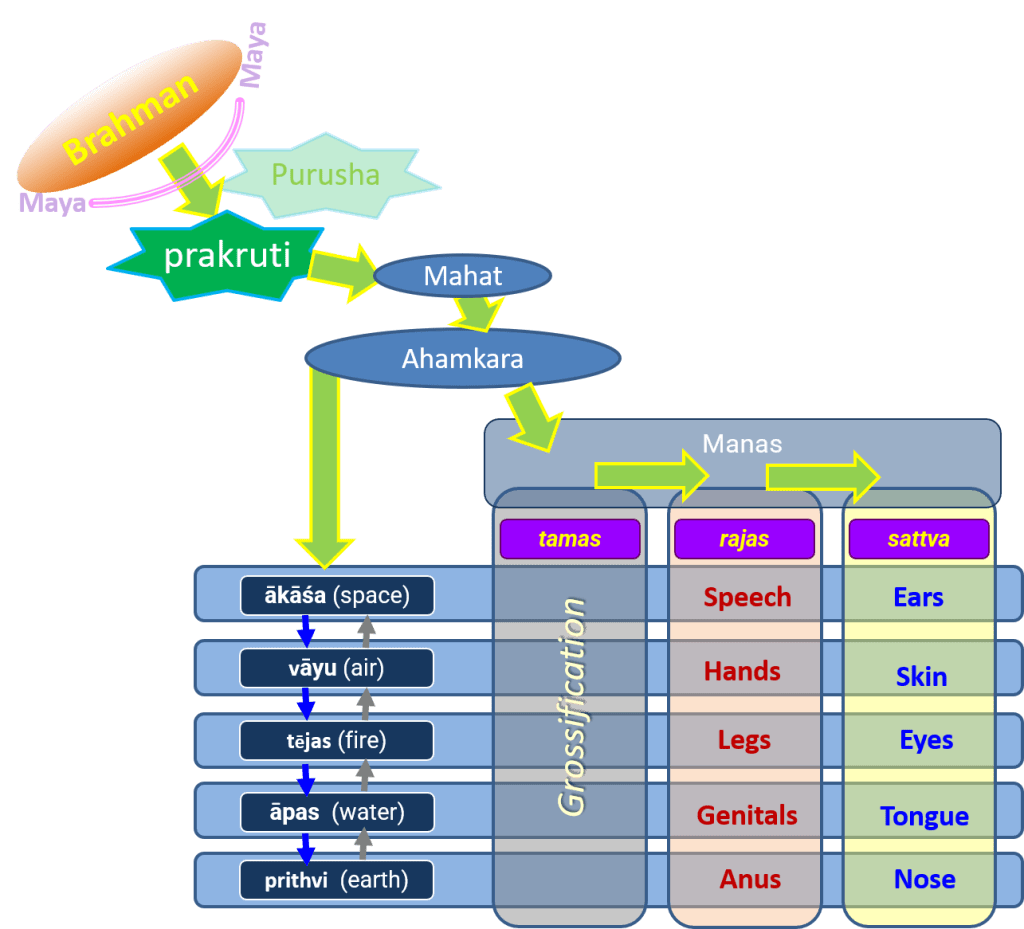
So, the two components of prakruti are like – the inanimate (empty) data structures, which are the elemental bhuta monads, and the methods by which the elements interact and manifest, which are the gunas – tamas, rajas and sattwa. Let’s look at this simple schematic.
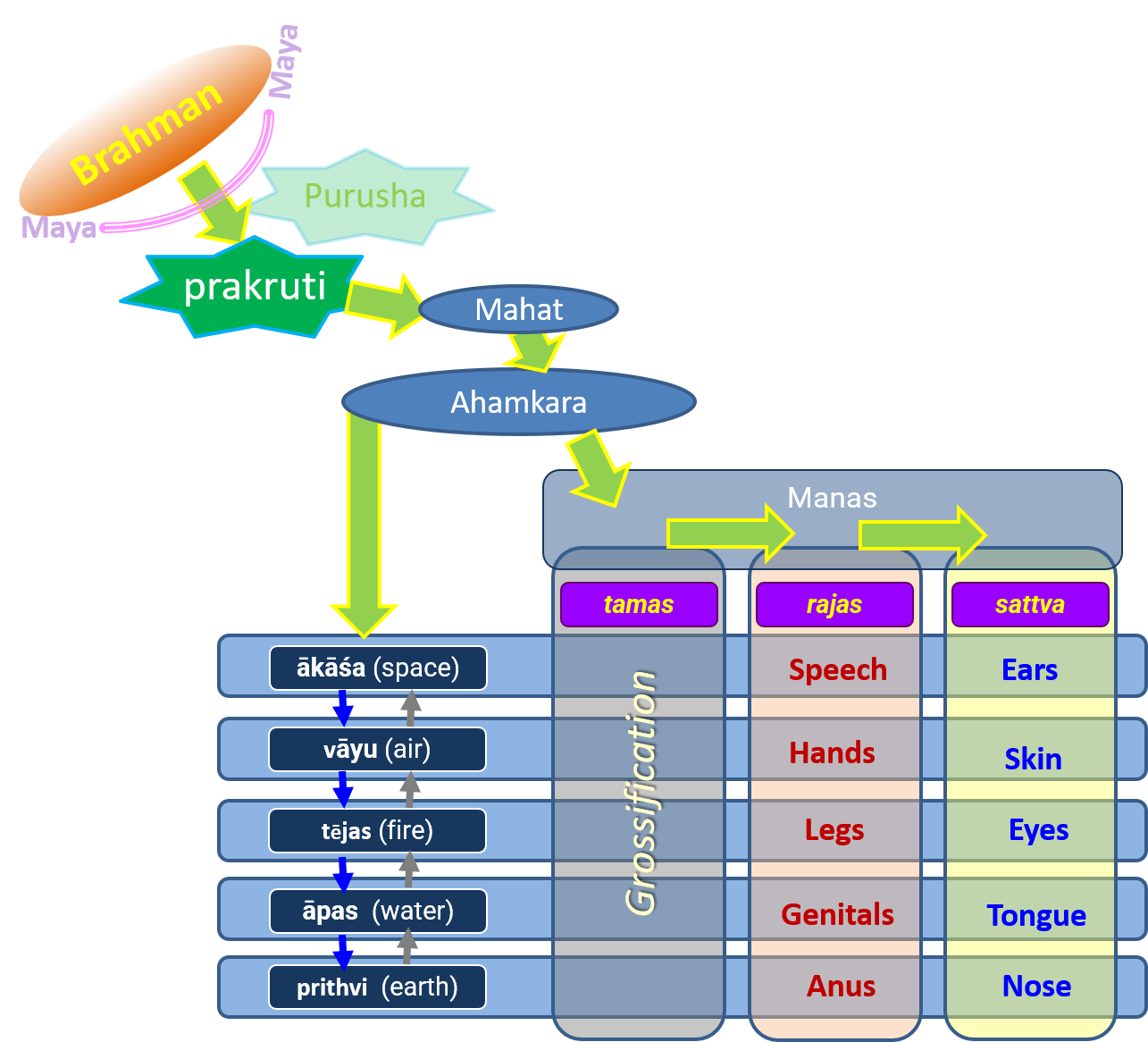
The schematic above is a condensed version of yogis’s theory of everything (see the reference for Samkhyakarika below for more details). The most important thing to notice here is that everything is that brahman. Everything is manifested through Purusha-prakruti interaction (Pr and Pk from here on). The arrows are to show loose relationships in terms of the manifestation order. In the case of five elements, they precipitate out of the one before, and will dissolve back time to time. To summarize these additional concepts, from the Pr_Pk interaction, pure universal (impersonal) intelligence emerges first – Mahat. This universal intelligence is something that modern scientists conceptualize as well; self-organization as fractal patterns is an example of such intelligence. Without this Intelligence, nothing changes, hence the driving force for evolution. This Intelligence evolves into I-ness (universal-I) – Ahamkara. From this, a group of sixteen (16) principles emerge – five of which are the great elements. This further evolves into (universal) mind, Manas, with all its sensory information-processing, ahamkara-protecting, and knowledge-generating characteristics. Now one can see why the knowledge can help us rise through the lower rungs, but need to be discarded once the individual mind reaches the awareness level of the universal-mind. The tamas vertical provides the objects for the sensory and action instruments, the sattwa and rajas and verticals respectively.
Suffices to say that Mahat, Ahamkara and Manas are called the internal organs, which work in the past, present and future, while the ten external organs shown in the schematic above function in the present only.
Note that the english translations of the elements do not represent the true meanings. For example prithvi, translated as earth; if you picked up a fist full of dirt, it actually contains all five elements. We have already covered these aspect of elements in a previous blurb, so we will only summarize it here, and quickly turn our attention to the gunas. What we call elements are essences of what we see with our senses as elements. Having noted that, we will summarize the elemental-essences in the reverse order; will start with Prithvi (#5). Even though the translated words like earth prithvi is easier, we should switch to the original word to minimize any confusion. With that:
1. prithvi
Prithvi element is most manifested, meaning most feminine of all elements as feminine seeks to manifest while the masculine seeks to sublimate [recall the triangle orientations in Srichakra]. Everything manifested, yes even water, has dominant prithvi element in it. Otherwise, it will be in the dissolved apas state.
2. Āpas
This is a very interesting and a comprehensive element, and Varuna is the ruler, an aditya, although āpas itself is a Vasu, just like all other elements. Āpas holds everything in a dissolved potential state, until something materializes it. Think of the mythology of pralaya and Noah’s ark – everything is drawn into a dissolved state. Water there is not this physical water, but the cosmic water, as in āpas. Also, recall the example from the blurb #46; consider a painting that you will draw tomorrow. Where’s it today? … in a potential state, dissolved in āpas.
Interestingly, in describing the fire altar set-up, in Taittariya Samhita (4.3), the rishis while talking about developing and strengthening the subtle body of the yajna performer to hold the internal fire lit, instruct placing various meters – gayathri, tristhub, Jagati, anusthubh and Pangkti – in waters. This is clear evidence to their thinking on the five elements – meters (chhandas) underlie everything manifested.
3. Tejas
This is probably the most important element as far as yogis’ model is concerned, because the element fire is responsible for interconversion. Easiest example is to convert thoughts into action. Tejas is a Vasu, and hence resides in all, while Agni is the ruling deity. Tejas and Agni are used interchangeably, and this is very common.
4. Vayu
We have been talking about various aspects vayu in the last twenty blurbs, and will not go into any more detail than to say that it is all about signal transduction. It’s job is to communicate and move information or akasa around.
5. Akasha
This element is what makes this theory differentiate itself from other theories of that time. This is the continuous medium with no gaps. Interesting that a need for such was realized even at that time. In modern physics, we can define space up to what’s called Plank length, and it is 1.6×10⁻³⁵ m. Shorter than that, we do not really know. Space as we know ceases to exist in an orderly manner at length scale, and we enter the bizzaro world of quantum science. In the yogis’ model, we could ask if they needed akasa needs to be continuous beyond Plank length scale – don’t know. But it is interesting that their meditations took them to that level of detail.
From Ramayana…
At the end of Ramayana – Rama and Sita, the protagonist couple, determine to end their earthen journeys. Rama walks of into a river, a body of water, and Sita gets absorbed into mother earth. Interestingly, Sita is also born from mother earth.
Now, contemplate using the elemental definitions of water and earth from above, and the masculine and feminine aspects… Water-consciousness, earth – form. Any connections there. These stories are a lot more than some vague historical connections. They integrated whole theories into them.
Gunas
The “guna” theory is very straightforward – there are three contributing aspects of everything – intrinsic drive to move (rajas), a counterbalancing inhibitory force (tamas), and a measuring or judging component, based on acquired or preprinted knowledge constructs (sattwa). These three qualities bind things into what they appear. Without these binding aspects, the building blocks fall apart. From Samkhyakarika:
triguṇam-aviveki viṣayaḥ sāmānyam-acetanaṃ prasava-dharmi |
vyaktaṃ tathā pradhānaṃ tat-viparitaḥ tathā ca pumān ||
The manifest is constituted of three gunas (aspects or qualities), non-distinguishable, objective, common, non-intelligent and prolific; so is the primordial nature. And masculine (puman/purusha) is its opposite or complementary aspect.
[Note that the manifest is an aspect of prakruti or primordial nature, and not the same]
Examples
Here’s an oversimplified example – imagine sitting in a chair, and wanting to grab a drink of cold water from your fridge. The motivation to get up from the chair and move towards kitchen is due to the rajas-guna; the inertia to think I will get that drink when I get up next and stay where I am is due to tamas-guna; and finally measuring where I am and calculating the progress made on the activity, and judging whether I am moving towards kitchen or not is the contribution of the sattwa–guna.
Consider a chemical reaction- the activation energy is what keeps things changing one to the other (tamas) Finally when sufficient energy is acquired, the reaction takes off (rajas). As it moves forward, it checks itself against new equilibrium, which is dependent upon the environment (not mine corner) – Sattwa. All three show up together in nature (prakruti).
This is the same everywhere. Our brains are doing the same thing even to create a thought. Should I (rajas), or not (tamas), and judging the state (sattwa). These three gunas with our senses and mind create 81 different personality traits, or behavior-variants (for our later elaboration and contemplation).
The universe did the same at the time of big bang, according to Taittiriya and Satapata brahmanas of Yajur Veda. Prajapati (the universal person) was there, and tamas was first born keeping him from doing anything. The potential built up to a point where it broke through tamas and the activity of creation began: rajas. Then finally Sattwa was borne. Hence, in the schematic above, the arrows point from Tamas –> Rajas –> Sattwa.
In reverse, in order to achieve a calm state of mind, the Sattwa or the judging has to be subdued first, meaning stop measuring and judging if you want to stop mental activity, which in turn will allow tamas to bring your mind to rest. It’s the judgement of a lack that drives our actions (Rajas).
Contemplation
We can go on, but with this background, now contemplate on Krishna’s coaching to Arjuna by the following verse:
“All actions are performed completely by the guṇas of Prakṛti; one who is deluded and bewildered by own ego thinks: ‘I am the doer’” – Gita 3.27
Decode what is you, what is the non-conscious material part, and what is making you individually choose and undertake actions? Yoga master is saying it’s all the actions are because of gunas of prakruti acting through you, and has nothing to do with you!
May we all be blessed with a vibrant mind_/\_/\_/\_
भद्रं नो अपि वातय मनः
(bhadraṃ no api vātaya manaḥ)
Further readings
Samkhya-karika: https://estudantedavedanta.net/Samkhya-Karika.pdf

 Yogic Thought
Leave a reply to 56. Yogic Vision for Life, and Realty – the Brahman – Yogic Thought Cancel reply