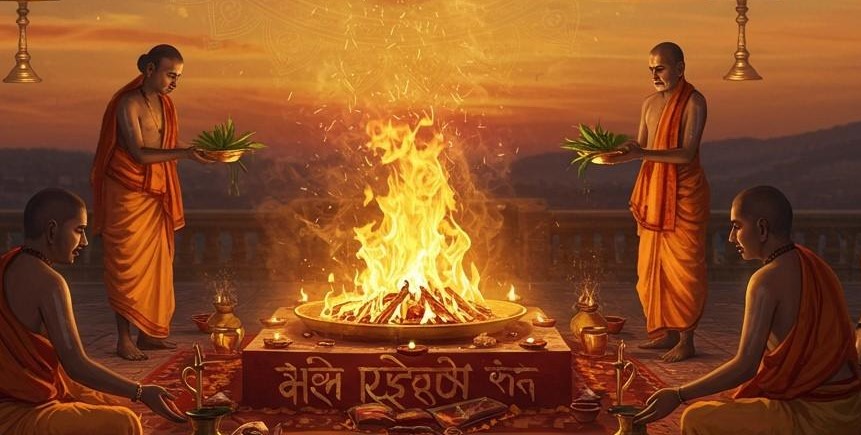
So, how many fires are there? The famous Rig veda starts and ends with a sukta for Agni! In a nutshell, since change is the nature of this universe, Agni is everywhere, in infinite forms, depending upon what needs to be converted from what to what. For example, you want to dissolve away the past karmic residues? Doesn’t matter what it is. You want to convert what you have to what you need – seek fire element‘s help. Again, we just need to do our part in invoking this element within us…
Review yogis’ Theory of Everything before delving into this post (post #46).
jaTare agnisthishtatu
agni is seated in the digestive organ – Laghu Nyasam
tadyatrainamado manthanti| tajjātamabhiprāṇiti prāṇo vā agnirjātamevainametatsantaṃ janayati
They produce that (fire) by churning, then he (the practitioner) breathes (blows) upon it, when produced; for fire indeed is breath (Satapata Brahmana 2.2.2.15)
te vā ete prāṇā eva yadagnayaḥ |
prāṇodānāvevāhavanīyaśca gārhapatyaśca |
vyāno ‘nvāhāryapacanaḥ |
Assuredly, the (internal yajnic) fires are those prana (pulsations driven by breaths): the Ahavaniya and Garhapatya are the inhale (prāna) and the upward breaths (udāna), respectively; and the Anvaharya-pacana (Dakshinagni) is the expansive-breathing. (vyāna). (Satapata Brahmana, 2.2.2.18)
Prajāpati alone, indeed, existed here in the beginning. He considered, ‘How may I be reproduced?’ He toiled and performed acts of penance. He generated Agni from his mouth (Satapata Brahmana 2.2.4.1)
atha ainaṃ devāḥ antarātman ādadha ta ta imam amṛtam antarātma …
The gods then established that (fire) in their innermost soul... (Satapata Brahmana 2.2.2.14)
The whole world swallowed up, hidden in darkness, was made manifest when Agni was born…
How many fires are there, how many suns, how many dawns, how many waters? I address you, oh forefathers (Pitṛs), not as a challenge, I ask you, sages, in order to know (the truth).
(Rg Veda 10.88.2 and 10.88.18)
With that, we are switching our focus to the third of the five elements in the yogic theory of everything, tejas, and cover the yogic thoughts on that element and the force (deity) that governs it next., Agni. Fire deity Agni seeds the third element, prakruti– Tejas.
Agni is the masculine principle while the Tejas is the feminine principle, and together they are responsible for interconversion. As an example of a routine interconversion process, think of how our bodies generate energy, from the food we consume and the air (oxygen) we breathe. Every cell has this built-in mechanism to convert these components into food-air complex, called ATP. That cell component is mitochondria, but the force that does the conversion is a form of agni in vedic terms. It’s in our stomach as the digestive organ (jaTara), it’s in our mind propelling thoughts, in our mouth as speech, in the saliva initiating the digestion process … Another example is converting thought energy into actions. To do this, this inter-conversion agent must know all things, since this agent is converting one into the other. Without knowing the to and from thingies, how can the agent convert? Therefore, the element agni is also called Jatavedas – or the knower of all things.
In summary, it’s ubiquitous! So much so that the vedic adepts (rishis), without any embarrassment, wondered how many (type of) fires there are… Because it’s everywhere! There would be nothing without Agni – it is the agent that converts one from the other. The Rig Veda for example, starts and ends with invocations to that Agni, and in fact, Rig veda is dedicated Agni. [while Yajur veda is for vayu and Sama Veda is about Surya]!
At what point did Agni emerge in the creation? Agni must have been present at least from the time of creation as it had to be brought into existence/manifest (became sat), from non-existence/unmanifest (from asat), right? With no surprise, Satapata Brahmana theorizes that agni was born at that time. Which came first? Yogis solved that by imposing a circular boundary condition [see Universe and I].
We have already talked about three types of fire that reside in our body, which is modeled in all vedic rituals (see the previous post on Death, post #61). The vedic model for Agni (fire) is that there are three of them in each one of us, one at the top (gārhapathya), one around the solar plexus (ahavaniya), and the last one in the root area (dakshina-fire or dakshinagni).
The element Fire has several constituents – the overseeing agent (Agni) that gives fire its specificity, the fuel (samit), the smoke (dhūmaḥ), the flame (arciḥ), the cinder (aṅgārāḥ), and finally the sparks (viṣphuliṅgāḥ).
We will pick the example of the creation of new life to understand these components of the element fire. This is from the famous Brihadaranyaka upanishad. This chain of events is applicable to evolution of the macro (universe) also. The central aspect of this creation process is the creation of the seed, in both male (sperm) and female (ovum) counterparts.
Creation of Life and Universe
Since emergence of anything new, a life, or a brand new universe is so critical, let’s review yogis theory on this topic, with the element fire as the main focus.
The table below starts with an intent-filled attentive state of mind, (sraddha), which eventually leads to creation of an entity with specificity (e.g. a human baby) via the production of the respective seed entity, which is described beautifully in the Brihadaranyaka Upanishad (section 6.2, slokas 9-13).
Note: think of these constituents as nerve signal currents and physical embodiments within ourselves, and less in terms of the macro or outside. For example, vrushti or downpour. It’s not just rain outside, but it is the rich nerve current downpour from the brain/mind paraphernalia to the physical organs, in this case for the generation of seed and new life. Contemplation of this table can be a years-long exercise. Note how the process starts from subtle and progressively manifests itself through several stages, into something more tangible. The output from one step becomes the oblation for the next.

That seed is that component of both sperm and egg that carries the information required to make any entity with specificity. The table above essentially lays out how a living being emerges, and then at the end of the lifecycle, how the same fire dissolves him (masculine information) back. Observe the sophistication of the hypothesized circularity of the process!
athainamagnaye haranti; tasyāgnirevāgnirbhavati, samitsamit, dhūmo dhūmaḥ, arcirarciḥ, aṅgārā aṅgārāḥ, visphuliṅgā visphuliṅgāḥ; tasminnetasminnagnau devāḥ puruṣaṃ juhvati; tasyā āhutyai puruṣo bhāsvaravarṇaḥ saṃbhavati || 14 ||
Then the priests carry him, the dead man, to be offered in the fire. The well-known fire [of the pyre] becomes his fire, the receptacle for the pyre in which he himself is the oblation. The pyre fuel his fuel, the smoke his smoke, the flame his flame, the cinder his cinder, and the sparks his sparks. All these familiar objects are meant. In this fire the gods offer the purusha (that specificity in each of the created entities) as the last oblation. Out of that offering the man emerges radiant, exceedingly bright, having been purified by all the rites performed from conception to.the funeral ceremony.
In the paragraph above, what does “becomes his” mean?
“His” here means, those elements of fire absorb the corresponding specificity elements of that person being “cremated”. The above verse beautifully lays out the logic, that agni carries his (the dead person’s) specificity with him, the smoke carries the smoke component of that entity being cremated, that flame does the same, that cinder does the same… That created item that becomes an oblation (the process that we call death); the cremation process distributes its specificity information back into everything that it comes in touch with. In this sense, cremation does not have to involve an actual physical fire. When buried, it is the fire element of the surroundings that disintegrate body, the specificity of that person gets absorbed into their respective fire-constituents. Note: purusha has nothing to do with males (only), and it is the specificity in both males and females. This single mis-translation destroyed these theories!
Remember, even when we are alive, when we inhale, we take in the information of the universe at that time, and when we exhale, we add our “I” imprint at that time, onto that inhale, and send it out. See how complicated breathing process is from this viewpoint; in simple terms, it connects us to the outside universe or creation. This is a continuous process… See this for a modern science point of view.
To close out this point, while talking about how liberation from cycles of life,(in the above verse) the yogis use an interesting state to describe that – vrutti! “teṣāṃ na punarāvṛttiḥ“. Rebirth is described here as “punar-vṛttiḥ”. Punar as in re-, and vritti as a fluctuation in the the awareness field (the chit of Patanjali). This behooves us to contemplate on how simplistic our concepts of birth, rebirth and cremation, are compared to this level of thinking. So, life is created only when a bundle of fluctuations with chunks of specificity information are strapped together. Very interesting. Life is nothing but correlated or entangled fluctuations, according to these yogi-physicists of yore!
How does one light this internal fire?
The fourth step of yoga, Pranayama, is that practice that lights and fuels the fire within us, for fire is breath according to Vedas, and the subsequent meditation steps channel that fire to the set intent. Mantras in a way set the breath pattern. See the blurb on mantras and styles of chanting. Note that mantra repetitions might take several cycles before it can imprints a pattern on the breath. Chanting is typically not just one or three times…
More specifically, the specialized designer mantras for this fire-lighting purposed are called Samidheni (fire lighting) verses! The chants are specific verses from Rig Veda. Sāmidhenī literally means ‘related to samidh or sacrificial fuel-stick’. These thirteen verses constitute this set. During a particular practice called Darśapurṇamāsa, at a particular stage, eleven or fifteen mantras from the Ṛgveda are chanted to kindle the fire.
The chanting follows specific breath patterns. Typically, each verse, or half or quarter portions, are to be chanted with one round of exhale, and inhales quick and short. [Now, we know that this breath pattern of short inhale and long exhale has the benefit of lowering the blood pressure].
They are supposed to have specific effect:
- Fire alighted by Samidheni verses is the brightest and the best – blazes more brightly than any other
- So also blazes the brahmana chanting them
- First samidheni verse alights Prana (forward current?)
- Second samidheni verse alights apana (downward current?)
- Third samidheni verse alights udana (upward current?)
- Fourth samidheni verse alights hearing (ear/ṣrota)
- Fifth samidheni verse alights voice (vāk)
- Sixth samidheni verse alights mind (instincts, the aṣva?)
- Seventh samidheni verse alights sight (eye/chakṣu?)
- Eighth samidheni verse alights middle prana (the driver breath?)
- Ninth samidheni verse alights reproductive drive/organ (śiśnam/शिश्नम्)
- Tenth samidheni verse alights vāṅ prana (possibly vyana)
- Eleventh samidheni verse alights hair (loma)
OPTIONAL READING
Sāmidhenī Verses – Lighting Fire
For those interested, below are those chants When the Darśapurṇamāsa sacrifice is being performed, at a particular stage, eleven or fifteen mantras from the Ṛgveda are chanted to kindle the fire. These are known as the sāmidhenī verses. They are:
- Ṛgveda 3.27.1
- प्र वो वाजा अभिद्यवो हविष्मन्तो घृताच्या । देवाञ्जिगाति सुम्नयुः ॥
pra vo vājā abhidyavo haviṣmanto ghṛtācyā | devāñ jigāti sumnayuḥ ||
- प्र वो वाजा अभिद्यवो हविष्मन्तो घृताच्या । देवाञ्जिगाति सुम्नयुः ॥
- Ṛgveda 6.16.10-12
- 6.16.10 अग्न आ याहि वीतये गृणानो हव्यदातये । नि होता सत्सि बर्हिषि ॥
agna ā yāhi vītaye gṛṇāno havyadātaye | ni hotā satsi barhiṣi || - 6.16.11 तं त्वा समिद्भिरङ्गिरो घृतेन वर्धयामसि । बृहच्छोचा यविष्ठ्य ॥
taṃ tvā samidbhir aṅgiro ghṛtena vardhayāmasi | bṛhac chocā yaviṣṭhya || - 6.16.12 स नः पृथु श्रवाय्यमच्छा देव विवाससि । बृहदग्ने सुवीर्यम् ॥
sa naḥ pṛthu śravāyyam acchā deva vivāsasi | bṛhad agne suvīryam ||
- 6.16.10 अग्न आ याहि वीतये गृणानो हव्यदातये । नि होता सत्सि बर्हिषि ॥
- Ṛgveda 3.27.13- 15
- 3.27.13: ईळेन्यो नमस्यस्तिरस्तमांसि दर्शतः । समग्निरिध्यते वृषा ॥
īḻenyo namasyas tiras tamāṃsi darśataḥ | sam agnir idhyate vṛṣā || - 3.27.14 वृषो अग्निः समिध्यतेऽश्वो न देववाहनः । तं हविष्मन्त ईळते ॥
vṛṣo agniḥ sam idhyate ‘śvo na devavāhanaḥ | taṃ haviṣmanta īḻate || - 3.27.15 वृषणं त्वा वयं वृषन्वृषणः समिधीमहि । अग्ने दीद्यतं बृहत् ॥
vṛṣaṇaṃ tvā vayaṃ vṛṣan vṛṣaṇaḥ sam idhīmahi | agne dīdyatam bṛhat ||
- 3.27.13: ईळेन्यो नमस्यस्तिरस्तमांसि दर्शतः । समग्निरिध्यते वृषा ॥
- Ṛgveda 1.12.1 [vrinimahe<<Vr – choose, ask; Vrsann: bull, indra, man]
- अग्निं दूतं वृणीमहे होतारं विश्ववेदसम् । अस्य यज्ञस्य सुक्रतुम् ॥
agniṃ dūtaṃ vṛṇīmahe hotāraṃ viśvavedasam | asya yajñasya sukratum ||
- अग्निं दूतं वृणीमहे होतारं विश्ववेदसम् । अस्य यज्ञस्य सुक्रतुम् ॥
- Ṛgveda 3.27.4
- समिध्यमानो अध्वरेऽग्निः पावक ईड्यः । शोचिष्केशस्तमीमहे ॥
samidhyamāno adhvare ‘gniḥ pāvaka īḍyaḥ | śociṣkeśas tam īmahe ||
- समिध्यमानो अध्वरेऽग्निः पावक ईड्यः । शोचिष्केशस्तमीमहे ॥
- Ṛgveda 5.28.5-6
- 5.28.5 समिद्धो अग्न आहुत देवान्यक्षि स्वध्वर । त्वं हि हव्यवाळसि ॥
samiddho agna āhuta devān yakṣi svadhvara | tvaṃ hi havyavāḻ asi || - 5.28.6 आ जुहोता दुवस्यताग्निं प्रयत्यध्वरे । वृणीध्वं हव्यवाहनम् ॥
ā juhotā duvasyatāgnim prayaty adhvare | vṛṇīdhvaṃ havyavāhanam ||
- 5.28.5 समिद्धो अग्न आहुत देवान्यक्षि स्वध्वर । त्वं हि हव्यवाळसि ॥
Though these are the eleven mantras, by repeating the first and the last verses twice each, the total becomes fifteen. All of them are addressed to the deity Agni requesting him to burn more brilliantly and carry the offerings to the Vedic gods. A samidh[1] is offered into the fire after each mantra.
OPTIONAL READING from SATAPATA BRAHMANA
SB 2.3.3.1 Now when Prajapati, in creating living beings, created Agni, the latter, as soon as born, sought to burn everything here: and so everybody tried to get out of his way. The creatures then existing sought to crush him. Being unable to endure this, he went to man.
B 2.3.3.2 He said, “I cannot endure this: come, let me enter into thee! Having reproduced me, maintain me; and as thou wilt reproduce and maintain me in this world, even so will I reproduce and maintain thee in yonder world!” He (man) replied, “So be it.” And having reproduced him, he maintained him. (hence that agni we talk about is within each of us… Not in the firepit, as well [mis]interpret.)
SB 2.3.2.9. Now when it is first kindled, and there is as yet nothing but smoke, then indeed that(fire) is Rudra…
SB 2.3.2.10. And when it burns rather brightly, then indeed that (fire) is Varuna…
SB 2.3.2.11 And when it is in full blaze, and the smoke whirls upwards with the utmost speed, then indeed that (fire) is Indra…
SB 2.3.2.12 And when the flame of the waning (fire) gets lower and lower, and (burns) as it were sideways, then, indeed, that (fire) is Mitra…
SB 2.3.2.13. And when the coals are glowing intensely, then, indeed, that (fire) is the Brahman. And if anybody wishes to become endowed with holy lustre (brahmavarcasin), let him offer then: and, assuredly, he who, knowing this, offers then, obtains that food (object).
SB 2.3.2.16. Now the first libation (purvahuti) represents the gods, and the second (uttarahuti) represents the men, and what remains in the ladle represents cattle.
Again, these yogic blurbs are not meant to closed form answers, but only act as seeds for our contemplation. Think about what they probably meant upward and downward whirls of smoke!
May we all be blessed with vibrant and healthy fires churning our minds_/\_/\_/\_
भद्रं नो अपि वातय मनः
(bhadraṃ no api vātaya manaḥ)

 Yogic Thought
Leave a reply to 64. Āpas – the Universal “Dissolved” State – Yogic Thought Cancel reply